


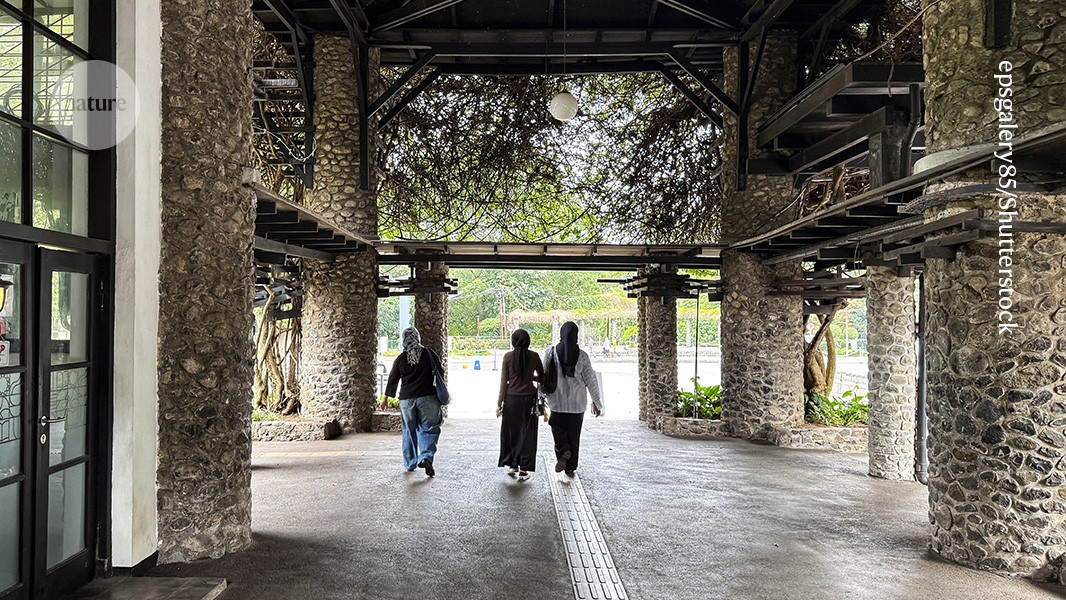
Doctoral students in Indonesia say weak supervision, sharp power imbalances and inappropriate behavior are undermining the quality of PhD training. The concerns come as the government pushes to increase the number of doctoral graduates from about 75,000 to 125,000 by 2045, despite a shortage of universities equipped to provide consistent, high-quality mentoring.
Doctoral students at Indonesian universities say the quality of supervision in the country is often poor and that many supervisors engage in inappropriate behavior.Credit: epsgalery85/Shutterstock
When Ruli Charitas Prahmana travelled to the United States as a guest lecturer, the contrast in academic culture was striking. “I was surprised to see my supervisor go cycling with his doctoral students on the weekends,” says Prahmana, a mathematics lecturer at Ahmad Dahlan University in Yogyakarta, Indonesia, and a visiting scholar at Western Michigan University in Kalamazoo.
Prahmana says such interactions would be difficult to imagine at home. They are among a minority of academics who occasionally have informal discussions with students at school or in warung, the small food stalls and restaurants found throughout Indonesia. Many colleagues, Prahmana says, never meet students in a casual setting.
Relationships between doctoral candidates and supervisors in Indonesia often focus less on direct scientific supervision, laboratory work and the wider research project than they do in many doctoral programmes elsewhere. Junior researchers say they may meet their supervisors only for a brief formal discussion, to sign a research proposal or to approve a thesis. Students at larger and more prestigious institutions might receive more direct instruction, but “most of the time what we have is a power asymmetry,” Prahmana says.
“I met with my supervisors regularly, but instead of mentoring me, they gossiped about other instructors,” says one of the 11 PhD students interviewed for this article. Several asked not to be identified to protect their careers.
Some students said they had been asked to take on work at their own expense. One interviewee said they had to pay for access to sampling sites before conducting wet-lab studies. “I need to withdraw Rp 200,000” — around US$12 — “We sampled each location week after week for a year,” the student said. In total, she was spending about $1,700 a year on sampling work. The average monthly salary in Indonesia is approximately $200.
“I think there are many professors who treat their students unfairly,” said an anonymous student from Semarang, Indonesia.
“But we just want to graduate early, so we have no choice but to accept what the boss says,” said another.
A demographic bonus
Some young academics attribute poor leadership to weak management of Indonesia’s doctoral programmes. The programmes are intended to increase the number of doctoral graduates from about 75,000 to 125,000 by 2045.
Brian Uriart, Indonesia’s minister of higher education, science and technology, said the target would support economic growth. Although national statistical data are patchy and large-scale censuses are conducted every 10 years, Indonesia is estimated to have 64 million people aged between 16 and 30. Uriart has described this group, which accounts for 22% of the country’s population, as a “demographic bonus”. He said Indonesia needed to “transform them into highly skilled human resources”.
Indonesia currently has 272 PhDs per million people, compared with about 14,000 PhDs per million people in the United States.

My relationship with my supervisor in the doctoral program deteriorated. What should I do?
To help increase the number of PhD graduates, the Indonesian Education Endowment Fund, which manages the country’s $9.1 million endowment, has set aside funding for an additional 2,500 doctoral scholarships this year, Uriart said. Nearly half are intended for people who want to study abroad. The remainder will support people studying partly or entirely in Indonesia.
But only some Indonesian universities have enough capacity to supervise a substantially larger number of doctoral students, says Berry Juliandi, dean of the Faculty of Mathematics and Natural Sciences at IPB University in Bogor. Juliandi argues that the new funding is not backed by strategic policies and regulations to improve academic oversight at universities, and therefore will not guarantee a high-quality PhD experience.
Indonesia has 4,303 higher-education institutions. The country’s National Higher Education Accreditation Agency classifies only 226 of them as “highly qualified”. The designation considers not only physical infrastructure, but also an institution’s scientific reputation and the experience and teaching skills of its instructors.
Fikri Yanda, a PhD student at Warairak University in Taiburi, Thailand, runs the pembela_mahasiswa_indonesia Instagram account, which discusses Indonesian academia. Yanda says conflicts between supervisors and PhD students are common at Indonesian institutions, including those considered highly qualified.

Ruli Charitas Prahmana, a mathematics professor at Ahmad Dahlan University in Yogyakarta, Indonesia, says there is often a power asymmetry between PhD supervisors and students in Indonesia.Credit: Rully Charitas Indra Prahmana
So far this year, Indonesia’s Ministry of Education has reported 874 cases of inappropriate behavior, including ethical misconduct, violence, sexual harassment and abuse of authority.
Andik Wijayanto, a biology doctoral student at Gadjah Mada University in Yogyakarta, said such behavior “hinders our freedom to think freely as academics” because scientists cannot challenge the status quo. Many students are afraid of making mistakes, he says. Wijayanto also teaches biology at Malang State University in East Java and says he has no problems with his supervisor.
Pressure to publish
In 2017, Indonesia’s Ministry of Higher Education disclosed that 3,800 of the country’s 5,366 professors had not published peer-reviewed papers in international journals considered reliable by the government.
The finding led to stricter regulations requiring all professors and other university lecturers with master’s or doctoral degrees, regardless of field, to publish in high-quality journals indexed by Scopus. The policy had unintended consequences: some academics were drawn into predatory journals, which charge authors to publish without providing legitimate peer review or adequate editorial support and often use aggressive or misleading solicitation practices. Some researchers also manipulated citation indices to improve their performance scores in government evaluation systems.
In 2021, the ministry introduced scientific-integrity regulations that sanction scientists involved in data fabrication, plagiarism and falsification of authorship. Another regulation, signed by Uriart in February, requires institutions to assess “scientific integrity” when evaluating university lecturers. These evaluations affect academics’ career opportunities.

My principal investigator does not provide any support or guidance regarding my PhD project. What should I do?
Source: www.nature.com