


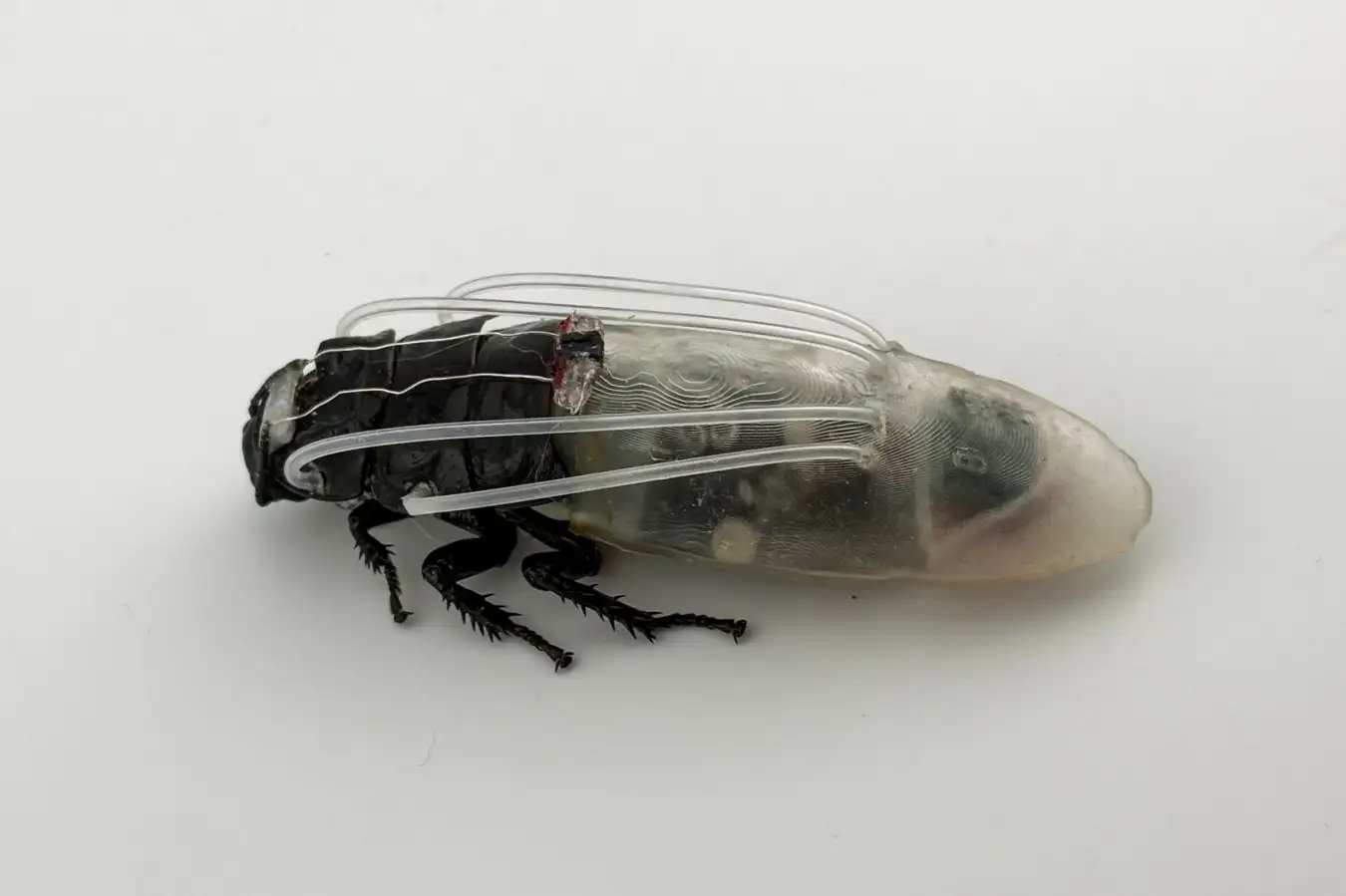

Cyborg Cockroach in Diving Suit
Credit: NTU Singapore
Swarms of cyborg insects, equipped with innovative diving suits, can now survive underwater, potentially paving the way for extraterrestrial exploration on Mars.
Led by Hirotaka Sato, researchers from Nanyang Technological University (NTU) in Singapore demonstrated that hissing cockroaches (Glomphadrina Portentosa) can be remotely controlled using implants in their sensory organs, known as cerci, since 2021. By 2024, a coordinated swarm of 20 cyborg insects was shown to cooperate effectively.
The primary goal of this groundbreaking research was to create biological robots capable of utilizing infrared sensors for search missions after natural disasters. Cockroaches are ideal for this purpose due to their efficient locomotion, strong reflexes, and ability to operate in diverse environments.
To solve the problem of underwater exploration, Sato’s team designed a waterproof diving suit, allowing these cyborg cockroaches to navigate flooded areas frequently encountered during disasters.
Cockroaches breathe through spiracles located on their abdomen and thorax. The team engineered a 3D-printed diving suit that secures these openings from water exposure while delivering oxygen. A small hose extends from the suit directly to the thoracic spiracle, providing a continuous oxygen supply.
Instead of using traditional scuba gear, the suit employs a mix of hydrogen peroxide and manganese dioxide that produces oxygen when reacting, which the cockroach absorbs. Remarkably, the insects could swim up to 50 centimeters deep for three hours without adverse effects, with all subjects remaining healthy three days post-experiment.
The suit allows the cockroaches to move naturally underwater, achieving speeds of 87.5 mm/s on land and 78.4 mm/s in water. Sato believes this technology could not only enhance search and rescue operations but also be utilized for space missions, given the lack of oxygen in extraterrestrial environments.
“This technology represents a significant advance toward developing spacesuits for cyborg insects,” Sato says. Future plans include testing the diving suits in various extreme conditions, such as vacuum, intense radiation, and temperature fluctuations to simulate environments on planets like Mars. However, concerns about potential contamination of Earth with Martian microorganisms linger.
Professors like Alan Winfield from the University of the West of England highlight that while the idea of scuba-diving cockroaches may seem unconventional, it has significant applications in environmental monitoring. Current miniature robots often struggle with battery issues, making cockroaches a more efficient and sustainable option, as they can forage for food and operate for extended periods without recharging.
Topics:
- Space Exploration /
- Robotics
Source: www.newscientist.com