


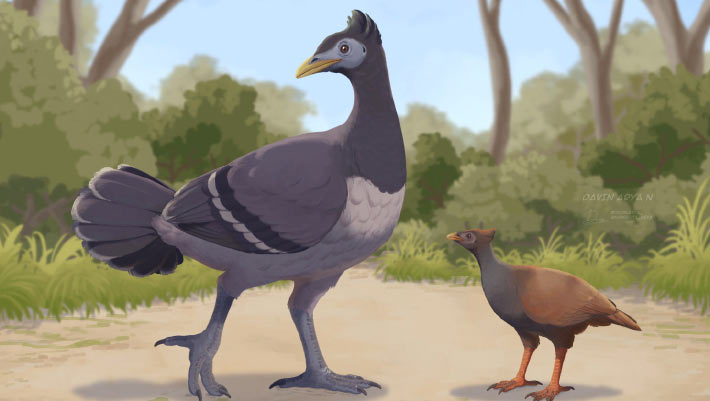
A new species of extinct megapode bird has been identified from a single foot-bone fragment found in Liang Bua cave on the Indonesian island of Flores. Estimated to have weighed about 3.9 kilograms, the bird was several times heavier than the modern megapode that lives on Flores today. The fossil dates to approximately 190,000–120,000 years ago and represents the first fossilized giant megapode leg discovered in Wallacea.
Megapodius Roxi (left) next to Megapodius Reinwald (right). Image credit: Davin Arya Nirwasita.
A giant megapode from Flores
Megapodes, also known as mound builders, are medium-sized to large terrestrial birds with powerful legs and sharp claws. Unlike most birds, they use environmental heat rather than their own body heat to incubate their eggs.
“Megapodes are a group of birds that use environmental heat rather than body heat to bury and hatch their eggs,” said paleontologist Haneke Mayer of the Bergen University Museum and colleagues.
“They are almost entirely confined to areas east of the Wallace Line in the Philippines, eastern Indonesia, Melanesia, and Australia.”
“Interestingly, megapodes do not occur in mainland Southeast Asia or the Greater Sunda Islands.”
The newly described species, Megapodius Roxi, weighed approximately 3.9 kilograms. By comparison, the only megapode currently living on Flores, the orange ash megapode (Megapodius Reinwald), weighs between 0.5 and 1.2 kilograms.
Researchers said the unusual distribution of megapodes may be related to several factors, including the presence of mammalian carnivores on western islands and competition with pheasants and related birds in mainland Asia and the Greater Sunda Islands.
A fossil from Liang Bua
The fossil is the lower half of a right tarsometatarsal, a bone in the lower leg and foot. It was excavated in 2009 from Liang Bua, a cave that also yielded the remains of the small hominin Homo floresiensis.
The bone came from deposits approximately 190,000 to 120,000 years old. It is larger than the corresponding bone in any known living or extinct species of Megapodius.
The species name honors Indonesian zooarchaeologist Rocus de Ave, according to the researchers.
“He played a seminal role in the analysis of animal remains and was the first to pinpoint the hominin bones and teeth that ultimately became part of the lower limb of Homo floresiensis after the discovery of the famous partial skeleton in 2003.”
“Megapodius Roxi is the first species of megapod named after an Indonesian researcher.”
Unresolved questions about the bird
The available fossil does not show whether the bird could fly, because no shoulder or wing bones were recovered. Researchers also cannot determine when the species became extinct or whether it coexisted with the smaller megapode species still found on Flores.
They suggest that modern megapodes may have reached the island only after the larger species had disappeared.
Megapode eggs could have provided an important food source for animals living on Flores. “Megapode eggs have a yolk that accounts for approximately 50–60% of the egg weight and is considered to be highly nutritious,” the authors said.
“The unique mounds and communal burrows make megapod eggs and chicks vulnerable to predation.”
“Their eggs would have been an available source of nutrition for both Homo floresiensis, who lived 50,000 years ago, and later modern humans.”
The study was published online on October 22, 2026, in Alcheringa: An Australasian Journal of Palaeontology.
Haneke J.M. Meyer et al. “A new species of megapod (Galliformes: Megapodiidae) that lived during the Pleistocene in Liang Bua, Flores Island.” Alcheringa, October 22, 2026. doi: 10.1080/03115518.2026.2741158.
Source: www.sci.news