


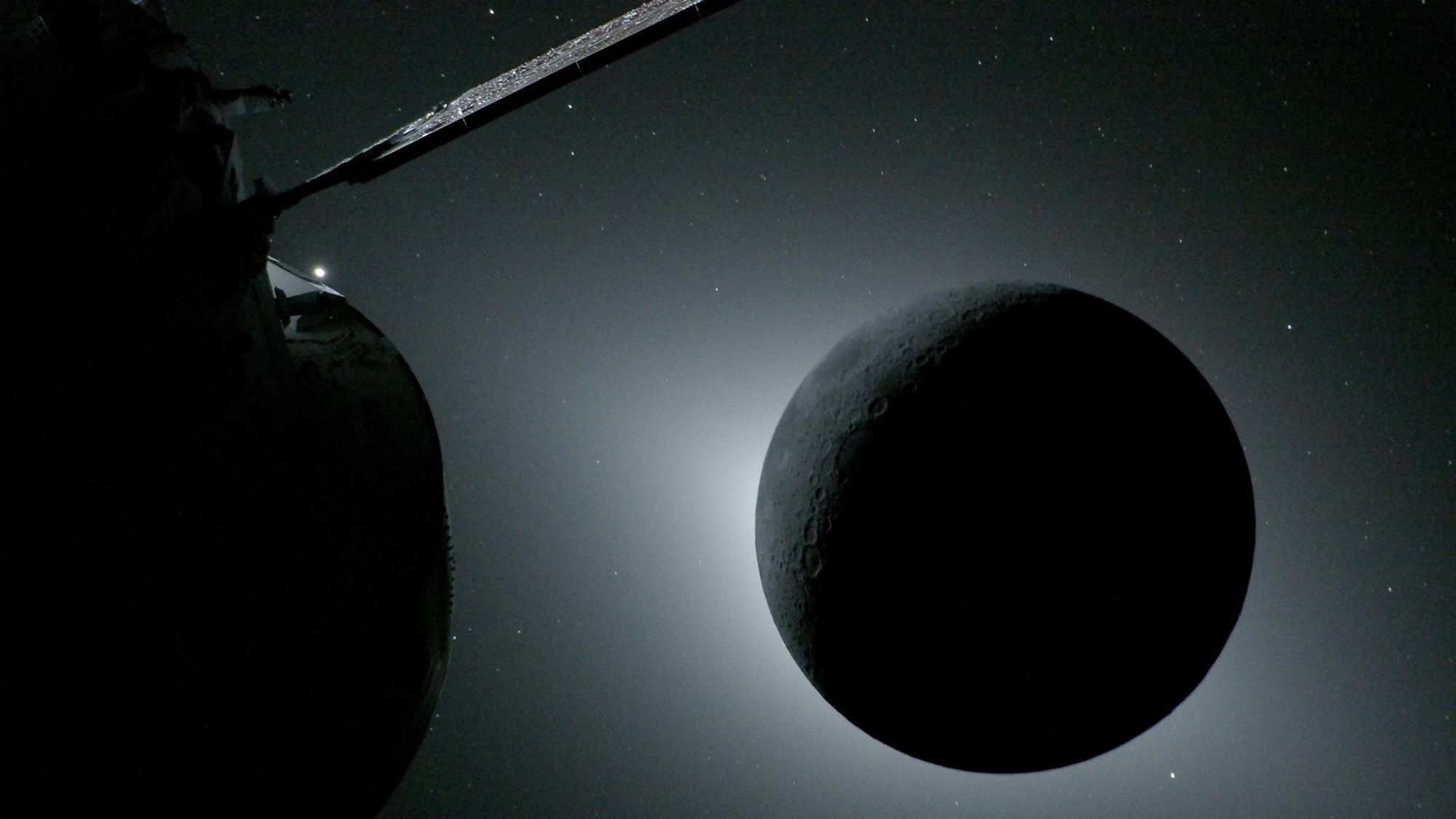
On April 6, the four-member crew of NASA’s Artemis II mission plummeted to the far side of the moon, disappearing from Earth’s view aboard the Orion spacecraft. Contact with the mission was lost for approximately 40 minutes.
Meanwhile, located about 250,000 miles (400,000 kilometers) away, Chris White, the mission’s chief communications officer, anxiously paced the halls of NASA’s Mission Control Center in Houston, eagerly awaiting his moment to act.
“I felt very nervous,” said White, the integrated communications officer (INCO). In an interview with Live Science, he mentioned that the INCO team was tasked with maintaining communications with the Orion spacecraft. This was particularly challenging due to the moon obstructing signals. They also controlled the external cameras, a responsibility White had previously undertaken for the International Space Station (ISS).
For over a year, researchers had prepared for Orion’s lunar journey, creating a checklist of nearly 300 commands for the cameras to execute during the spacecraft’s blackout period. All they had to do was wait as time ticked by.
Forty minutes later, as Orion resurfaced from the far side of the moon, telemetry data started arriving on White’s monitors, followed shortly by voice contact. However, it would take another day for the breathtaking flyby images to reach Houston. When he finally viewed the file the next morning, White was overwhelmed.
“I opened the photo and – solar eclipse pictures. I couldn’t breathe. I thought, ‘How could I have done this so perfectly on the first try?'” White shared.
The stunning imagery captured by the INCO team during the Orion mission is now being appreciated by millions around the globe. Live Science recently caught up with White for an exclusive insight into the Artemis II mission and its remarkable images.
Get the world’s most fascinating discoveries delivered straight to your inbox.
Chris White (right), INCO Director, and Matthew Johns (left), INCO Flight Controller in the White Flight Control Room at NASA’s Mission Control Center in Houston on April 6. A monitor behind them displays the Orion spacecraft approaching the moon for a flyby.
(Image credit: NASA/Robert Markowitz)
BS: What was your specific role on the Artemis II mission?
CW: As the INCO, I managed all communication systems onboard the spacecraft. This involved overseeing video feeds, in-flight sound systems, and advanced optical communication systems like the Artemis II Laser System. We also coordinated various other minor systems.
Throughout takeoff, I never glanced away from the console screen.
BS: How was the atmosphere during takeoff?
CW: During lift-off, I was in the back support room, where the atmosphere was electric. Everyone was laser-focused on our objectives. In simulations leading up to the launch, we had practiced with a CGI view of the liftoff. Yet during the actual takeoff, I never looked up from my console screen; I was too engrossed in ensuring everything was functioning correctly. It wasn’t until the following day that I could relax and catch up on the footage.
The INCO team remained busy throughout the first three days of the mission. For many of us, it wasn’t until the third day that things started to calm down—a feeling that many of us didn’t truly experience until the spacecraft was safely back on Earth.
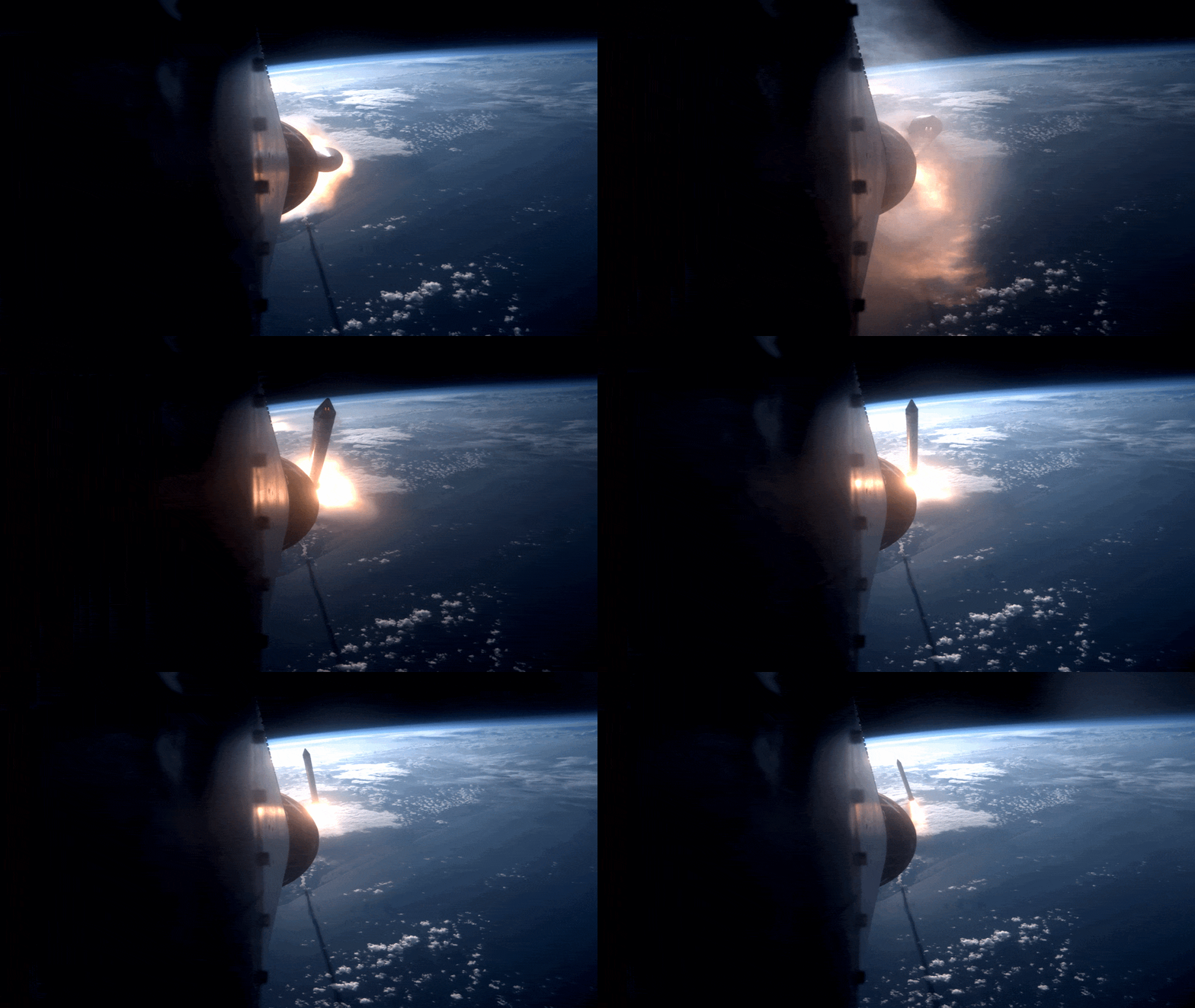
A camera onboard the Orion spacecraft captures a solid rocket booster being jettisoned moments after liftoff.
(Image credit: NASA)
BS: Can you share your experience observing the crew as they approached the moon?
CW: The experience was breathtaking. I watched the moon through the ISS’s camera, observing it grow larger through the five-day journey leading up to flyby. However, on the sixth day, it seemed to rapidly approach us.
Interestingly, the moon appeared distorted. It sounds unusual, but we’re accustomed to viewing it from Earth. Observing it approach from an angle made the far side more visible, creating an awe-inspiring sensation as it swelled in size. Yet, it was mentally challenging to reconcile its appearance with my preconceptions; it didn’t align with what I expected.

The Orion spacecraft approaches the moon during its historic flyby, with White noting that the moon looked different from this unusual perspective.
(Image credit: NASA)
BS: Did the astronauts notice any unusual colors on the moon?
CW: Conveying those colors was challenging. Due to bandwidth restrictions, many subtle details were hard to distinguish. However, at one point, I experimented with the camera’s exposure settings and noticed muted grays taking on a brownish hue, which I hadn’t anticipated.
This perception became clearer in some of the crew’s high-resolution images. I was honestly surprised to see even hint of color as we approached.
My mind struggled to reconcile what I was seeing.
BS: Was there a detailed checklist for shots during the flyby?
CW: Absolutely. The flyby was a highly orchestrated event, requiring precise timing for both the Orion camera and crew. We’d begun planning a year in advance to identify specific shots we needed. All timings were arranged in the final hours leading to the flyby, encompassing around 290 commands during an 8-hour window, which I meticulously scripted and timed.

Orion’s cameras capture Earthset, the surreal moment when the crescent Earth vanished behind the lunar horizon.
(Image credit: NASA)
BS: How did you manage to capture images during the signal loss phase?
CW: We knew Earthset timing closely, meaning we anticipated the loss of signal (LOS) precisely at earthrise. I switched the camera to a time-lapse mode, capturing a 30-second interval as the Earth gradually diminished behind the moon. This was all pre-planned.
While on the far side of the moon, the camera continued taking pictures at intervals. It performed well—running everything with well-timed scripts and commands.
BS: How soon after approaching the moon’s surface did you see the captured images?
CW: Fortunately, our optical communication maintained a strong link later that evening. Consequently, all images transmitted via lasers reached me the following day. I couldn’t access them until then, but the moment I opened that eclipsed image, I was left breathless. I thought, “How could I have nailed this on the first try?”
BS: What’s the most memorable photo you captured during the flyby?
CW: Definitely. Many days, people inquire, “Where are the stars?” This phenomenon is common, as a spaceship emits light so bright that it overshadows distant stars. However, with the sun positioned behind the moon, the foreground moon came into focus, allowing sunlight to shine from behind it. I observed stars like Venus, Saturn, and Mars amidst it all. The images were nothing short of spectacular.

The crew aboard Orion witnessed a total solar eclipse while orbiting the moon’s far side, capturing the moment light gradually returned.
(Image credit: NASA)
BS: What were you doing when the signal was lost? Describe the atmosphere during that period.
CW: I was walking around the control center. The INCO team is tasked with preserving communication with the spacecraft, but when a celestial object obstructs the line of sight, our options are limited. The experience is nerve-wracking, filled with thoughts like, “Did I set everything correctly? Will we regain contact?” For those 40 minutes, I tried to distract myself by engaging with colleagues around the facility.
It wasn’t until three to four minutes post-Earthrise that stable footage became available, followed by soon receiving a call from the crew. I heaved a sigh of relief upon hearing their voices again.
BS: Reflecting on this mission, has your mood changed?
CW: People often ask this, but I feel like I haven’t had enough time to reflect comprehensively. Gradually, it’s sinking in that we successfully sent four individuals farther to the moon than ever before. This experience has transformed not just them and our flight control team but altered many people’s perceptions of the moon as well—it’s truly remarkable.
BS: Do you have plans for your role during Artemis III?
CW: I will absolutely be part of the INCO team for Artemis III. While I won’t lead the mission, I anticipate joining the team at the console for more photographic endeavors during their missions.
BS: Any closing thoughts?
CW: I want to emphasize that this was a team effort. The coordination encompassed not only the INCO team but also precise scripting and planning. Successfully operating these cameras required collaboration with utility teams, ensuring solar arrays were positioned correctly. There were also navigation and control engineers who developed sophisticated systems.
This endeavor wasn’t solely about my efforts or those of the INCO team; it took the entire flight control team working in unison to achieve these breathtaking images.
Editor’s note: This interview has been condensed and lightly edited for clarity.
Are you a NASA enthusiast? Test your knowledge with our Artemis quiz to find out!
Source: www.livescience.com