


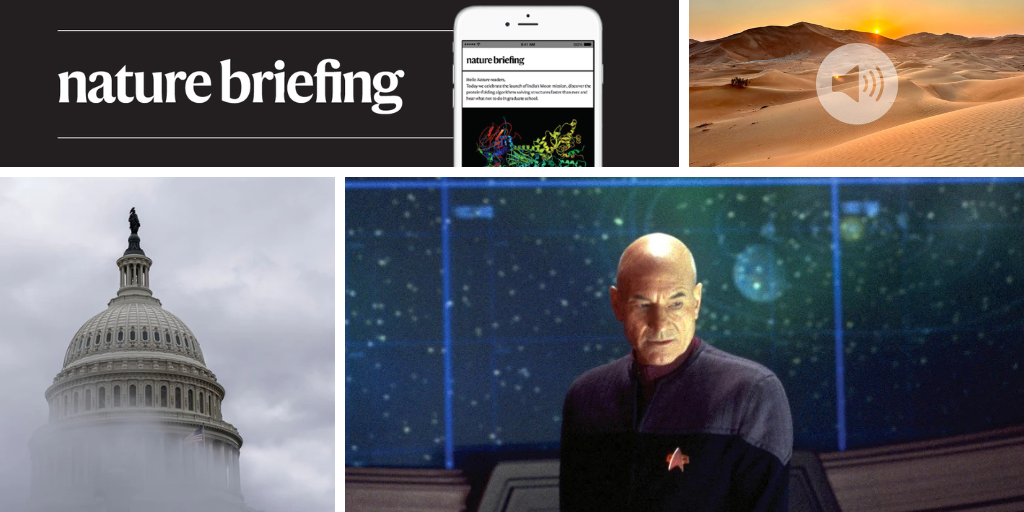
Patrick Stewart, best known for playing Captain Jean-Luc Picard in Star Trek, has died at 86. This edition also examines the possible effect of the United States midterm elections on science policy, a surge in applications for European Research Council Starting Grants, and evidence that high-profile journals favor “charismatic” fossils. Other coverage explores technologies for destroying PFAS, ancient human migration across Arabia, and the development of systems that can detect deteriorating mental health before a crisis.
Would you like to receive this briefing from Nature free in your inbox every day? Sign up here.
Scientists have paid tribute to actor Patrick Stewart, who has died at the age of 86. In the Star Trek series, Stewart played Captain Jean-Luc Picard, a character whom researchers say embodies the qualities of a great scientific leader.
“Picard made me reconsider why I do science in the first place,” says physicist Nicolas de Aguiar Alves. “It made me realize that this might mean something, and for that I will be forever grateful.”
Nature | 4-minute read
Polling data from the 3 November midterm elections in the United States suggests that Democrats may take control of one or both chambers of the US Congress. Such an outcome could significantly affect the country’s scientific landscape.
Republicans currently control both chambers, giving the party and President Donald Trump’s administration unified control of the federal government. Since President Trump took office, his administration has cut scientific staff and terminated thousands of research grants. Many researchers and science advocates hope that a new Congress would challenge the administration, protect science funding and investigate government actions.
Nature | 7-minute read
Applications to the European Research Council’s Starting Grant programme have risen by 60% in a year, potentially driving success rates to exceptionally low levels. One reason for the increase is the ease with which applications can be created using artificial-intelligence tools.
The programme received 7,710 proposals for funding in 2027, but only 373 grants were available. The success rate will therefore be below 5%, the lowest since 2007. “It’s almost a lottery,” says systems and synthetic biologist Devan Mehta.
Nature | 5-minute read
This week’s infographic

Dinosaur and mammal fossils are overrepresented in high-profile scientific publications compared with less “charismatic” fossils. Paleontologist Brian Gee analysed more than 4,200 research papers published since 2000 and found that more than 50% of fossils described in the palaeontology journals Science or Nature belonged to Avemetapoda, the group that includes dinosaurs and birds, or Mammalia, which includes mammals and their relatives.
Gee argues that this bias could distort incentives in palaeontology research and discourage early-career researchers from studying less attractive species.
Reference: bioRxiv preprint (not peer reviewed)
Features and impressions
New portable technology helps remove perfluoroalkyl and polyfluoroalkyl substances (PFAS), commonly known as “forever chemicals”. The durability of these molecules—the property that once made them so useful—also makes them extremely persistent pollutants.
Researchers have previously developed techniques that permanently remove PFAS from water and other materials, but treating the resulting PFAS-containing waste has proved more difficult. New methods can destroy the compounds using extreme heat and pressure or electricity. Scientists must now determine where and how these technologies should be used.
A woman discusses the good old days of relations between humans and aliens. Where did the disc fly to? Two workers exchange notes in an unconventional way: Somewhere beyond the transcontinental burrito tunnel.
Nature | 6-minute read and Nature | 6-minute read
The world’s largest sand sea, the Rub al Khali, was once part of the lush savannah known as “Green Arabia”. The region around the desert contains abundant traces of ancient humans, but expeditions into its interior have returned empty-handed.
This has led archaeologists to suggest that ancient people needed not only water but also stone in order to settle. “The way we think about migration has just been turned upside down,” says archaeologist Jeff Rose. Ancient humans “didn’t opportunistically populate the entire landscape; they went specifically to certain places where there were rich sources of raw materials.”
Nature Podcast | Listen for 26 minutes or Nature Video | Watch for 12 minutes
Subscribe to the Nature Podcast on Apple Podcasts, Spotify or YouTube Music, or use the RSS feed.
Quote of the day
Building systems that can not only respond to mental-health crises but also identify gradual declines in well-being before they become crises is “the most important unfinished business in mental health today,” says mental-health researcher Lucas Mullins Marquez, whose sister and grandmother took their own lives. Natural Mental Health | 6-minute read
Today, leaf penguinsons fly around the rock formations of Wadi Rum in Jordan. Can you find the penguin?
The answer will be in Monday’s email. Many thanks to Briefing photo editor and penguin wrangler Tom Horton.
This newsletter is constantly evolving. Let us know what you think by sending feedback to [email protected].
Thank you for reading,
Jacob Smith, Associate Editor, Nature Briefing
• Nature Briefing: Careers — insights, advice and award-winning journalism to help you optimize your work life.
• Nature Briefing: Microbiology — the most abundant life forms on Earth, microorganisms, and the roles they play in health, the environment and our food system.
• Nature Briefing: The Anthropocene — climate change, biodiversity, sustainability and geoengineering.
• Nature Briefing: AI and Robotics — 100% written by humans, of course.
• Nature Briefing: Cancer — a weekly newsletter written with cancer researchers in mind.
• Nature Briefing: Translational Research — covering biotechnology, drug discovery and pharmaceuticals.
Source: www.nature.com