


How Many Indigenous People Lived in the Americas Before Columbus?
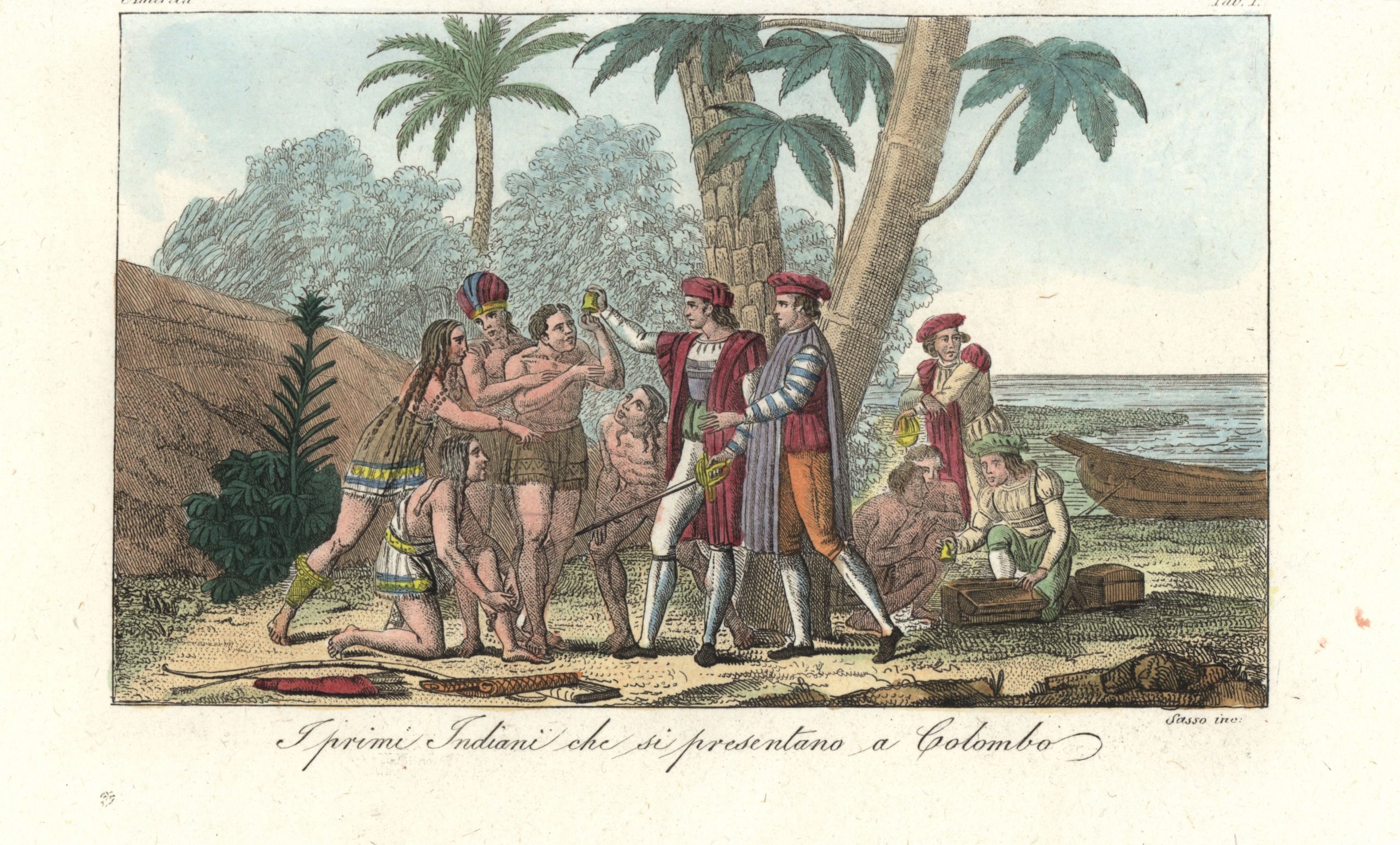
When Christopher Columbus arrived in the Americas on October 12, 1492, he encountered Indigenous peoples, including the Lucayan people of the Bahamas. Columbus wrote in his diary about meeting a large group of men, trading with them and learning about other groups living on nearby islands.
Within a few decades, however, the Indigenous populations of the Americas had suffered a catastrophic decline. A combination of epidemics, warfare and enslavement caused what anthropologist Eric Wolf called the “Great Dying.”
For centuries, researchers have tried to determine how many Indigenous people lived across the Americas before European colonization. The answer remains surprisingly difficult to establish. Estimates based on historical records, archaeological evidence and the ability of different landscapes to support human populations range from about 1 million to 112 million people.
Recent research suggests that the population of North America peaked several centuries before Europeans arrived. If Europeans had reached the continent during that population peak, the course of American history might have been very different.
Why estimates of the pre-Columbian population vary
People have lived in the Americas for at least 14,000 years, according to archaeological evidence, entering the continents through the region around the Bering Strait. The first Americans then spread rapidly across the newly encountered lands.
What happened to the population between that early expansion and Columbus’s arrival remains unclear. Researchers have limited and uneven evidence, and no single source can provide a complete population count for the Western Hemisphere in 1492.
“We don’t have a good quantitative estimate,” anthropologist George Milner of Pennsylvania State University told Live Science. “The numbers are all over the place.”
Early estimates of the Indigenous population
One of the first modern researchers to estimate the Indigenous population before Columbus was anthropologist Henry Dobyns. In his 1983 book, Dobyns used estimates of how many people different landscapes could support, along with historical records of 16th-century disease outbreaks.
He estimated that approximately 112 million Indigenous people lived in the Americas before European contact. That figure was more than 100 times higher than some earlier estimates.
“Essentially, Dobyns filled the landscape to its maximum carrying capacity, so that all environmentally similar sites were occupied by the same number of people,” Milner said. “He also made the assumption that infectious diseases spread widely and universally, which makes sense once the landscape is filled.”
Archaeological research during the 1970s and 1980s, however, showed that the Americas were not evenly settled. Population density varied significantly between regions, making Dobyns’ estimate appear too high to many researchers.
A 2019 estimate: 60.5 million people in 1492
Researchers later began developing population estimates for specific regions. They examined evidence such as the relative density of pottery fragments, the number of stone tools, the size and number of houses, archaeological occupation areas and mortality patterns in human remains.
In a 2019 study, geographers compiled 129 population estimates from 82 published studies. They divided the Western Hemisphere into seven regions: the Caribbean, Mexico, Central America, Inca territory, the Amazon, North America and the rest of the Americas.
The researchers estimated that approximately 60.5 million people lived in the Americas in 1492. Their estimate for present-day Canada and the United States was about 3 million to 6 million people—less than one-third of Dobyns’ estimate of 18 million.
North America’s population before European contact
The largest population in the Western Hemisphere in 1492 was concentrated in what is now Mexico, where the Aztec Empire was located. The Inca lived along the western coast of South America. Archaeologists have also found evidence of large and complex Indigenous settlements throughout what is now the United States and Canada.
In a 2010 study, Milner and geographer George Chaplin examined historical population estimates and archaeological occupation areas in eastern North America.
They estimated that approximately 1.6 million people lived in the eastern United States and southeastern Canada. Their broader estimate for North America in the early 16th century was between 2.8 million and 5.7 million people, with a best estimate of 3.8 million.
“If you want to start estimating a specific population, you need to use a scale that works across the region,” archaeologist Robert Kelly of the University of Wyoming told Live Science. “People produce things like this. Fires were everywhere because everyone had to start a fire for heat and cooking.”
What radiocarbon dating reveals about population changes
Charcoal from ancient hearths is one of the artifacts archaeologists use to radiocarbon-date archaeological sites. Researchers can also analyze carbon-14 dates from animal bones and plant remains to study when people lived in particular places.
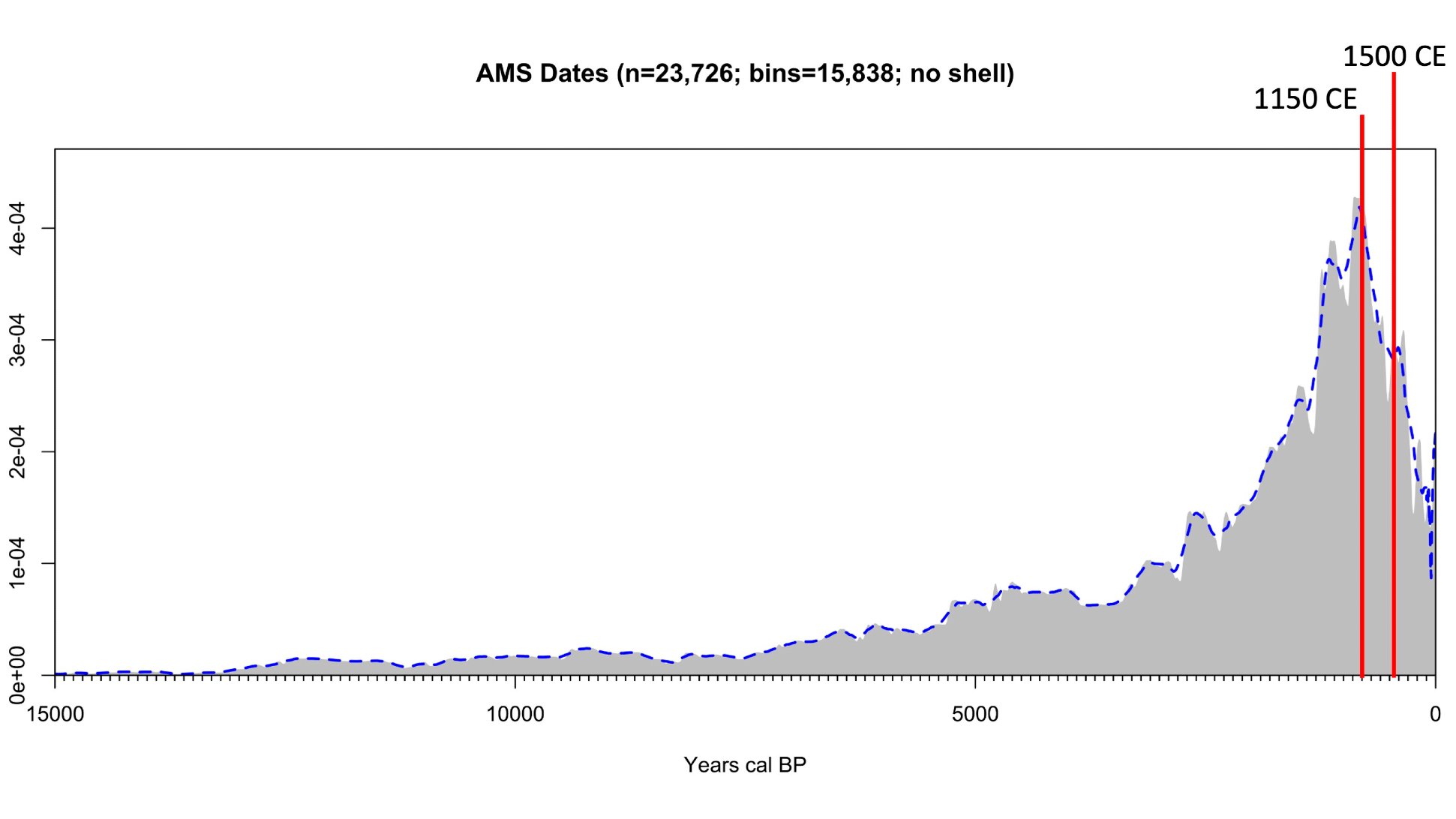
The Canadian Archaeological Radiocarbon Database, or CARD, contains radiocarbon records from across North America. In a 2009 study, geographer Matthew Peros and his colleagues combined the database’s radiocarbon dates to create a curve showing how the number of dated materials changed over time.
The researchers reasoned that periods when more carbon-dated material was produced could indicate periods of higher population. Their results suggested that the population of North America increased rapidly around 50 B.C. and reached a peak around A.D. 1150.
Indigenous populations may then have declined before sustained European contact. One possible explanation is that mortality increased as people gathered in more densely populated communities, allowing diseases such as tuberculosis to spread more easily.
A 2025 study places the population peak around A.D. 1150
In a 2025 study, Kelly and his colleagues found a similar population peak. By then, the CARD dataset had grown to approximately 100,000 radiocarbon dates, making the analysis more reliable than earlier studies.
“The 1150 date is an interesting discovery and one that surprised us,” Peros told Live Science. “We expected it to be around 1500, right after the Europeans arrived.”
The researchers emphasized that Indigenous populations did not simply grow until European contact and then suddenly decline. Instead, their results indicated a population peak around A.D. 1150, followed by a decline and a slight recovery shortly before A.D. 1500.
To estimate the population in 1492, the researchers combined the radiocarbon curve with assumptions about the starting population and average annual population growth. They hypothesized that a founder population of about 1,000 people entered North America approximately 15,000 years ago.
Using those assumptions, they estimated that North America’s population reached about 2.5 million people in A.D. 1150 and declined to approximately 1.8 million by 1492.
Those figures could be higher if people arrived earlier than 15,000 years ago or if more people entered the Americas during the initial migration. Evidence from sites such as White Sands in New Mexico suggests that humans may have been present in North America as early as 23,000 years ago.
Cahokia shows the scale of Indigenous civilization
By around A.D. 1000, the city of Cahokia, near present-day St. Louis, Missouri, covered about 6 square miles, or 16 square kilometers. Its population may have approached 20,000 people.
“If Europeans had tried to settle the continent in 1000 A.D., they would have encountered far more Indigenous peoples,” Kelly said. “They could have sent thousands of fighters and it would have been a completely different experience for the Europeans. It might have been a very different history.”
Why the pre-Columbian population matters
Experts have estimated that between 2 million and 4 million people lived in the regions that are now the United States and Canada before European contact. Continued archaeological research could eventually produce a more complete population estimate for the Western Hemisphere.
Milner said that demographic research is important because it helps scientists understand long-term population changes and plan for the future. Studying past population growth, disease and environmental pressures can provide useful comparisons for understanding modern demographic and environmental change.
Establishing how many Indigenous people lived in the Americas in 1492 is also essential to understanding North American history. The continent was not empty when Europeans arrived. Indigenous peoples and civilizations had lived throughout the Americas for thousands of years.
“North America was not an empty continent when Europeans arrived,” Peros said. “For a long time, there have been people and civilizations almost everywhere in the Americas. It’s important that people understand that when we talk about issues of settlement and landing.”
Source: www.livescience.com