


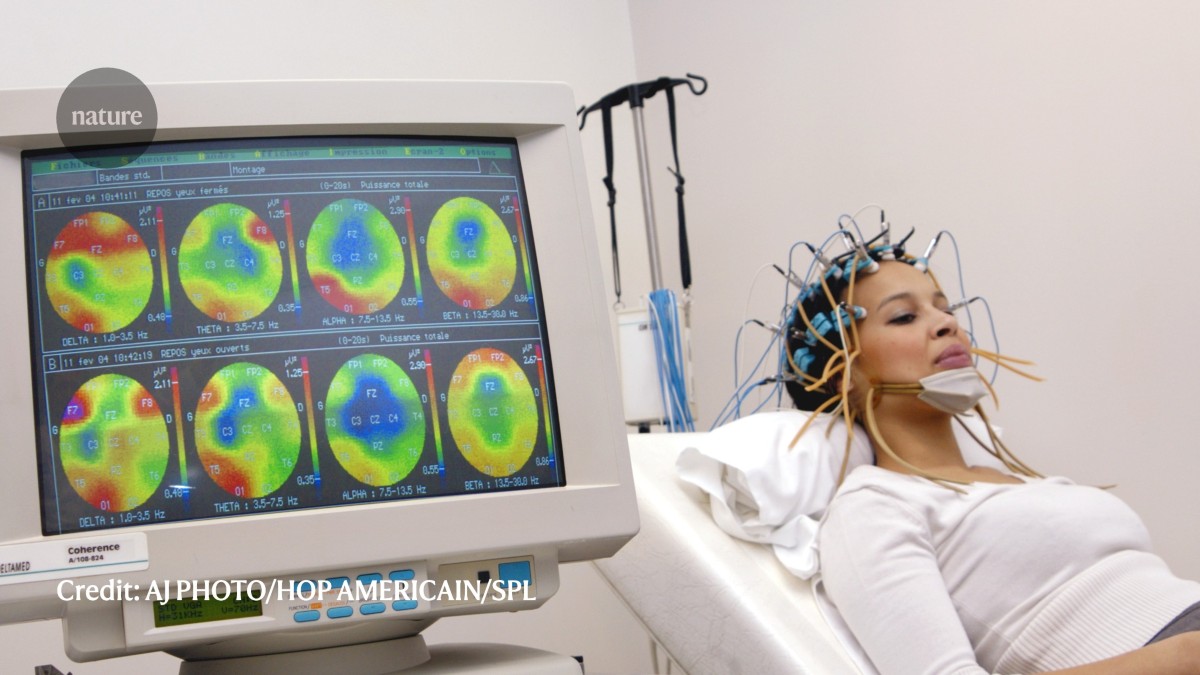
Imaging can be used to measure the degree of variation and complexity across brain regions that correspond to states of consciousness.Credit: AJ Photo/Hop Americain/SPL
Scientists are making progress in measuring consciousness, even though they have not yet explained how brain activity produces subjective experience. Research on people who are asleep, anesthetized, in comas or apparently unresponsive has revealed signs of hidden consciousness, while tools such as the perturbation complexity index are helping researchers distinguish conscious brain activity from simple wakefulness. At the same time, competing theories of consciousness are being tested more directly, and evidence from artificial intelligence, plants, animals and astrobiology is broadening the debate over what kinds of systems might be conscious.
At first glance, human consciousness seems impossible to doubt. We know we are conscious because we experience the world in vivid detail: a song steeped in sadness, for example, or a childhood memory that transports us to another place and time.
Yet the roots of consciousness—the experience of being aware of one’s own existence—remain difficult to define. Researchers and philosophers have debated for centuries how physical processes in the brain give rise to the subjective, first-person experiences that people seem to share. This challenge is known as the “hard problem” of consciousness.

Nature Spotlight: Neuroscience
Scientists still cannot explain how brain activity creates our entire inner world, but the field is advancing. Researchers can now measure brain activity and connectivity more reliably and search for concealed signs of consciousness.
The emerging picture, informed by neuroscience and fields including plant science, artificial intelligence and astrobiology, treats consciousness not as a single light that is either on or off, but as a potentially more widespread and coordinated state than previously thought. The rapid rise of AI has intensified debate over whether humans are the only conscious beings and whether a brain is necessary for consciousness at all.
“People are often troubled by the fact that their understanding remains vague,” says Matthias Mischel, a cognitive science philosopher at the Massachusetts Institute of Technology in Cambridge. “But it’s very important to note that definitions in the history of science come at the end, not the beginning, of the scientific process. We claim to be in the midst of it now, and it’s an exciting place to be.”
Seeds of consciousness
There is no direct test for human consciousness, but researchers have made progress in identifying what are known as neural correlates of consciousness (NCCs). These are individual indicators, or combinations of events, that identify the minimal neural mechanisms needed to initiate conscious experience. Certain neurons might need to fire, for example, or particular patterns of brain activity might signal internal experiences.
Below these thresholds, a person might carry out actions without conscious awareness. Someone might zone out while driving, for instance, and then quickly regain attention.
Researchers have identified some NCCs by studying people in states not normally associated with consciousness, including sleep, anesthesia and coma. Melanie Bolly, a neurologist at the University of Wisconsin-Madison, says this research is important for distinguishing genuine NCCs from activity that merely indicates that a person is awake and responding to the surroundings.
“This is a major advance, separating out the true features of consciousness, rather than simply measuring what is associated with conscious experience and its consequences,” Boley says.

Is social media changing children’s brains? Science says
Studies have found that about a quarter of people who are medically unconscious may actually experience a form of hidden consciousness, remaining aware of the world around them. In a landmark 2024 study, researchers asked 241 people who appeared unresponsive after brain injuries to imagine activities such as playing tennis or opening and closing their hands. Brain-imaging scans showed activity associated with these tasks in dozens of patients, raising questions about whether consciousness can persist in an apparently inactive state.1
These findings are encouraging researchers to move away from viewing consciousness as a binary state and toward understanding it as a dynamic process that exists on a continuum. This approach has enabled the development of indicators designed to test fundamental assumptions about consciousness. One of the most promising is the perturbation complexity index (PCI).2
PCI estimates a person’s level of consciousness by measuring how the brain responds to short magnetic pulses. Electroencephalography (EEG), which uses electrodes to track electrical activity in the brain, records the response. In a conscious brain, neural activity typically spreads across different regions in a complex and distinctive pattern. These properties are known as integration and differentiation, respectively. During sleep or anesthesia, responses tend to become simpler and more repetitive.
“PCI is a very accurate correlate of consciousness and is thought to be useful in many research settings,” says neurophysiologist Johan Frederick Strom of the University of Oslo. However, widespread clinical adoption has been limited because the measure is laborious to collect, he adds. “And yet it is gaining traction.”
Stress-testing theories of consciousness
Growing knowledge about consciousness has led to hypotheses that go beyond measuring its features and attempt to explain what it is. More than 450 such theories currently exist. Many differ in scale or emphasis but share some characteristics. Two of the most prominent are Global Neuronal Workspace Theory (GNWT) and Integrated Information Theory (IIT).
GNWT proposes that most brain activity is restricted to specialized areas: visual regions process shapes and colors, while language regions process words. When information becomes sufficiently important to be broadcast across multiple regions, awareness arises. A face whose representation remains within the visual system can produce simple unconscious responses, whereas a face that activates regions throughout the brain’s global workspace can contribute to conscious experiences across multiple systems.
IIT addresses a different question: what does experience look like? When people view the world or recall memories, they experience a scene as a whole rather than as separate colors, sounds and textures. IIT argues that consciousness depends on how strongly the parts of a system influence one another while remaining distinct. Both integration and differentiation are therefore needed to generate a range of states and experiences. A conscious system must be more than a collection of independent parts; it must form a whole whose states cannot be fully explained by examining each part separately.
A major challenge in testing these theories is that research methods have often lacked neutrality or rigor. An analysis of hundreds of experiments published in 2022 found that consciousness research had frequently been conducted in ways that biased results in advance toward particular theories.3 This makes it difficult to compare studies directly, says Christoph Koch, a consciousness researcher at the Allen Institute for Brain Science in Seattle, Washington, who has studied the subject for decades.
“People get so attached to their theories that their confirmation bias can get in the way of honest, collaborative efforts,” he says.
Lucia Meloni, a cognitive neuroscientist at Germany’s Ruhr University Bochum, recently led the first effort to force a direct comparison between the two schools of thought. She brought together supporters of both theories and neutral participants, asking them to agree in advance on a series of experiments and predictions. The group examined the theories’ underlying assumptions.4
The researchers used three measurement techniques: EEG; functional magnetic resonance imaging (fMRI), which tracks brain activity by detecting subtle changes in blood flow; and magnetoencephalography (MEG), which measures the magnetic fields produced by electrical currents in the brain.

Plants don’t have brains, but they can make decisions and solve problems.Credit: Jason Milligan/Courtesy of Understory
One important difference between the theories concerns which parts of the brain are most important for consciousness. GNWT predicts that a broad range of brain activity suddenly “fires” when a stimulus produces a conscious experience. It also expects the prefrontal cortex to play a key role as it uses information to generate complex behavior.
IIT instead focuses on a “hot zone” at the back of the brain, including parts of the systems responsible for vision, hearing and touch. This region is thought to be important because related stimuli converge there to produce a unified experience.
The research team found that conscious information was represented in both areas. However, the result also challenged important predictions of both theories. The sustained activity that IIT predicts in the posterior cortex was not evident, while the widespread firing predicted by GNWT was limited. The study did not resolve the debate; instead, it suggested that both theories might explain part of the answer.
Meloni does not view this as a failure, but as the most exciting possible outcome. “We’re happy with what we found because both theories remained untouched,” she says. “There is no room for growth if your predictions are correct, but you can do better science when you question your thinking.”
How far can consciousness expand?
Scientists are also trying to broaden their thinking through interdisciplinary research. Evidence from plant and non-human animal biology, robotics and the search for extraterrestrial life could help identify the conditions under which consciousness arises.
It remains unclear whether consciousness requires a brain—or even neurons. Astrobiologists have long searched for intelligent life, but given the scale of the known universe, researchers cannot reasonably assume that such life would resemble humans.
Source: www.nature.com