


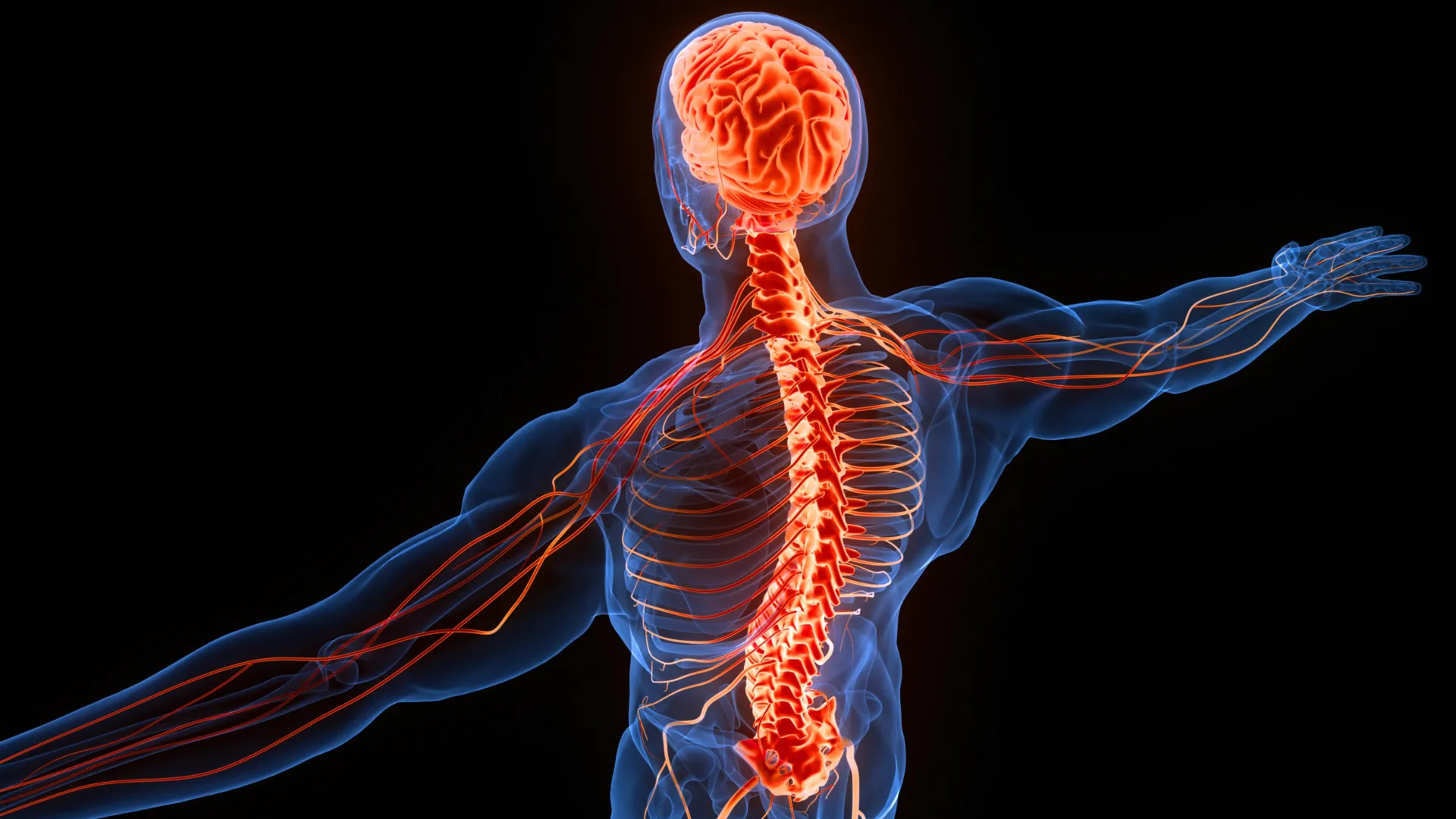
The brain’s left hemisphere generally controls the right side of the body, while the right hemisphere controls the left. A new hypothesis from neuroscientists Martin Wessendorf and Daniel Wang suggests that this cross-wired organization may have originated more than 500 million years ago, when later sensory and motor circuits developed around ancient visual pathways.
How visual information crosses the brain
Dr. Martin Wessendorf, a neuroscientist and associate professor emeritus at the University of Minnesota, studies how the brainstem controls neurons in the spinal cord. Daniel Wang specializes in cognitive neuroscience and neurodegenerative diseases. Together, they investigated the evolutionary origins of neural circuits that connect one side of the brain with the opposite side of the body.
In a study published in Frontiers of Neuroanatomy, the researchers examined several cross-wired neural circuits in tetrapods—animals with four limbs, including mammals, birds, reptiles and amphibians. Their hypothesis is that evolution built many of these circuits around ancient visual systems.
The brain contains numerous pathways that cross the midline of the central nervous system. Understanding why these contralateral, or opposite-side, connections exist requires examining how sensory and motor circuits developed over evolutionary time.
One possible explanation begins with the eyes. Light passing through the eye’s lens produces an image on the retina that is reversed. Objects to an observer’s right are projected onto the left side of each retina, while objects to the left are projected onto the right side.
Visual information then travels along the optic nerves to a structure called the optic chiasm. At this point, nerve fibers are arranged so that information from the right visual field reaches the left side of the brain, while information from the left visual field reaches the right side.
Some of these signals reach an ancient midbrain structure called the optic tectum, known in mammals as the superior colliculus. The optic tectum helps generate rapid reactions to visual events, such as noticing sudden movement nearby.
Each side of the optic tectum contains a representation of the opposite visual field. Deeper layers also contain corresponding maps of bodily sensations, known as somatosensory information.
The optic tectum is found in all vertebrates and is considered one of the oldest structures in the vertebrate nervous system. Its early evolutionary appearance may help explain why many other neural pathways cross through or around similar regions.
Crossed pathways for bodily sensation
The researchers examined two major pathways that carry sensory information from the body to the brain. Both pass through the central nervous system, and both appear to be widely distributed among tetrapods.
The dorsal column pathway
The dorsal column pathway carries information about gentle touch, vibration and the position of different parts of the body. Signals from the limbs and trunk travel upward through the rear portion of the spinal cord before reaching neurons in the brainstem, just above the spinal cord. The pathway then crosses to the opposite side.
Fish do not have this pathway, but it has been identified in amphibians, reptiles, birds and mammals. Its presence across these major groups suggests that the arrangement emerged early in tetrapod evolution and has remained largely conserved.
The spinothalamic tract
A second pathway, the spinothalamic tract, transmits sensations such as pain, itch and certain types of touch. Unlike the dorsal column pathway, it crosses to the opposite side within the spinal cord itself.
After crossing, the signals travel upward to the thalamus, a region above the midbrain that plays a central role in processing sensory and motor information.
This crossed arrangement is found in birds, mammals and reptiles. It also occurs in some cartilaginous fish, including sharks and rays, suggesting that this aspect of nervous-system organization may have deeper evolutionary roots.
How crossed pathways control movement
The nervous system’s intersecting organization extends beyond sensory processing. Researchers have identified three important pathways involved in controlling skeletal muscles that connect one side of the brain with the opposite side of the spinal cord.
The tectospinal pathway
The tectospinal pathway helps the body respond rapidly to information from the surrounding environment.
The optic tectum processes more than visual signals. It also receives information about sounds and physical sensations, organizing these inputs into a map that corresponds to its visual maps.
For example, someone preparing to cross a road might suddenly notice a car approaching in the corner of their eye and instinctively turn toward it. The tectospinal pathway is one circuit that helps produce this rapid response. Similar reactions can be triggered by unexpected sounds or touches.
Motor signals originate in the deepest layer of the optic tectum and travel through nerve fibers to the opposite side of the spinal cord. This pathway is present in most tetrapods and in some cartilaginous fish.
The erythrospinal pathway
Another circuit, called the erythrospinal pathway, is thought to help animals control their limbs. It begins in a midbrain structure called the red nucleus and extends to the opposite side of the spinal cord.
The pathway is particularly prominent in most mammals, but it has also been observed in other tetrapods and in some cartilaginous fish.
The evolution of fine motor control
A third pathway, the corticospinal tract, is especially important in humans because it supports precise movements, including delicate control of the fingers. Its evolutionary history is more complex than that of the other pathways.
All vertebrates have a telencephalon, the front portion of the brain. In humans, the telencephalon includes much of the cerebral hemispheres and accounts for a large proportion of total brain size. However, only mammals have a cerebral cortex organized into six distinct layers.
This six-layered cortex supports advanced functions such as integrating sensory information with memory, coordinating movement and processing language.
The corticospinal tract extends from the cerebral cortex to the spinal cord, but its function varies among animals. In most mammals, it primarily affects sensory processing. Its fibers reach regions of the spinal cord that receive information from the body, allowing the brain to influence incoming sensory signals.
In primates, including humans, and in certain other animals capable of highly precise movements, the pathway also reaches regions of the spinal cord responsible for muscle control. These connections support complex actions such as the coordinated finger movements required for delicate tasks.
Depending on the species, corticospinal tracts may modulate sensory information or contribute directly to locomotion. In both cases, the fibers cross the midline of the nervous system.
The researchers suggest that humans may have developed advanced fine motor skills by adapting ancient neural circuits that originally helped control sensory input. Instead of evolving an entirely new system, evolution may have assigned additional functions to existing pathways.
A possible origin more than 500 million years ago
Taken together, these pathways suggest a possible explanation for the brain’s unusual cross-connections.
The researchers propose that early visual circuits helped establish a pattern in which sensory and motor pathways were organized across opposite sides of the nervous system. Later circuits, particularly in tetrapods, may have inherited this arrangement.
All modern vertebrates have an optic chiasm and an optic tectum organized around information from opposite visual fields. The researchers therefore suggest that these structures may already have been present in primitive jawless fish during the Cambrian period, approximately 538 million to 486 million years ago.
If the hypothesis is correct, the basic organization underlying the brain’s cross-connections began developing more than 500 million years before modern humans appeared.
The idea may be testable. Scientists could examine fossil skulls from ancient jawless fish for anatomical evidence indicating whether these animals possessed an optic chiasm and an optic tectum.
Evolutionary inheritance rather than direct advantage
The hypothesis also challenges the assumption that every unusual biological trait evolved because it provided a direct survival advantage.
Evolution often modifies existing structures instead of creating entirely new systems. Once ancient visual pathways established a crossed organization, that arrangement may have influenced the development of later sensory and motor circuits.
In particular, the organization of the visual system—and especially the optic tectum—may have provided a structural basis that later neural pathways followed.
Under this explanation, connections between one side of the brain and the opposite side of the body may not exist because that arrangement is inherently more effective. Instead, they may reflect the lasting influence of ancient structures that evolution repeatedly reused.
The relationship between the brain’s hemispheres and opposite sides of the body could therefore be one of the clearest examples of the nervous system preserving its evolutionary history. Its origins may ultimately lie in the visual systems of animals that lived more than 500 million years ago.
Source: www.sciencedaily.com