


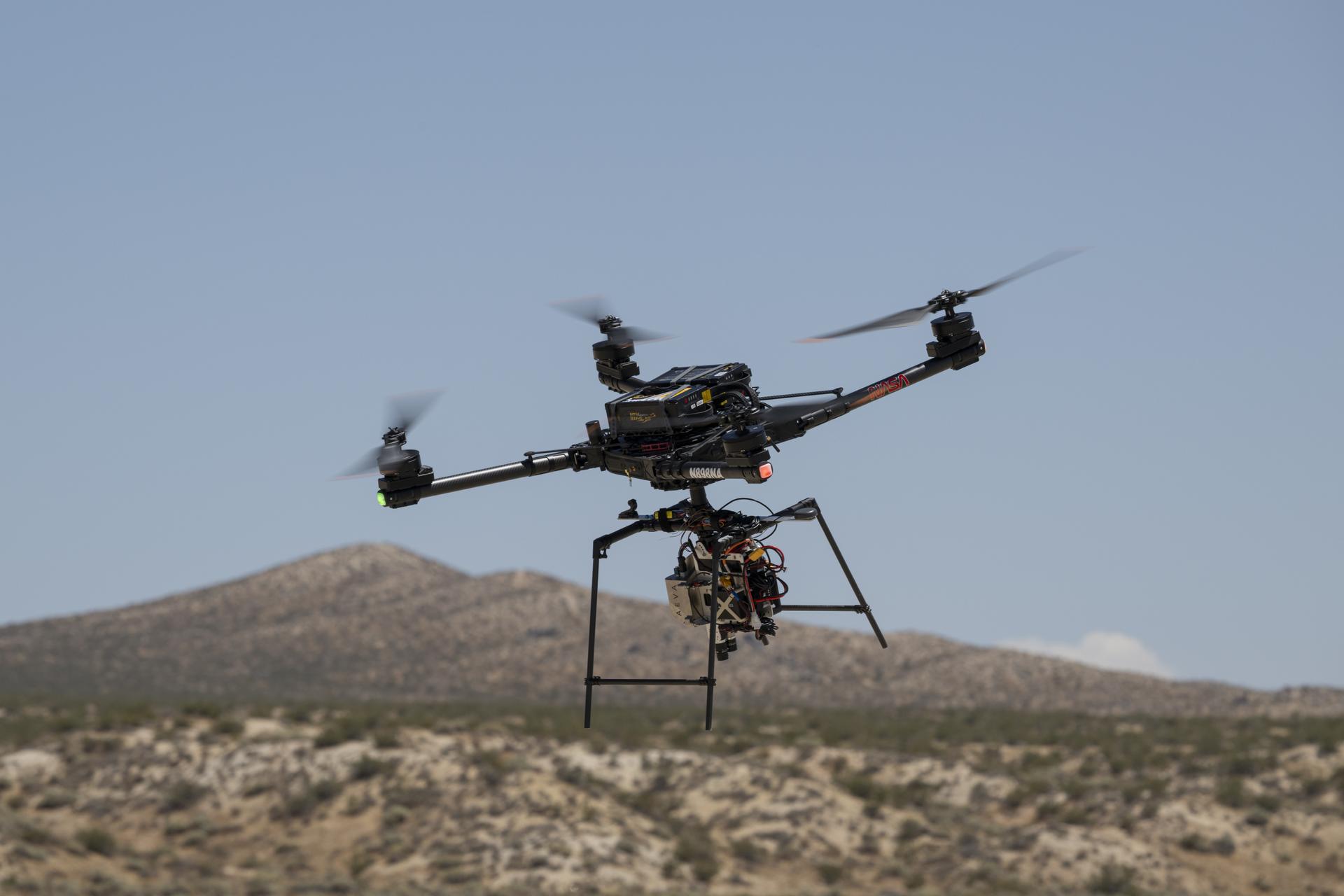
NASA has demonstrated an autonomous landing technology that could help spacecraft identify safe touchdown sites on the Moon and other planets. On Aug. 27, the agency’s Alta-X drone completed a simulated lunar descent and landing at Rogers Dry Lake near NASA’s Armstrong Flight Research Center in Edwards, California, using the Safe and Precise Landing – Integrated Capability Evolution (SPLICE) payload.
Mapping terrain during descent
During the test, SPLICE used an advanced guidance system to map the terrain and evaluate potential landing areas. If the targeted site is deemed unsafe, the system can redirect the vehicle to a safer location. It produces high-resolution digital elevation maps using light detection and sensor data.
Researchers at NASA’s Johnson Space Center in Houston developed the SPLICE payload and worked with NASA Armstrong experts to integrate, test and fly it aboard an Alta-X drone in June and July. Those tests verified communications, data processing, telemetry and command-and-control links between the payload and the drone, ahead of full-scale testing at Voyager Technologies in Mojave, California, later this month.
“This flight test is the culmination of nearly a decade of work on the SPLICE project,” said NASA Project Manager Davis Adams. “This flight increases the level of technology readiness and prepares it for integration into future robotic flights and manned lunar flights. The guidance and navigation system validation is applicable to ground, lunar, and Mars descent and landing missions.”
Preparing for future lunar missions
NASA has worked with several commercial lunar lander providers to implement versions of SPLICE on their platforms. Many landers planned for future lunar missions are expected to use data gathered during NASA’s development of systems such as SPLICE to perform soft touchdowns on the lunar surface.
“We are currently coordinating with industry on how to use the guidance system once the system is listed in the NASA Software Catalog, expected this fall,” Adams said. “Some companies are also evaluating the system’s navigation capabilities for precision landing applications and its potential for expanding autonomous ground mobility.”
NASA’s Flight Opportunities project, based at NASA Armstrong, supported flight testing of SPLICE early in its development and helped establish the foundation for continued improvements in its technology readiness. The project’s tests included descent altitudes and landing trajectories similar to those expected for lunar missions in 2019, as well as demonstrations of two NASA-developed precision-landing sensor systems in 2020.
Source: www.nasa.gov