


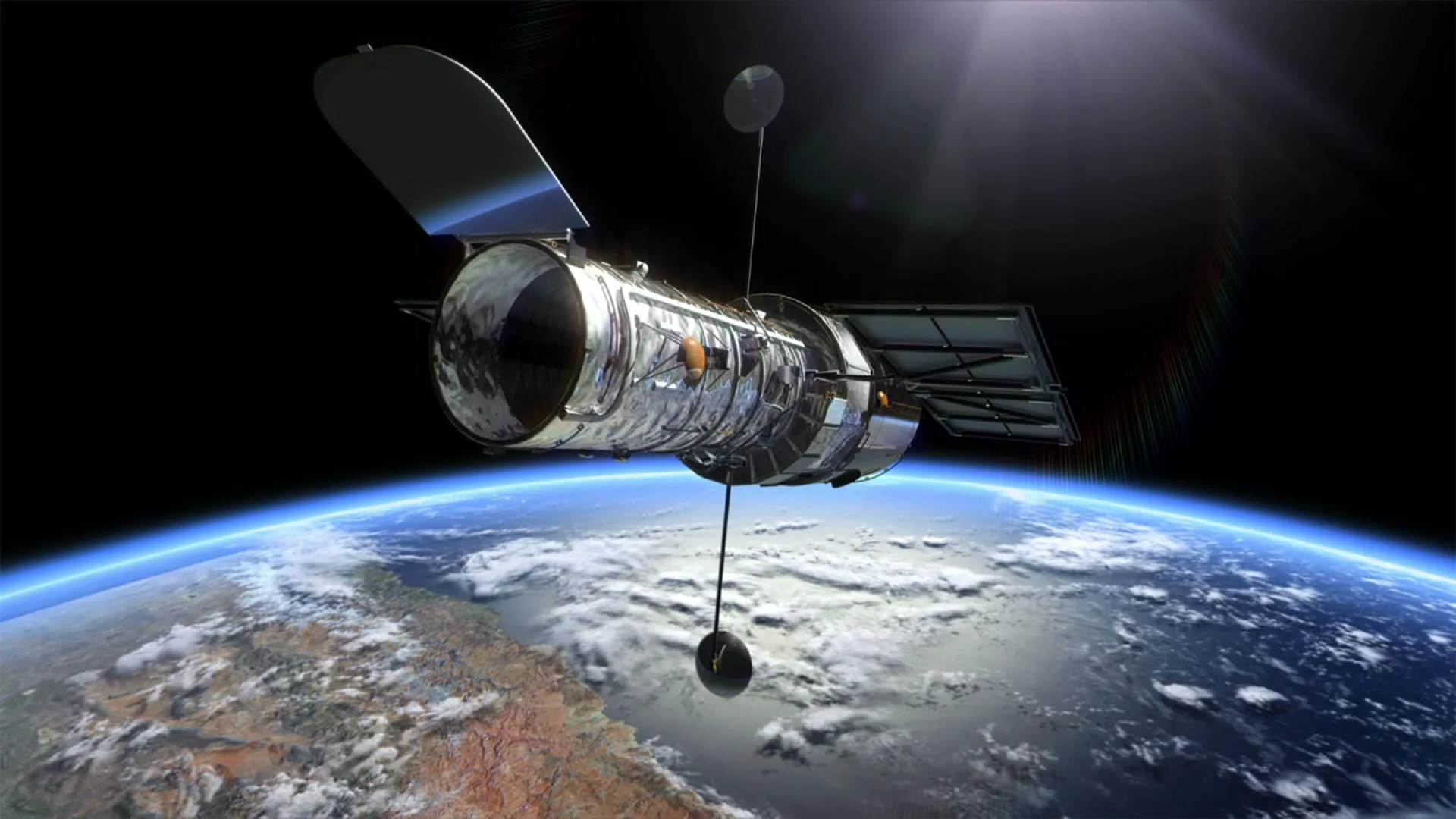
NASA is examining whether commercial space companies could help extend the Hubble Space Telescope’s operational life, potentially by raising its orbit, servicing the observatory, or supporting its eventual disposal. Hubble has spent more than 35 years transforming scientists’ understanding of the universe, but atmospheric drag is gradually lowering its orbit and could bring the telescope back into the atmosphere in 2033 or 2034.
NASA seeks commercial options for Hubble
On October 29, NASA issued a request for information seeking details about commercial technologies that could provide services to Hubble while it remains in orbit. The agency wants to determine whether new spacecraft capabilities could keep the observatory operating longer, improve its performance, or help it safely complete its mission.
“There is still important science ahead of Hubble, and we must consider every reasonable opportunity to continue delivering it for as long as possible,” said NASA Administrator Jared Isaacman. “If there are innovative, cost-effective ways to extend the life of assets already in orbit, we have an obligation to the American taxpayer and the scientific community to explore it. Extending Hubble’s life means more discoveries, more science, and more opportunities to expand our understanding of the universe.”
Possible orbit boost and servicing missions
One option under consideration is sending a probe to push Hubble into a higher orbit. Raising the telescope’s altitude could counter its gradual orbital decline and allow it to continue conducting scientific observations for many more years.
NASA is also interested in missions that could maintain the telescope or improve its capabilities. Alternatively, commercial spacecraft could help NASA safely decommission Hubble once its scientific work is complete, either by guiding it through a controlled descent into Earth’s atmosphere or by arranging for its disposal in orbit.
None of these possibilities has been formally approved. NASA is exploring them to better understand which technologies are available and whether commercial companies can provide practical and affordable solutions.
“Hubble is a national icon that has fundamentally changed the way humanity views space for more than 35 years,” said Nicki Fox, deputy administrator for NASA’s Science Mission Directorate at NASA Headquarters in Washington. “The commercial industry has evolved rapidly in recent years, providing new capabilities for in-space satellite acquisition and servicing. Given the time until the expected Hubble re-entry, we hope to explore a wide range of possibilities for pushing Hubble to higher orbits while developing a follow-on flagship mission.”
Companies interested in participating can review the NASA Online Information Request. The agency is accepting responses until Monday, November 30th at 3pm EST.
Why Hubble could re-enter the atmosphere by 2034
Hubble remains operational, but its orbit is gradually shrinking. As the telescope moves through low Earth orbit, trace amounts of Earth’s atmosphere create drag that slowly reduces its altitude.
Although Hubble is hundreds of miles above Earth, the atmosphere does not disappear completely at that height. The remaining gas produces resistance as the telescope travels through it. Over time, that drag can cause the observatory to lose altitude and descend into denser layers of the atmosphere.
Hubble does not have a propulsion system that can periodically raise its orbit. Without external assistance, its gradual loss of altitude cannot be reversed.
NASA’s current analysis suggests that Hubble will probably re-enter Earth’s atmosphere sometime between 2033 and 2034. To prevent that outcome with an orbital boost, NASA estimates that a mission would need to be completed by 2032.
That schedule leaves a limited period in which to assess potential solutions, develop a mission, and carry it out before Hubble descends too far.
Continuing Hubble’s scientific legacy
Since beginning operations more than 30 years ago, Hubble has become one of the most influential scientific observatories ever launched. Its observations have reshaped astronomers’ understanding of the universe, and it continues to produce discoveries supporting research across many areas of astronomy.
Hubble is the product of a long-standing partnership between NASA and ESA, the European Space Agency.
NASA’s Goddard Space Flight Center in Greenbelt, Maryland, oversees the telescope and its mission operations, with additional operational support from Denver-based Lockheed Martin Space.
Scientific operations are conducted by the Space Telescope Science Institute in Baltimore, which is operated by the Association of Universities for Astronomical Research on behalf of NASA.
As commercial spaceflight technology advances, NASA is evaluating whether Hubble could benefit from capabilities that were unavailable when the telescope was designed. If a mission to raise its orbit and strengthen its systems is successful, the historic observatory could continue exploring the universe well beyond its currently predicted orbital lifetime.
Source: www.sciencedaily.com