


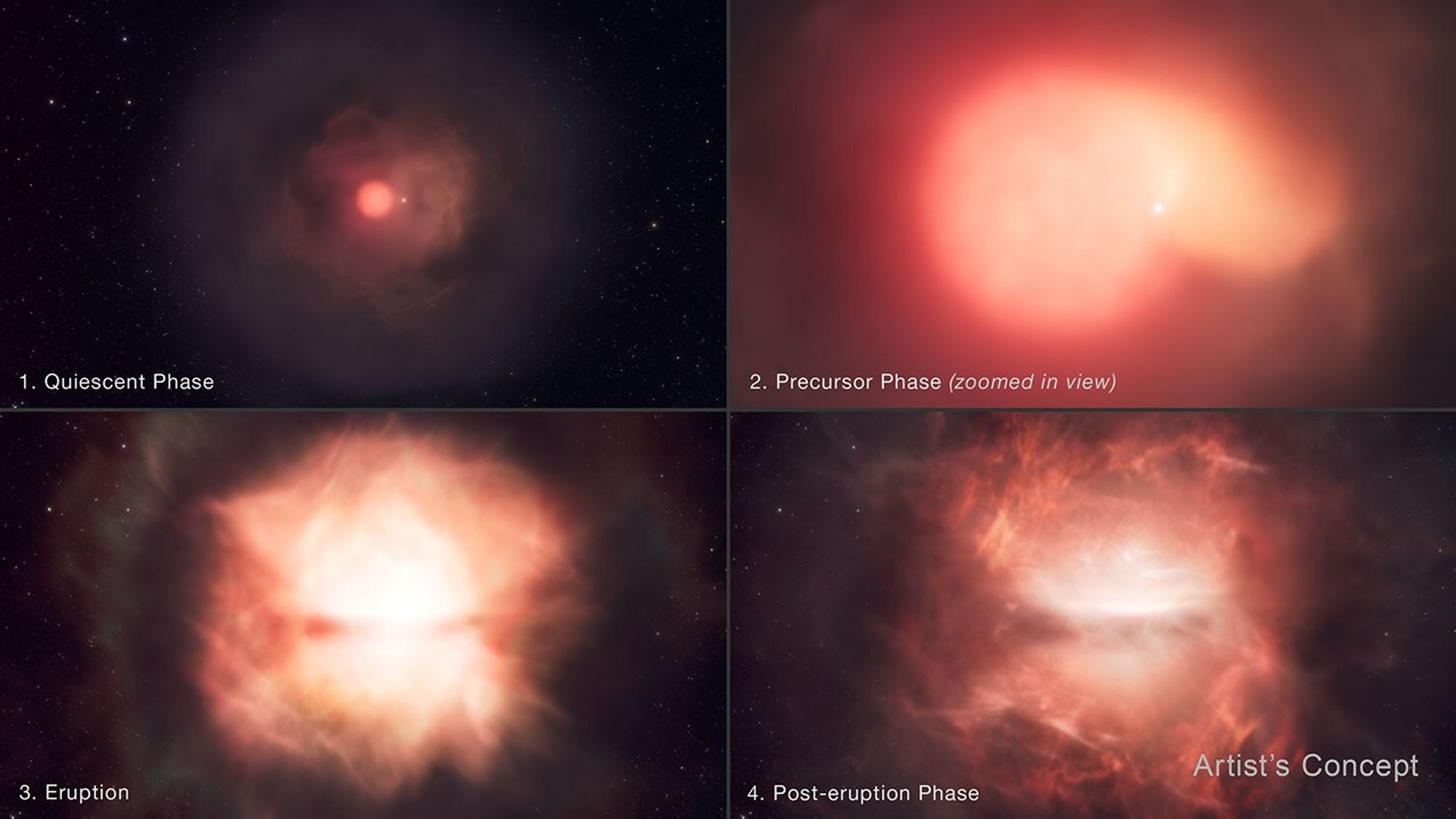
Astronomers have observed two stars merging for the first time, capturing the interaction between a supergiant and a companion slightly smaller than the Sun. After orbiting each other for thousands of years, the stars merged in less than seven years—a short enough period for researchers to follow the event from beginning to end. The findings were described in a study published Nov. 18 in the journal Nature.
“Star mergers are difficult to predict and therefore very difficult to observe in real time,” Viraj Karambelkar, an astrophysicist at Columbia University and the study’s lead author, said in a NASA statement. “But we noticed in 2023 that something unusual was happening and continued to monitor what the system would do.”
A stellar merger unfolds
Researchers identified the binary system as Bao, officially designated AT 2025abao, and began monitoring it. Their observations suggest that, at some point in 2018, the smaller star collided with the surface of the supergiant.
The interaction then intensified. The stars began exchanging gas in a process known as common-envelope evolution. The larger star drew in increasing amounts of material from its companion, which eventually spiraled into the supergiant’s core and released a tremendous burst of energy.
Image credits: NASA, ESA, CSA, STScI, Viraj Karambelkar (Columbia), Kishalay De (Columbia); image processing: Alyssa Pagan (STScI); acknowledgments: DSS, Robert Gendler.
Study co-authors described the final outburst as “like a bomb exploding inside a living star.” Kishalay De, an astronomer at Columbia University, made the comment in a statement.
What happened to the stars?
The researchers were surprised by both the speed of the interaction and its outcome. Bao might have been expected to explode as a supernova, form a neutron star or collapse into a black hole. Instead, observations indicate that the system appears to have settled back into a single giant star.
Further observations could reveal how the rejuvenated Bao survives after absorbing its companion.
Clues to other stellar mergers
The team’s analysis could help guide future studies of supergiant and binary-star systems. A clearer understanding of common-envelope evolution may allow astronomers to reconstruct how earlier stellar mergers occurred.
With new observatories such as NASA’s Nancy Grace Roman Space Telescope, Karambelkar predicts that Bao will not be the last merging star system discovered by scientists.
Topics: James Webb Space Telescope
Source: www.livescience.com