


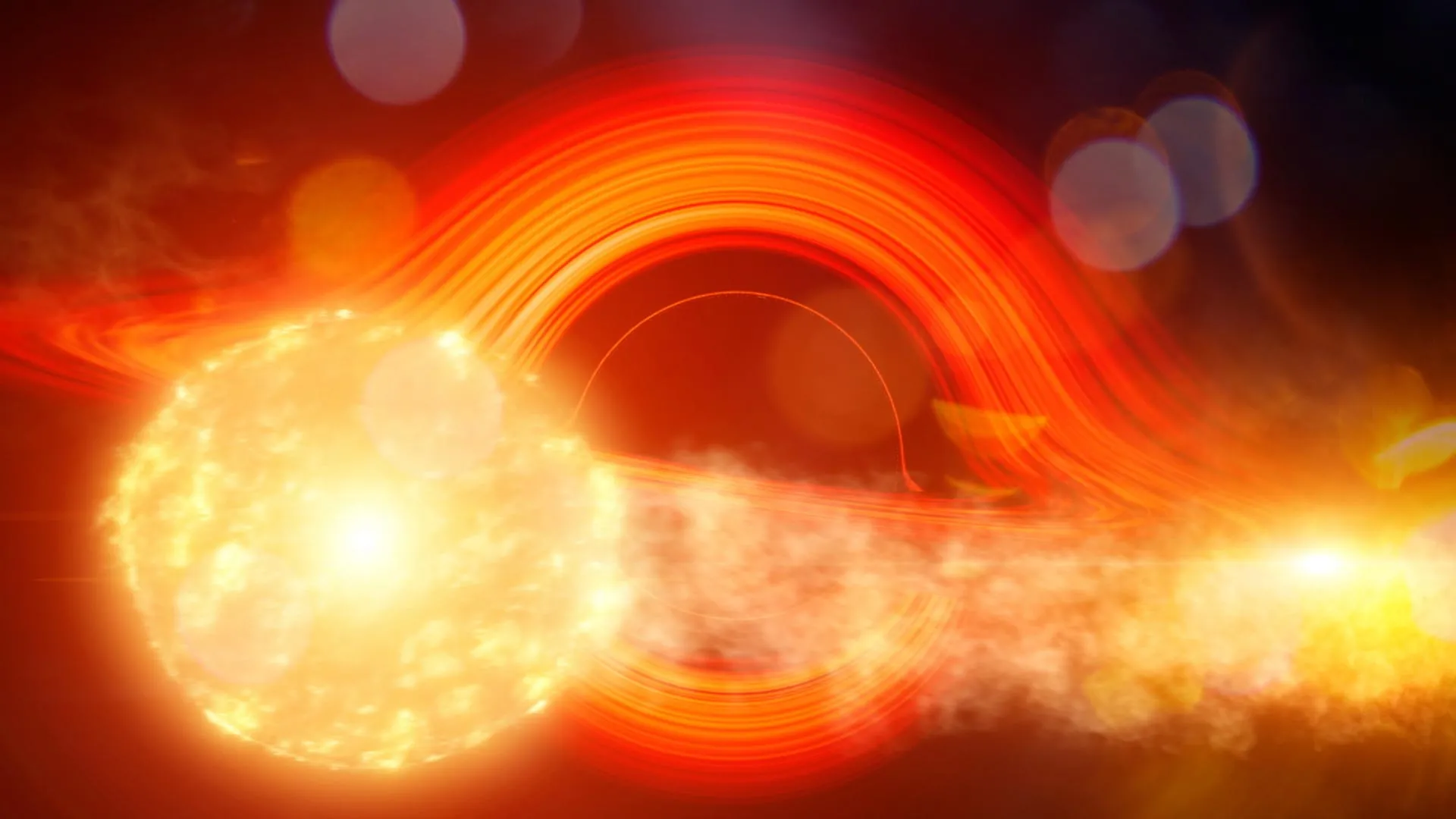
New infrared observations and computer simulations suggest that a pair of giant stars may be the source of mysterious gas clouds orbiting the Milky Way’s central supermassive black hole, Sagittarius A*. Led by the Max Planck Institute for Extraterrestrial Physics (MPE), an international research team traced several compact clouds to powerful stellar winds from the binary system IRS 16SW. Material released by the stars could eventually help supply the black hole.
The center of the Milky Way is a crowded, turbulent region. Sagittarius A*, or Sgr A*, is surrounded by stars, gas and dust moving through an environment dominated by intense gravity. Studying this region allows astronomers to investigate how matter behaves near a black hole and how material reaches it.
Infrared observations over the past two decades have revealed several small, dense gas clouds moving close to Sgr A*. These objects could offer clues about how matter travels toward the black hole, but their origins have remained uncertain.
A connected stream of gas clouds
In 2012, astronomers identified G2, a compact cloud of ionized gas containing several times the mass of Earth. Its hydrogen and helium emissions are consistent with hot gas mixed with dust. G2 follows a highly elongated orbit around Sgr A*, along with a faint extension known as G2t.
Researchers later found a similar object, G1, in older observations. It was moving along a closely related path. The similarities raised the possibility that G1, G2 and G2t were not independent clouds, but concentrations within a larger, continuous flow of gas.
Small variations in gas density can make a continuous flow appear to be divided into separate clouds. That is because the brightness of gas increases in proportion to the square of its density, causing denser regions to stand out more clearly.
More recently, astronomers found that gas associated with G2’s trail had become concentrated in another compact cloud following a similar orbit. The object might have been called G3, but that designation had already been assigned to another object. Together, the related clouds form a flow through the galactic center known as the G1-2-3 streamer.
These clouds could also matter to the black hole’s activity. Calculations indicate that the arrival of roughly one Earth mass of gas at Sagittarius A* every decade could provide enough material to sustain its current activity. Identifying how the clouds form may therefore help explain how black holes receive fuel.
Tracing the clouds to a binary star system
Astronomers have considered several possible sources for the clouds, including powerful winds from massive stars, stellar explosions such as novae, and gas pulled from other objects by a black hole’s gravity.
To investigate the question, the MPE-led team used two infrared spectrometers, SINFONI and ERIS. Both instruments use adaptive optics to produce sharper observations. The researchers measured the clouds’ positions and velocities, then reconstructed their paths around Sagittarius A* using distinctive hydrogen emission signatures known as Brackett-gamma lines.
The observations revealed that G1, G2 and G2t travel along trajectories with approximately the same shape and direction. It would be highly unlikely for three unrelated clouds to have such closely matching orbital properties, strongly suggesting that they came from a common source.
By working backward from the clouds’ motion and their velocities along the line of sight, the researchers identified a likely source: IRS 16SW. The system is a large contact binary, meaning that its two stars are extremely close to each other.
IRS 16SW is part of a disk of young stars rotating clockwise around Sagittarius A*. Its location and motion are consistent with the observed gas flow. Small differences between the clouds’ orbits could also result from the two stars’ movement around each other.
How stellar winds could create the clouds
Computer simulations of gas flow and interactions provided additional support for the explanation. The models show that powerful winds from a binary star system can collide with surrounding material, generating shocks in the interstellar environment. The gas can then accumulate and become compressed into a dense concentration that eventually separates from the system.
After being released, these compact clouds could move inward along paths resembling those observed for the G1-2-3 streamer. This process offers a physical explanation for how a single binary system might produce several clouds traveling along closely related orbits.
Implications for Sagittarius A*
The findings suggest that massive stars near the Milky Way’s center may provide a continuing supply of gas to Sagittarius A*. Instead of relying only on material already circulating around the black hole, Sagittarius A* could receive fresh gas from powerful winds produced by nearby stars.
The proposed mechanism connects several important astronomical processes: the evolution of massive stars, the movement and compression of gas, and the feeding of a supermassive black hole. By identifying a possible source for the clouds near Sagittarius A*, the researchers have provided new clues about how stars may help sustain activity at the center of our galaxy.
Source: www.sciencedaily.com