


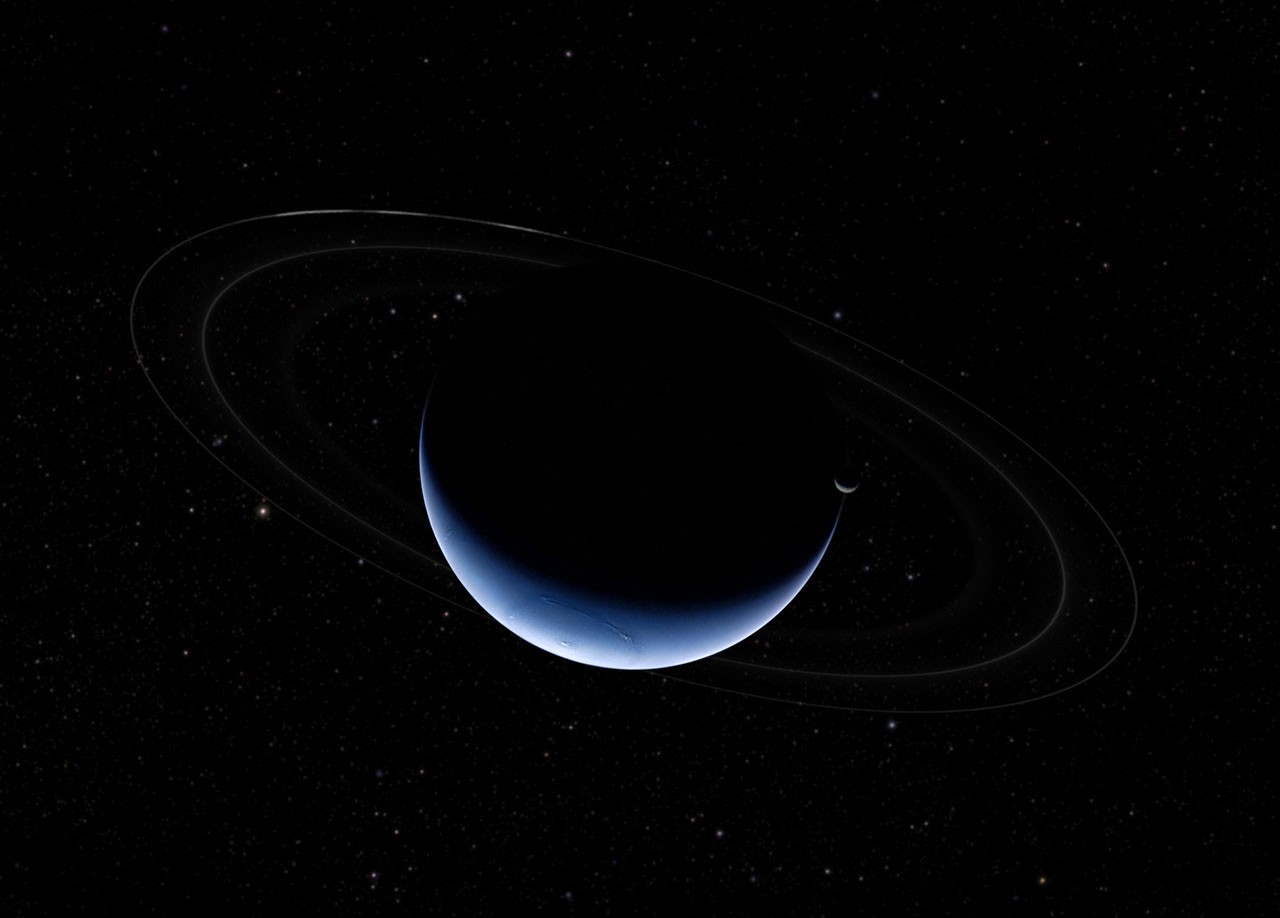
Voyager 2 made its closest approach to Neptune on August 25, 1989, becoming the only spacecraft to visit the distant ice giant. A composite scene based on images recorded during the encounter and the following days shows Neptune, its largest moon Triton, and the planet’s faint ring system from just beyond Neptune’s orbit. The spacecraft is still traveling through interstellar space in 2026.
A farewell view of Neptune
Seen from an interplanetary perspective, Neptune and Triton appear as pale crescents illuminated by the Sun. Cirrus clouds and dark bands surround Neptune’s south-polar region, while cloudy vortices appear above the poles. Voyager 2’s close encounter provided the first photographs of Neptune’s very faint ring system, including three bright ring arcs. The fainter portions of the rings have been modeled in this composite image.
The background covers a 7.5-degree-wide field of stars created from a sky survey centered on the constellation Camelus. It represents Voyager 2’s spectacular view of the Neptune system as the spacecraft departed.
Voyager 2’s approach to Neptune was the only spacecraft visit to this remote ice giant planet. The composite scene was inspired by the spacecraft’s images. Information about the cloud structures is discussed in this study, while more about Neptune’s faint ring system is available separately.
Tomorrow’s photo: swirling
Source: science.nasa.gov