


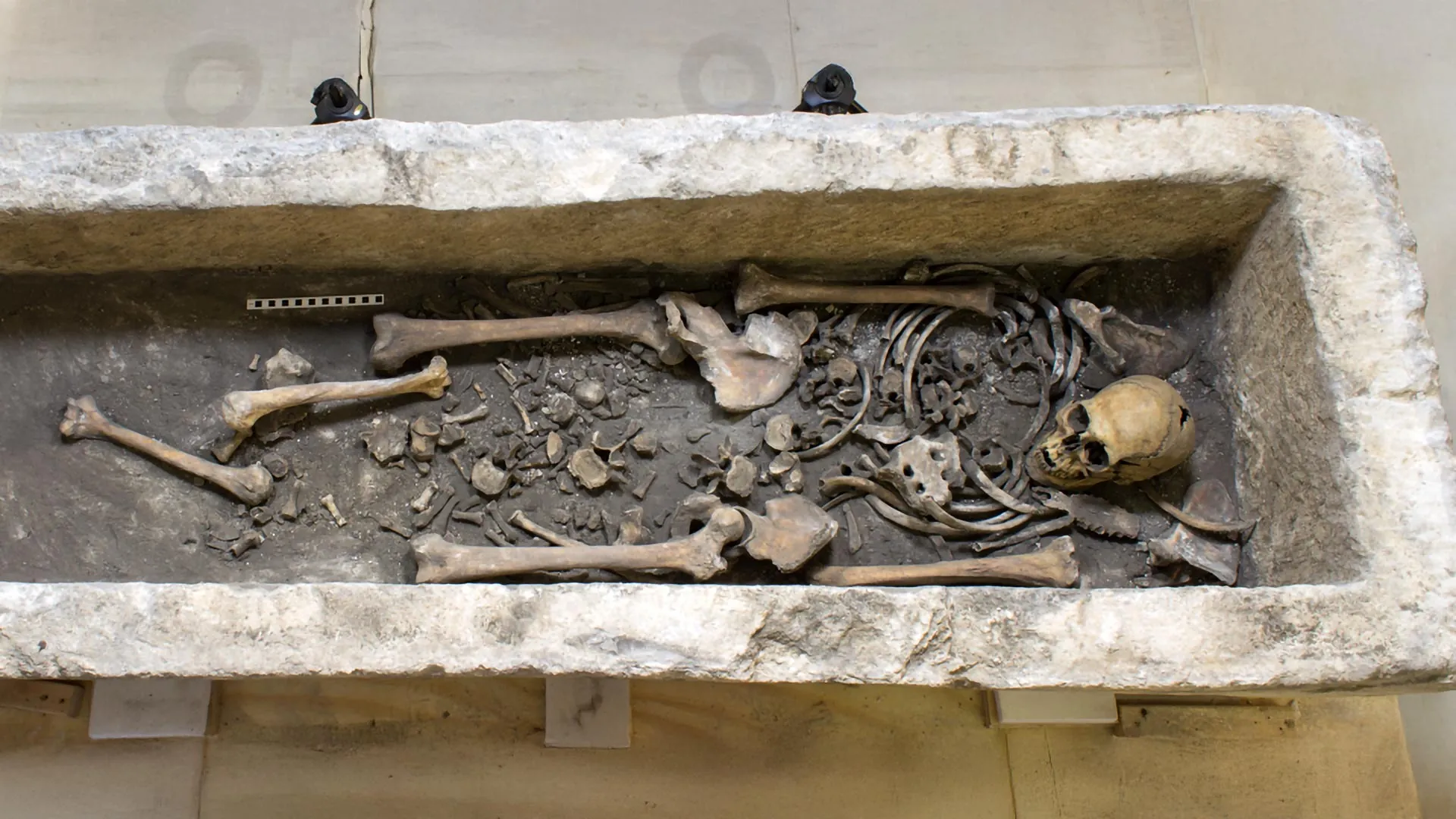
The identity of a man buried inside an ancient Roman sarcophagus at Westminster Abbey may be closer to being solved more than 150 years after the remains first attracted attention. Although the limestone coffin bears the name of Valerius Amandinus, a wealthy Londoner who lived between AD 300 and 400, a large Latin cross carved into its lid dates to around the 10th or 11th century. New archaeological research suggests that the sarcophagus was reused for the remains of a prominent medieval monk, possibly one of two abbots who led Westminster Abbey.
Two medieval abbots are potential candidates
The new findings, published in peer-reviewed papers in the Journal of the British Archaeological Society, come from Professor Warwick Rodwell, a consultant archaeologist at Westminster Abbey.
Rodwell identifies Abbot Aelfwig, who died around 1020, as the most likely candidate. Westminster Abbey was a Benedictine monastery at the time, and Aelfwig served there as a monk before becoming abbot.
Another possibility is Ulnos, who succeeded Aelfwig and died in 1049. Both men are believed to have been buried at the monastery, meaning the remains could belong to either one.
“There are two strong candidates for the sarcophagus’ occupant,” Rodwell said.
“We don’t know the date of birth of either, but both are equally true if we assume that the abbot was in his early 20s when he was ordained and nearly 50 when he died.”
“The fact that Aelfwig was already a monk at Westminster may give him an advantage.”
The elaborate burial also suggests that the deceased held an important position. Rodwell said the man may have been “honored” with a “fine sarcophagus”, an unusual distinction that would have been appropriate for an abbot.
Those responsible for the burial appear to have reused an existing Roman sarcophagus rather than commissioning a new one. The man was placed inside a wooden coffin, while a prominent Latin cross was carved into the stone lid. The burial may therefore represent an early example of a valuable object being recycled for an entirely different purpose.
New excavation reveals the skeleton’s age
Roman sarcophagi and their mysterious occupants have fascinated researchers for generations. Rodwell’s latest conclusions draw on several studies conducted over the years with experts, including research associated with Channel 4’s Time Team.
In 2009, a television programme investigated the archaeology and architecture of Henry III’s original sacristy on the north side of Westminster Abbey.
The same area was the site of an earlier accidental discovery in 1820, when workers encountered a Roman coffin whose lid had been broken into six pieces. The damage was repaired around the time the sarcophagus was officially “discovered” in 1869.
More recently, Pre-Construct Archaeology, one of the UK’s largest commercial archaeology and heritage organisations, carried out new excavations of the sacristy. The work supported construction of a new Westminster Abbey facility, the Sacristy of Charles III, which was scheduled for completion in 2025 and opening the following year.
As part of the research, bones expert James Young Langthorne of Pre-Construct Archaeology examined the skeleton.
His analysis found that the deceased was a man between 35 and 49 years old and approximately 5 feet 9 inches tall. Those findings differ significantly from assessments made in the 1800s, which described the remains as belonging to a “strong young man” under 30 years old and approximately 5 feet 7 inches tall.
Radiocarbon dating places the burial around 1,000 years ago
One of the most important clues came from scientific dating. Bone samples were submitted to the Scottish Universities Environmental Research Centre for radiocarbon analysis, which produced a date range of AD 987 to 1052.
This indicates that the Roman sarcophagus was buried during the late Saxon period, several centuries after it was made. The date range also overlaps with the deaths of Aelfwig and Ulnos, supporting the possibility that the skeleton belonged to one of the medieval abbots.
“This confirms that the reuse of the sarcophagus and associated modification of the lid took place in the late Saxon period,” Rodwell wrote.
The results provide scientific support for the theory that ancient Roman burial vessels were repurposed to honour important religious figures about 1,000 years ago.
A skeleton hidden in plain sight
The study also brought renewed attention to an unexpected discovery made in 2016. For years, researchers believed that the human remains were missing and that an important part of the burial’s history remained unresolved.
That assumption proved incorrect when the sarcophagus was taken to a conservation studio. After PCA researchers removed the lid, they were surprised to find an almost complete human skeleton inside.
The examination produced another clue, which Rodwell described as an “amazing new discovery”. Researchers identified the rectangular outline of a long-vanished structure inside the sarcophagus. Its shape had been preserved by white residue left by lime historically used in burials.
Rodwell believes the outline marks the position of the original wooden coffin in which the deceased was placed before being enclosed in the Roman sarcophagus.
“Although no physical traces of its features remain, we can only assume that it was a wooden coffin that had completely decayed during the seventh century after the sarcophagus was buried in the sacristy courtyard,” Rodwell wrote.
The rediscovered remains, evidence of a wooden coffin and new scientific dating have changed researchers’ understanding of the unusual burial. Although the man’s identity has not been definitively established, the findings suggest that a medieval abbot may have been buried in a Roman coffin that was already centuries old.
Visitors can see the sarcophagus today in the Queen’s Diamond Jubilee Gallery at Westminster Abbey.
Source: www.sciencedaily.com