


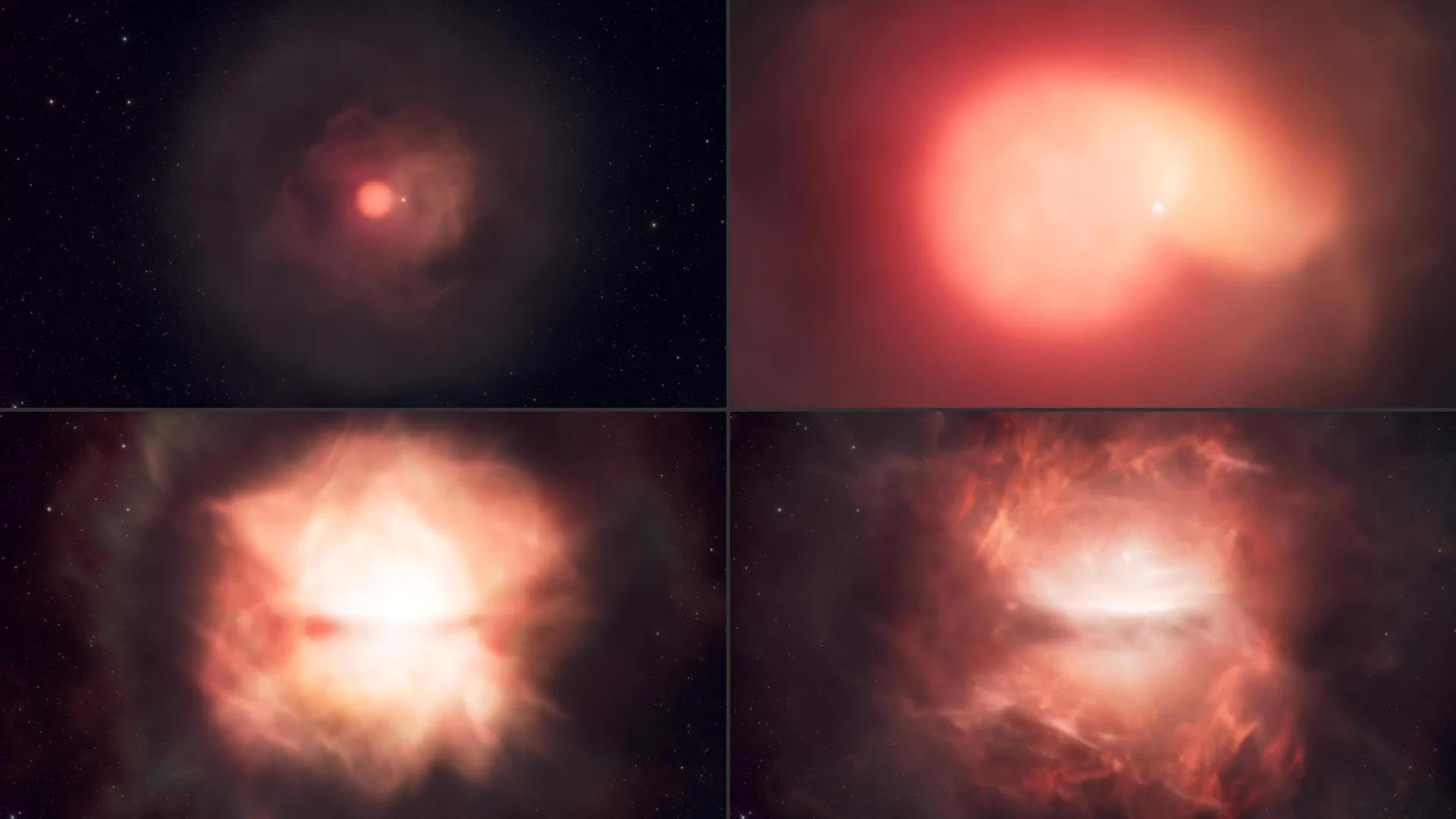
Astronomers have identified an unusual stellar collision in the neighboring Andromeda galaxy: a small star spiraled into a massive supergiant and ultimately merged with it. The event, studied with NASA’s James Webb Space Telescope and years of observations from other facilities, appears to have left behind a single star that may have been “rejuvenated” by the merger. Researchers have nicknamed the remnant Bao.
The smaller star had about 0.7 times the mass of the Sun, while its companion was a swollen supergiant. The encounter occurred near the outer edge of Andromeda as part of a NASA-funded research effort.
A merger observed as it unfolded
Webb’s observations provided important evidence about what happened. Combined with measurements collected over several years by ground-based and space telescopes, the data allowed scientists to reconstruct how the system changed before, during and after the merger.
“Star mergers are difficult to predict and therefore very difficult to observe in real time,” said Viraj Kalambakar, lead author of the new paper and a NASA Hubble Fellow at Columbia University in New York. “But we realized something unusual was happening in 2023 and continued to monitor the system to see what would happen. Then, in 2025, the star erupted!”
Kalambakar said the team observed Bao 47 days after the eruption peaked, describing it as the earliest follow-up observation of such an event. Webb’s data helped the researchers characterize the system before, during and immediately after the merger.
For thousands of years, the two stars existed as a binary system, orbiting each other without merging. That relative stability ended when the smaller star began grazing the massive outer atmosphere of its companion.
Once the interaction began, the process accelerated. The two stars completed their “unification” after seven more orbits, or about seven years. Previously observed mergers involving pairs of smaller stars took thousands of orbits to reach the same outcome.
The speed of the final eruption also surprised astronomers.
“We thought that an explosion like this from a star would take many years,” said co-author Nadia Blagorodnova, an associate professor at the University of Barcelona in Spain. “The brightness started increasing one day, and within a week the brightness reached its peak!”
Subtle warning signs had appeared before the eruption. As the smaller star moved through the giant’s outer atmosphere, it disturbed the surrounding gas and stripped away material, gradually changing the system’s brightness.
“When a companion star begins to interact with its host star’s outer surface, it produces a subtle slow brightening effect that was clearly seen in the Bao data,” said co-author Kisharai De, an assistant professor at Columbia University in New York. “As the companion star continues its orbit, the outer layers of the host star continue to peel away, and its gas flows out into the surrounding space.”
A violent common-envelope evolution
The interaction is an example of a process astronomers call common-envelope evolution. It begins when one star expands enough to engulf its companion, placing both stars inside a shared layer of gas.
As the smaller star moves through that gas, drag slows its orbit and removes orbital energy. The star then spirals progressively deeper toward the center of the larger one.
In Bao’s case, the smaller star eventually plunged into the giant’s interior and merged with it. Webb’s observations supplied evidence that the two stars had become one.
Not every common-envelope encounter ends in a merger. In some cases, both stars survive as separate objects in tighter orbits, while losing a significant amount of material.
Those surviving systems are important because they may eventually produce some of the universe’s most extreme objects and events. Depending on how the stars evolve, they could form neutron stars or black holes, undergo violent supernova explosions, generate gravitational waves, or produce rapidly rotating objects known as millisecond pulsars.
Understanding common-envelope evolution is therefore essential for explaining how many of these unusual cosmic objects form.
Reconstructing the collision with Webb
To determine what happened to Bao, the researchers refined computer simulations of the two stars and compared the results with Webb’s observations.
Webb’s mid-infrared measurements were particularly valuable because they revealed dust expelled by the giant star over millions of years. Infrared observations can detect material that is difficult to see at visible wavelengths, providing clues about the system’s history long before the final eruption.
The simulations indicated that the larger star was truly massive. Before the merger, the two stars had a combined mass of about seven Suns, a radius 350 times that of the Sun and a brightness 18,000 times greater than the Sun’s.
Its enormous proportions earned it the nickname “Big Bao.”
“This star was an absolute beast, completely outperforming its opponents in the data,” said co-author Dr. Karel Temminck, a student from Radboud University in Nijmegen, Netherlands, who led the simulation.
The researchers also calculated the smaller star’s mass for the first time. Nicknamed “Little Bao,” it was probably smaller and dimmer than the Sun, with an estimated mass of about 0.7 solar masses—approximately 70% of the Sun’s mass.
Initial simulations suggested that Little Bao might retain enough energy to escape Big Bao’s gravity and survive the encounter. Further analysis produced a different result: Little Bao was pulled deep into Big Bao’s core, releasing a huge amount of energy as the stars merged.
“It was like a bomb going off in a living star,” De said.
The merger left another important question: what is happening to Bao now?
The surviving star contains material inherited from both original stars, but its final structure and mass distribution remain uncertain. Future observations will be needed to determine how the combined object stabilizes and evolves.
Years of observations revealed the warning signs
The discovery is especially valuable because astronomers were observing the system long before its dramatic eruption.
Webb provided key information about the amount of material ejected and the efficiency of the common-envelope process. The research team also used ultraviolet, visible and near-infrared observations from multiple observatories. Together, these measurements created a detailed record of the system’s behavior as the merger approached and unfolded.
The researchers had published their earlier findings shortly before the star exploded. In fact, they published the first paper just before the 2025 eruption.
The first major clue appeared in February 2023, when astronomers examining archived observations from NASA’s retired NEOWISE, or Near-Earth Object Wide-field Infrared Survey Explorer, mission noticed that the star’s brightness was behaving unusually.
Earlier records showed that the object had maintained a stable brightness through 2018. The changes that followed suggested that a significant transformation was beginning.
By September 2024, observations from the Wide Field Infrared Transient Explorer, or WINTER, showed further activity. The system was becoming increasingly bright and ejecting dust into the surrounding space.
In July 2025, NASA’s SPHEREx mission—the Spectrophotometer for the History of the Universe, Era of Reionization, and Ice Explorer—observed Bao during a routine sky survey.
The telescope detected a striking change: the star rapidly dimmed in visible light while brightening in infrared light. That combination provided another indication that the system was undergoing a major transformation.
On October 17, 2025, the Zwicky Transient Facility detected an eruption. The observations showed a sudden increase in brightness accompanied by a sharp rise in temperature.
Scientists quickly arranged additional observations to follow the event. In November 2025, NASA’s now-retired Neil Gehrels Swift Observatory and the National Science Foundation’s NOIRLab Gemini North telescope in Hawaii provided new measurements.
Webb joined the effort on December 24, 2025, through an emergency-approved Director’s Discretionary Time program. The special observing opportunity allowed the telescope to examine the aftermath while the system was still changing rapidly.
A new window into stellar evolution
The study of Bao, officially designated AT 2025abao, represents a significant advance in the investigation of stellar mergers. Instead of studying only the remnants of events that occurred hundreds, thousands or millions of years ago, astronomers were able to observe the process as it happened.
That timing allowed the team to measure how efficiently a common-envelope interaction transferred energy and ejected material. The results can help researchers improve models of binary-star evolution and determine why some systems merge while others survive as close pairs.
The discovery also comes as the Nancy Grace Roman Space Telescope prepares for large-scale surveys. Its planned observations may reveal additional unusual stellar events.
One major program, the Galactic Bulge Time-Domain Survey, will repeatedly monitor large numbers of stars and search for objects that change in brightness or appearance. These temporary or variable phenomena, known as transient events, could include other systems undergoing transformations similar to Bao.
With more discoveries and systematic follow-up observations, researchers hope to determine how often stars engulf their companions and what happens afterward.
“We’re going to see a huge influx of similar discoveries in the future,” Kalambakar said.
The research was partially funded through NASA’s Astrophysical Data Analysis Program.
The James Webb Space Telescope is the largest and most powerful space observatory ever launched. It supports the work of thousands of astronomers worldwide, studying objects in the Solar System, planets orbiting other stars, and the formation, structure and evolution of the universe.
Webb is an international collaboration led by NASA in partnership with the European Space Agency and the Canadian Space Agency.
Source: www.sciencedaily.com