


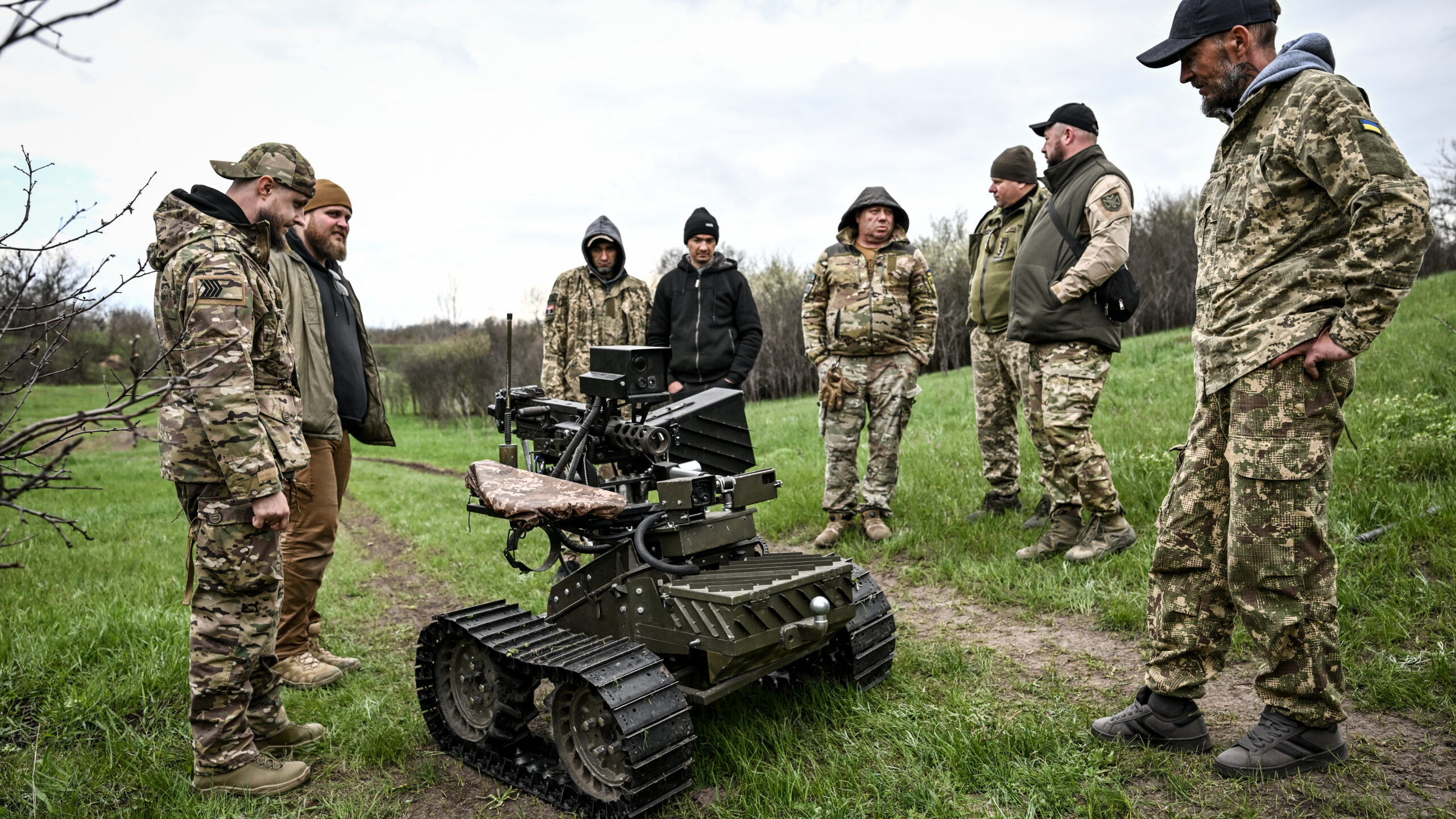
In a groundbreaking move in battlefield innovation, Ukraine has harnessed the power of flying drone carriers and drone boats to deploy ground robots equipped with weapons and explosives directly into combat.
This strategic deployment enables slow-moving, wheeled robots to navigate rugged terrain and breach Russian defenses, facilitating unprecedented robotic amphibious attacks in contested areas. These tactics reflect the Ukrainian military’s ongoing commitment to leverage drones and robots to counterbalance the Russian military’s dominance in personnel, all while minimizing risks to soldiers’ lives.
On July 19, it was reported that a Russian military Telegram channel released a video showcasing a Ukrainian Hexacopter drone transporting a ground robot below it via a cable. According to United24, a news platform managed by the Ukrainian government, the Russian Telegram channel documented that heavy bomber drones from Ukraine were advancing towards Russian positions, with four-wheeled ARK-1 robots equipped with explosive anti-tank mines, provoking a wave of furious reactions from pro-Kremlin commentators.
While the success of this particular mission remains uncertain, the tactic has the potential to enhance the survivability of ground robots by enabling them to evade Russian aerial surveillance and drone strikes, allowing them to approach targets more swiftly. The ARK-1 robots, although somewhat slow, can achieve speeds of up to 45 miles per hour.
Ukrainian ground robots also participated in military operations aimed at the Kinburn Spit on June 25. This narrow sandy peninsula extends west into the Black Sea and connects to the left bank of the Russian-occupied Kherson Oblast.
After being captured by Russian forces in June 2022, the Kinburn Spit became a strategic position for controlling port access to the Black Sea in southern Ukraine. In early June, Russia began to withdraw from the peninsula, as Ukraine’s medium- and long-range drone strikes began to strain their supply lines.
Source: arstechnica.com