


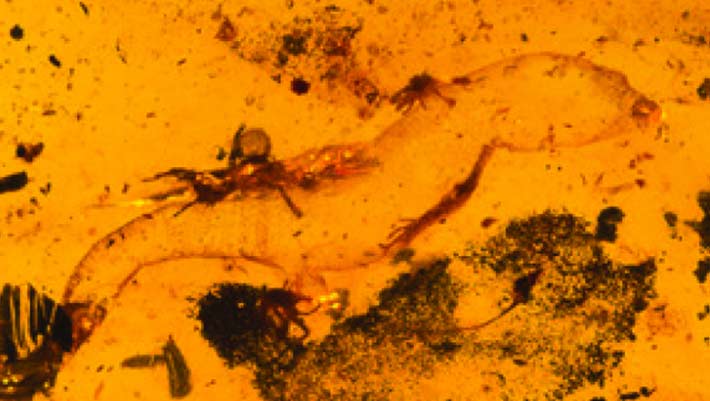
Paleontologists have unveiled the remarkable discovery of a new genus and species of ancient gecko, named Carinasquama rusmithii, from two amber specimens extracted from a 99-million-year-old (Middle Cretaceous) deposit in Kachin State, Myanmar. One specimen exhibits a notable bulge at the base of the tail, indicating the presence of male lizard’s hemipenes, or copulatory organs.
Holotype (A) and paratype (B) specimens of Carinasquama rusmithii, viewed ventrally. Image credit: Daza et al., doi: 10.3897/sjp.145.188227.
This ancient gecko thrived in the tropical forests of present-day Myanmar approximately 99 million years ago.
Measuring between 1.6 to 2.2 cm in snout-to-mouth length, Carinasquama rusmithii is comparable in size to some of today’s smallest living geckos.
What distinguishes this discovery is the bulge observed at the tail base of one specimen, interpreted as a hemipenile ridge—an external feature indicative of male copulatory organs, or hemipenes, typically retracted within the tails of male squamates, a group encompassing lizards and snakes.
Researchers classify this finding as one of the oldest lizard fossils to be confidently identified as male, as soft tissue structures like this rarely survive the fossilization process.
“Paleontologists often rely on skeletal features to determine the sex of fossil specimens, a process complicated by incomplete fossil remains,” the researchers noted.
“In fossil assemblages, sexual dimorphism may present as ornamentation or be detected through multivariate analysis.”
“Estimations of gender can occur when embryos or eggs are discovered within or alongside female specimens; however, other sex-specific traits are uncommon in fossils.”
“In squamates, a hemipenile protuberance is typically observable in males.”
“These structures rarely leave marks in hard rock fossils but can be preserved in amber.”
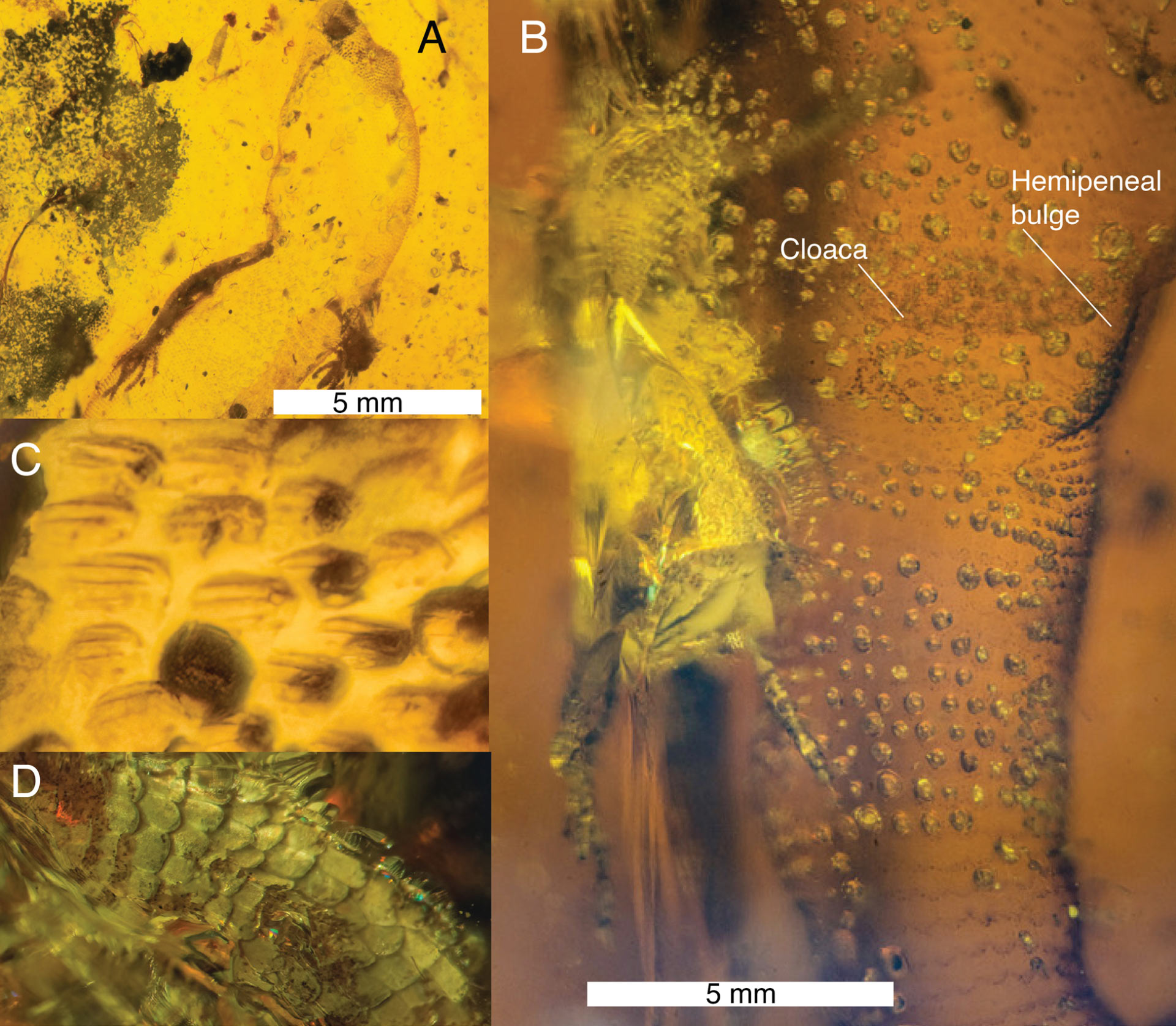
Carinasquama rusmithii Detail of the integument: (A) Dorsal view displaying head and back scales. (B) Ventral view highlighting the hemipenis bulge at the cloaca. (C) Close-up of multi-carnation scales. (D) Ventral view with spotted tail scales. Image credit: Daza et al., doi: 10.3897/sjp.145.188227.
Using advanced micro-CT technology, scientists reconstructed the skeletons of two specimens of Carinasquama rusmithii in three dimensions.
The specimens are so well-preserved that despite much of the space where their remains once lay being hollow, the surrounding integument (including scales, skin texture, and the outline of the cloaca) is preserved in great detail.
“The absence of frontal scales, the lack of frontoparietal scales, granular and homogeneous head scales, fused eyelids, and uniform scale sizes throughout the body with visible interstitial skin between scales are characteristics shared with extant Gekkotan,” the authors explained.
The exact phylogeny of Carinasquama rusmithii remains ambiguous; however, researchers provisionally classify it within the broader Pan-Gekkota group.
“Scottish lizards have been identified as part of the Pan-Gekkota family, which encompasses some of the earliest fossil lizards to clearly show male characteristics,” the examination team noted.
“This hemipenile bulge found in one of the fossils documents the existence of hemipenes in mid-Cretaceous squamates, although its origins probably predate this group’s emergence.”
The findings of the research team are detailed in their paper published in the Swiss Journal of Paleontology.
_____
Daza, JD et al. 2026. Evidence of male anatomy in a dwarfed amber gecko from mid-Cretaceous Burma. Swiss Journal of Paleontology 145: 785-799; doi: 10.3897/sjp.145.188227
Source: www.sci.news