



The pCloud Pass password manager was targeted in a cyberattack after customers reported alerts stating that an unfamiliar device had connected to their accounts, including accounts protected by two-factor authentication (2FA). pCloud said the attack was stopped quickly and that a small number of email addresses were exposed, but it did not disclose whether encrypted password vaults were accessed or stolen.
Customers report unfamiliar device connections
The incident was first reported by pCloud customers who began receiving email notifications claiming that a new device had connected to their pCloud Pass accounts.
In two Reddit threads, customers from around the world said the alerts identified an unfamiliar device named “pd.” The notifications showed a connection from the Luxembourg IP address 45.131.244.7, which users said belongs to pCloud’s own infrastructure.
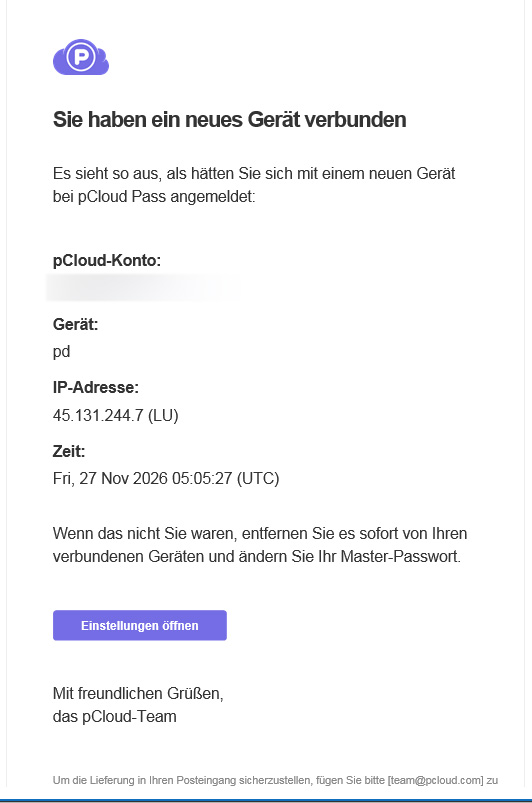
Source: BleepingComputer
Several customers said they received the alerts despite having 2FA enabled. However, when they reviewed the connected devices listed in their accounts, some found that the unfamiliar devices did not appear.
Other pCloud customers reported receiving the same notifications even though they had never used the company’s password manager. One customer said the alert was sent to an email address associated with a pCloud storage account that he had requested to be deleted about a year earlier.
pCloud says the attack was stopped
In response to the reports, pCloud acknowledged that its password manager had been targeted but said the attack was quickly thwarted.
“A cyberattack targeted pCloud Pass, which was quickly stopped by the pCloud team,” the company said in a statement.
“Unfortunately, a small number of pCloud Pass users’ email addresses were exposed and login attempts were made. Our systems will automatically send a notification to each of these addresses.”
pCloud said the incident was limited to its password manager and did not affect its cloud storage services. The company also said that passwords, notes and other information stored in pCloud Pass were not compromised because the data is encrypted on customers’ devices and can only be decrypted with a master password.
However, pCloud did not say whether attackers accessed or stole encrypted password vaults.
Uncertainty remains over encrypted vaults
Whether encrypted vaults were obtained is significant because an attacker with a copy could try to decrypt it offline, without being subject to the service’s login rate limits or 2FA protections.
A similar risk was demonstrated by the 2022 LastPass breach, when attackers stole backups containing encrypted password vaults. Researchers later linked that breach to cryptocurrency theft. The attackers were believed to have cracked or reused a weak master password to access private keys and seed phrases for stored cryptocurrency wallets.
Notification links point to a QA environment
Readers who contacted BleepingComputer also noticed that the “Open Settings” link in the pCloud Pass notification pointed to passqa1.pcloud.com. The hostname appears to belong to a quality assurance (QA) environment rather than the password manager’s main product website.
BleepingComputer said the links in copies of the notifications shared with the publication pointed to the same hostname.
pCloud also discussed how advances in artificial intelligence are accelerating the discovery of software vulnerabilities, but the company did not specifically say that the incident was an AI-powered attack.
The company said it will never request a master password or recovery password by email, phone or chat, and warned customers to remain alert for phishing attacks.
Other password managers targeted this month
The pCloud Pass incident is the latest in a series of cyberattacks affecting password managers this month.
In early November, mSeven Software warned mSecure customers to change stored passwords, reset 2FA and remove passkeys after reports that hackers had stolen an encrypted customer database.
On Wednesday, 1Password disclosed a data breach after attackers deployed malicious code to the company’s backend services, compromised employee GitHub accounts and stole customer data.
1Password said its customers’ password vaults and the encryption keys protecting them were not compromised.
Source: www.bleepingcomputer.com