


Close Menu
HitechubHitechub
    What's Hot
    Science

    Influenza Epidemic Could Spread Incredibly Quickly: What Scientists Are Monitoring

    Technology

    Former Ping Identity and CyberArk Executive Joins AppViewX to Strengthen Machine and Agent Identity Security

    Science

    Ol Doinyo Lengai, the “Mountain of God,” Erupts the Fastest-Flowing Lava on Earth Seen From Space

    Important Pages:
    • About Us
    • Privacy Policy
    • Terms & Conditions
    Facebook X (Twitter) Instagram Pinterest
    Facebook X (Twitter) Instagram
    HitechubHitechub
    Friday, November 27
    • Shop
      • Fashion
        • Mens
        • Womens
        • Accessories
          • Handbags
          • Keychain
          • Masks
          • Money clicps
          • Neck Pillow
          • Rings
          • Towels
          • Wallets
        • Jewelry
        • Watches
        • T-shirts
        • Hawaiian shirts
        • Vests
        • Swim trunks
        • Swimsuits
      • Fun
        • Magic cubes
        • Magnifiers
        • Misc
        • Photo books
        • Puzzles
        • Toys
      • Home
        • Cleaning/Care
        • Mailbox covers
        • Mugs
        • Pot Holders
        • Spoon
      • Office and Electronics
        • Chairs
        • Office Supplies
        • IPad cases
        • Laptop stickers
        • Mouse pads
        • Notebooks
        • Pencil bags
        • Pens
        • Phone cases
      • Personalized
      • Pets
      • Sports
        • Cycling
          • Balaclava Mask
          • Bike Bell
          • Bike Computer
          • Bike Fender
          • Bike Grips
          • Bike Kickstand
          • Bike Light
          • Bike Locks
          • Bike Mitts
          • Bike Pumps
          • Bike Repair Stand
          • Bike Seat
          • Bike Trainer
          • Bike Wheels
          • BIKES
            • Folding Bikes
            • Road Bikes
          • Carbon Fiber Bike Products
          • Cycling Mask
          • Kid’ Bike Helmets
          • Inner Tube
          • Motorcycle Bag
          • Nylon Pedals
          • Adult Helmets
          • Photochromic Sunglasses
          • Soft Coolers
          • Suction Cup Bike Rack
          • Tool accessories
          • Winter Cloth
          • Heart Rate Monitor
        • Outdoors/Camping
          • Outdoor Bags
        • Sweatband
    • Technology
      1. AI
      2. Gadgets
      3. View All

      This is the most popular CEO in the world

      Sectors in which “Chat-GPT” is most often used

      Artificial intelligence has begun to “swallow” professions

      The unusual robot conductor of a concert in Seoul

      Here’s how you can tell if your phone is being tapped

      PlayStation 5 becomes a completely silent console and gets more space

      This is the first phone that can be used to park a car

      Best Gaming Laptops 2023: Powerful Portables for PC Games

      pCloud Confirms Password Manager Hack Following Suspicious Login Alert

      How Advanced Prosthetics Help Us Explore the Human Mind

      Unpatched Cacti Zero-Day Exploit With Public PoC Enables Remote Code Execution

      Best Black Friday Deals and Discounts Handpicked by Ars Technica

    • Science
      1. Space
      2. Wheels
      3. View All

      Space Perspective: A Journey to the Edge of Space

      5 Fascinating Facts About Space

      Space Exploration: Unveiling the Wonders of the Universe

      Toyota wants to make a new generation battery with a range of up to 1,200 km

      Meet Toyota’s lunar “baby” that could make exploring the Moon easier

      What does a night drive look like with one of the most beautiful cars in the world: the Rolls-Royce Ghost

      Scientists Identify Two Ages When Children Are Most Vulnerable to Screen Time Effects

      WATCH: Why Are We the Last Humans Left on Earth?

      Cassiopeia’s Dust Fingerprint Reveals Former Star’s Reorganization Before Explosion

      Scientists Convert Hard-to-Recycle Plastic into High-Performance Lubricant

    HitechubHitechub
    Home » Scientists Convert Hard-to-Recycle Plastic into High-Performance Lubricant
    Science

    Scientists Convert Hard-to-Recycle Plastic into High-Performance Lubricant

    Share Facebook Twitter Pinterest WhatsApp
    Share
    Facebook Twitter LinkedIn Pinterest WhatsApp

    Virginia Tech researchers have developed a chemical process that converts polyvinyl chloride (PVC) waste from items such as plumbing pipes, window frames and credit cards into polyalphaolefins, a key ingredient in synthetic lubricants such as engine oil. The approach could address two environmental challenges at once: the accumulation of difficult-to-recycle plastic waste and the environmental cost of producing valuable industrial lubricants.

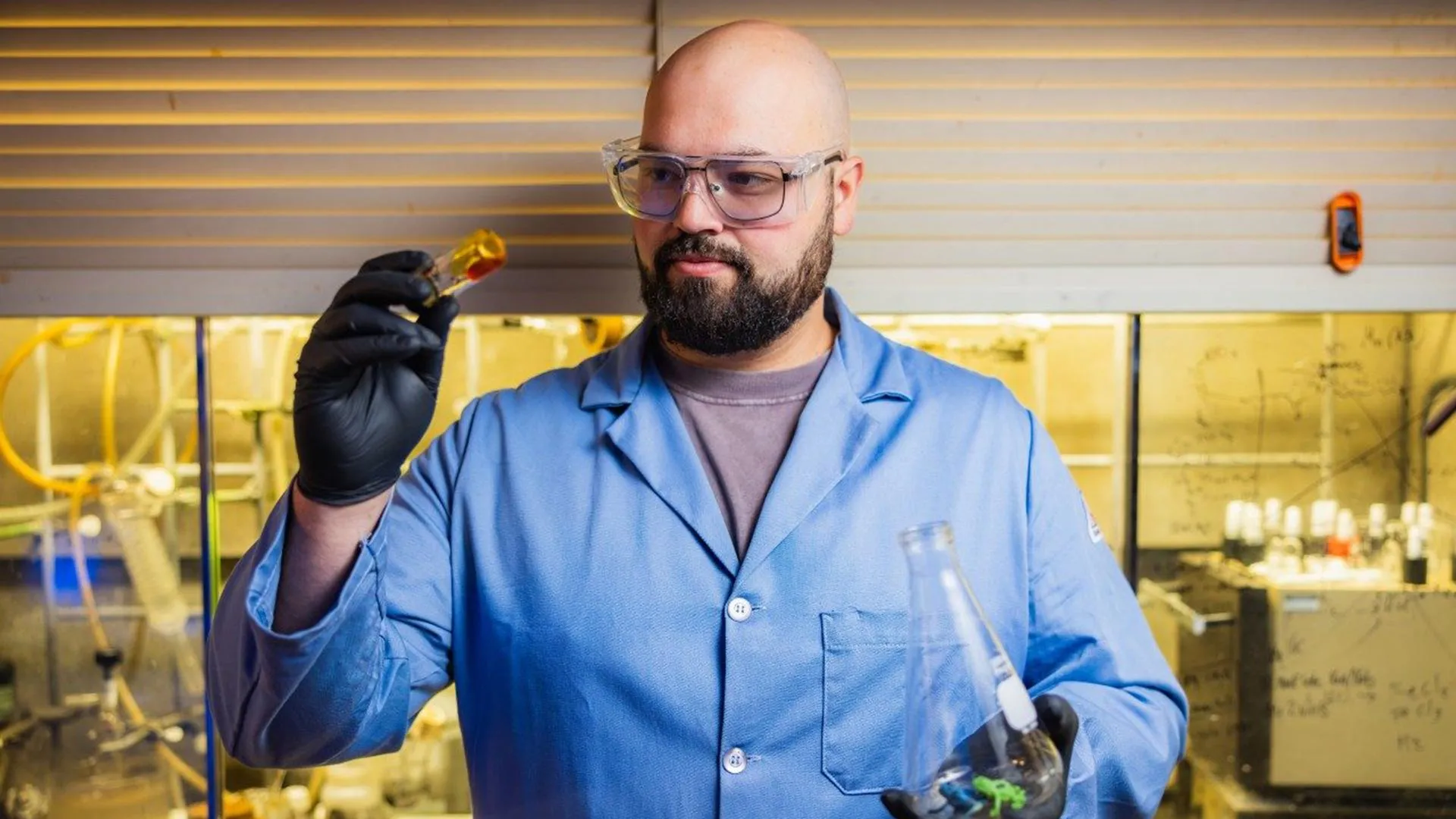
    Led by chemist and chemical engineer Guoliang “Greg” Liu, the team reported its research in Nature. The process breaks PVC down and transforms it into a relatively thick lubricating oil with properties associated with high-performance synthetic base oils.

    Turning PVC waste into lubricant

    PVC is particularly difficult to recycle because it contains chlorine and because manufacturers use a wide range of additives to give it properties such as flexibility, stiffness and heat resistance. These factors complicate conventional recycling methods, and much of the world’s discarded PVC ends up in landfills.

    At the same time, global demand for lubricants continues to grow, while producing these materials can carry significant environmental costs. Lubricants reduce friction and wear between moving components, help engines operate more efficiently and extend the life of mechanical equipment. Products ranging from lawn mowers and cars to jet engines depend on them.

    Virginia Tech’s process could provide an alternative source of these essential materials while helping address plastic pollution. The researchers placed PVC—the type commonly used in household plumbing, window frames and credit cards—in a solvent. They then added aluminum trichloride and alpha olefins, a class of hydrocarbons used to make synthetic lubricants.

    The mixture was heated to 158 degrees Fahrenheit for three hours. The researchers then extracted a relatively thick lubricating oil.

    The resulting polyalphaolefins are part of a group of synthetic base oils valued for their stability, lubricating properties and performance across a wide temperature range. They are commonly used as the basis for high-performance synthetic engine oils.

    “Firstly, we have proven that it is feasible to use plastic waste to produce high-performance lubricants. Second, these lubricants are environmentally friendly and can meet the emerging sustainability needs of the market,” Liu said.

    Building on earlier plastic-recycling work

    The discovery builds on previous work from Liu’s laboratory, including studies published in Science and Nature Sustainability. In those studies, researchers demonstrated that other types of plastic waste could be converted into surfactants.

    Surfactants help water interact with oils and greases and are widely used in soaps and detergents. Encouraged by those results, the researchers decided to tackle the more difficult problem of PVC waste.

    “We want to contribute to improving PVC recycling and upcycling,” Liu said.

    Unlike traditional recycling, which generally seeks to recover and reuse materials, upcycling converts discarded materials into products with greater value or utility.

    Liu recruited a group of graduate researchers to investigate the possibility. Eric Munyaneza Nwayo, who was completing the final year of his doctoral program, was selected to lead the project. After Liu suggested a change in direction, chemistry graduate student Connor S. Thompson, who had been working on a different research topic, joined the effort.

    Abby Siviero, a first-year graduate student, also joined the team and quickly became a key contributor.

    “I used to call them the Three Musketeers,” Liu said.

    An unexpected direction in polymer chemistry

    The researchers initially experimented with ways to alter PVC’s molecular structure and turn it into more useful materials.

    Like other plastics, PVC is a polymer made from long molecular chains composed of repeating chemical units. The team initially hoped that changing the chemical groups attached to those chains would produce materials with desirable properties.

    “The idea was simple: PVC is one of the most activated forms of polyethylene and should be easily converted into other molecules by replacing the chlorine atoms with other groups,” Liu said.

    However, the early experiments consistently produced disappointing results. Instead of a functional material with useful performance characteristics, the researchers obtained a soft, sticky substance with little practical value.

    Those results led Liu to reconsider the strategy. Rather than continuing to modify the long molecular chains, he thought that breaking them into smaller pieces might produce something more useful.

    “One day, I realized: If this polymer is so sticky and soft, why don’t we just keep breaking the polymer chains into smaller segments?” Liu said.

    As the researchers refined the chemical process and assessed the properties of the resulting materials, Liu realized that the work could have implications beyond plastic recycling. The team had identified a potential new route for producing valuable industrial lubricants.

    Evaluating the technology’s potential

    To better understand the new oil’s properties and commercial potential, Liu sought help from researchers at several institutions.

    He provided samples to Ali Erdemir at Texas A&M University, where researchers evaluated the performance of the finished material. William Goddard of the California Institute of Technology contributed chemical calculations that helped investigate the chemistry behind the process.

    At Virginia Tech, Xi Chen examined the technology’s economics and manufacturing requirements and developed a model exploring how the oil could be produced at scale.

    The study confirmed that waste PVC can serve as a starting material for producing high-performance lubricants. Extending the process beyond the laboratory, however, remains an important next step.

    Liu hopes to further improve the technology’s environmental sustainability and make the resulting lubricant more widely available. The approach could give one of the world’s most problematic plastics a valuable second life while providing industry with an alternative source of essential lubricating materials.

    “Lubricants are the silent heroes of our world. We often don’t notice their existence, but they work quietly in our world. We want to be able to produce oil on a larger scale to reach more people around the world,” Liu said.

    Source: www.sciencedaily.com

    Share. Facebook Twitter Pinterest LinkedIn WhatsApp
    Previous ArticleBest Black Friday Deals and Discounts Handpicked by Ars Technica
    Next Article Unpatched Cacti Zero-Day Exploit With Public PoC Enables Remote Code Execution

    Related Posts

    Science

    Scientists Identify Two Ages When Children Are Most Vulnerable to Screen Time Effects

    Science

    WATCH: Why Are We the Last Humans Left on Earth?

    Science

    Cassiopeia’s Dust Fingerprint Reveals Former Star’s Reorganization Before Explosion

    Science

    Narwhal Tusk: The Surprising Engineering Secrets Behind Its Legendary Unicorn Horn

    Science

    The Unforgettable Beauty of Wetlands: Book Summary and Key Insights

    Science

    Rare Turtle Discovered in Passenger Baggage at Amsterdam Airport

    Science

    James Webb Telescope Discovers Earliest “Little Red Dot” Candidate, Formed 450 Million Years After the Big Bang

    Science

    Postcard from the Grave: Exploring Nature’s Haunting Beauty

    Add A Comment
    Leave A Reply Cancel Reply

    Stay In Touch
    • Facebook
    • Twitter
    • Instagram
    • Pinterest
    Top Picks
    Science

    Revolutionary AI-Powered Robot Dog: Climbs Stairs, Navigates Forests, and Jumps Logs with Advanced Training Technology

    The quadruped robot has demonstrated remarkable agility by altering its running style while navigating diverse…

    Southwest Water Receives the Lowest Environmental Rating

    Microbial Invasion: What Happens When Glaciers Retreat – Sciworthy

    2025 Myanmar Earthquake Reveals How California’s “Big One” Could Unfold

    Why Strong Science Alone Isn’t Enough to Prepare for a Pandemic

    Most Popular
    Science

    How AI Models Track Zoonotic Diseases to Help Prevent the Next Pandemic

    Science

    Buried Pants and a New Definition of a Kiss Win the 2026 Ig Nobel Prize

    Categories
    • AI (9)
    • Gadgets (6)
    • Science (3,621)
    • Space (3)
    • Technology (3,052)
    • Wheels (3)
    Our Picks
    Science

    Chasing a Fire Cloud in Utah: A Spectacular Natural Phenomenon

    Technology

    Microsoft Windows Defender Update Blocks New Zero-Day Exploit

    © 2026 Hitechub.
    • Home
    • About Us
    • Privacy Policy
    • Terms & Conditions

    Type above and press Enter to search. Press Esc to cancel.

    GDPR Cookie Banner

    We are using cookies to give you the best experience on our website.

    You can find out more about which cookies we are using or switch them off in .

    Ad Blocker Enabled!
    Ad Blocker Enabled!
    Our website is made possible by displaying online advertisements to our visitors. Please support us by disabling your Ad Blocker.