


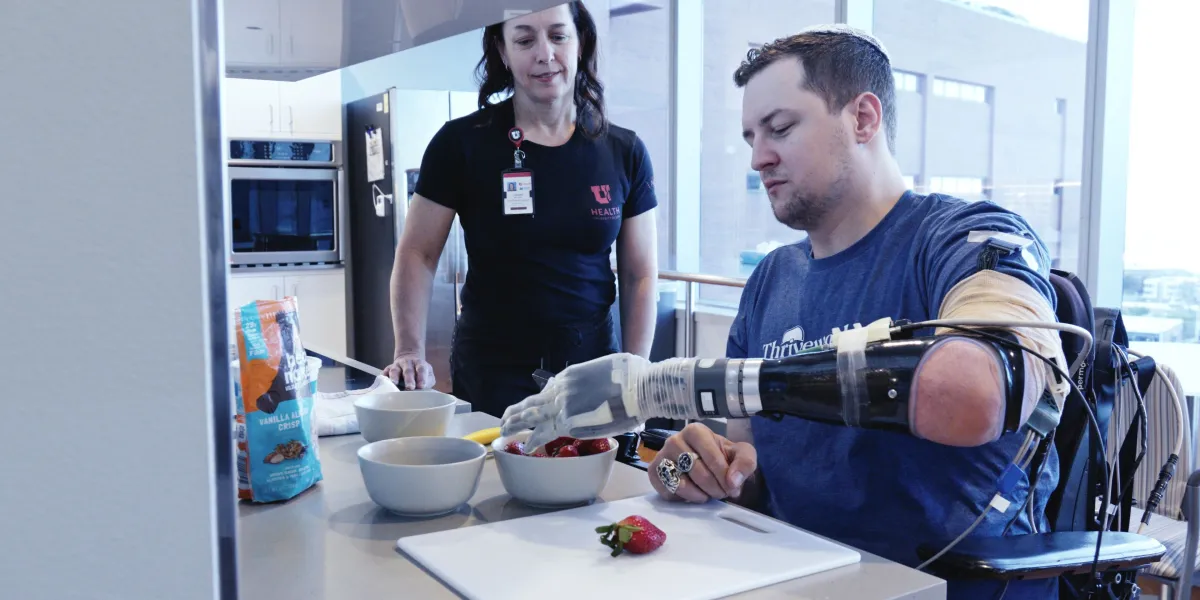
Alexander (Avi) Davidson is helping researchers at the University of Utah study a nerve-connected prosthetic arm that may allow users to feel sensations through an artificial limb. After a severe teenage injury left his left hand paralyzed, Davidson became a trauma therapist and has since volunteered to test the experimental technology in everyday life, offering researchers insight into how bionic limbs perform outside the laboratory.
A prosthetic arm connected to the nerves
Davidson is participating in clinical trials of a prosthetic arm connected directly to the nerves in his arm. Wires extend from his arm to connect with the system, allowing him to feel through the prosthesis.
He is the ninth person to try this technique, but the first to use it independently, including taking the device home and using it to drink from a cup. The tasks are challenging: drinking is not easy, and neither is writing, as shown in this example.
What stood out most about Davidson’s experience was his mindset—not only toward his injury and the process of learning to use cutting-edge technology, but also toward life more broadly.
Years of rehabilitation and training
In the 17 years since his accident, Davidson has learned to use seven different prosthetic legs. Taking part in this trial has required hundreds of hours of laboratory training and physical therapy alongside his demanding work.
He underwent surgery to have electrodes implanted in his arm and will eventually need another procedure to remove them. The current prosthetic technology also cannot be used for long periods indefinitely.
“It’s disappointing and it’s frustrating, but I don’t regret this accident,” he told me. “I’m not trying to profit from this. I wanted to be part of this effort from the standpoint of being able to help move the technology forward.”
Questions the trial may answer
The University of Utah research team hopes the trial will help answer long-standing questions about the technology. How does it work in the real world beyond the laboratory? What do people ultimately use it for? And where can the system be improved?
The trial may also reveal unexpected effects. Davidson noticed that when he overused the prosthetic wrist, it could become painful and stiff, much like a natural wrist. Stretching it eased the sensation, but researchers do not yet know why this happens.
Scientists also do not know whether using the bionic hand changes Davidson’s brain. Before the trial began, they performed brain scans to examine how his missing left hand was represented in his brain. The researchers will investigate whether that representation changes and what the findings could mean for people born without limbs. They also want to understand how bionic limbs affect the brains of those users.
What happens after the trial?
Davidson will likely keep the device for at least another year, until late January 2027. What happens after that remains uncertain. The outcome will depend on the progress of the research, how Davidson feels, and how much funding the team can secure. It is also unclear how long the device is expected to function inside a person’s body.
The research will continue to be followed as the team learns more about the technology and Davidson’s experience using it in daily life.
This article first appeared in The Checkup, MIT Technology Review’s weekly biotech newsletter. Get it in your inbox every Thursday and be the first to read more articles like this. Sign up here.
Source: www.technologyreview.com