


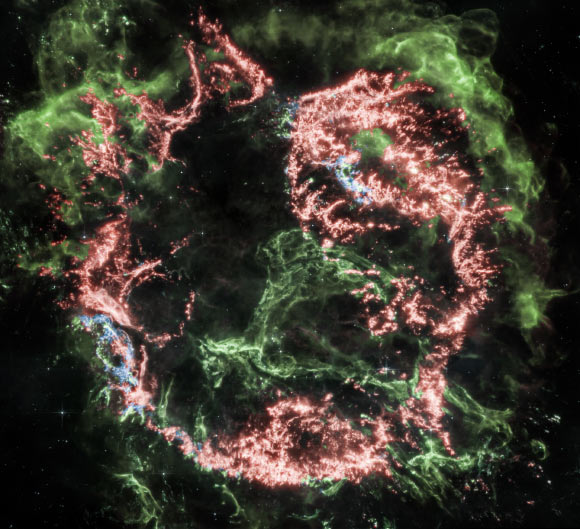
Astronomers using the Mid-Infrared Instrument (MIRI) aboard the NASA/ESA/CSA James Webb Space Telescope have isolated dust ejected from individual debris clumps in Cassiopeia A, the youngest known supernova remnant in the Milky Way. The observations reveal that different clumps are dominated by distinct types of dust, providing clues about the layers of the star that exploded and the processes that occurred shortly before its collapse.
A closer look at Cassiopeia A
Cassiopeia A, also known as Cas A, SNR G111.7-02.1, or NRAO 711, is located about 11,000 light-years away in the constellation Cassiopeia. The remnant is approximately 10 light-years across.
When its original star ran out of fuel, it collapsed under its own gravity and exploded as a supernova, possibly becoming one of the brightest objects in the sky for a short time. Astronomers believe the explosion occurred around 1680, although no verifiable historical records confirm it.
“Using Webb, we have significantly increased our ability to resolve individual clumps, allowing us to perform more sophisticated dust chemistry,” said Purdue University astronomer Dr. Dan Milisavljevic.
“As a result, we can link the explosion to the composition of the progenitor star hundreds of years in the future,” he said. “We think this tells the story of what was happening in the hours leading up to the core collapse.”
“Understanding this process is essential for explaining which elements supernova explosions release into galaxies and how those elements enrich future generations of stars and planets.”
Distinct dust compositions
In earlier Webb observations, the dust appeared to be mixed together because many regions were blurred. The telescope’s sharper view shows that individual clumps are instead dominated by only one or two types of particles.
Within an argon-rich clump, most of the dust is silicon dioxide, the main component of sand. A neon-rich, carbon-monoxide-rich clump consists mostly of amorphous carbon, or soot.
A third region inside the Green Monster is composed mainly of warm magnesium silicate. This material forms a structure of gases released by the star before it exploded, and its distribution supports the idea that it originated around the star rather than in the explosion itself.
The composition of the ejecta dust provides a view of the star’s interior. Silicon dioxide points to regions containing more silicon than magnesium, while carbon dust suggests that carbon remained after oxygen became trapped in carbon monoxide.
Clues to the star’s final stages
The researchers compared the observed conditions with computer models of exploding stars. Only models in which the star’s carbon-burning and oxygen-burning layers merged before the explosion produced both dust-rich regions at the same time.
“Our study demonstrates that the composition of spatially resolved dust can constrain the chemical structure and properties of nuclear decay explosions, with far-reaching implications for the interpretation of unresolved mid-infrared radiation from extragalactic supernovae,” the scientists concluded.
The study was published in Astrophysical Journal Letters.
Tea Temim and others. 2026. “JWST resolves dust emissions from individual ejecta clumps in Cassiopeia A: dominant grain compositions indicate ancestral shell coalescence.” Astrophysical Journal Letters 1012, L26. doi: 10.3847/2041-8213/aea901
Source: www.sci.news