


Key Highlights
Africa’s inaugural private satellite successfully launched into space.
Created by innovative high school girls.
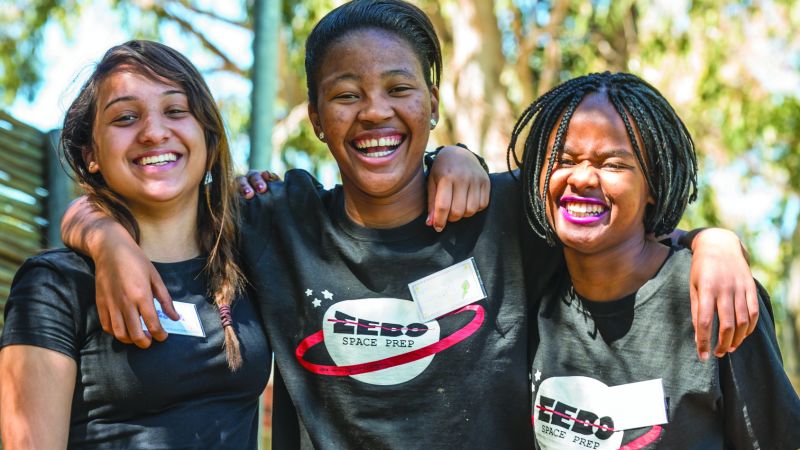
At just 17, Brittany Buru, along with 16-year-old Sesamu Mugenkiswa, is set to launch Africa’s first private satellite into space in 2019.
These bright students are part of a dynamic team from Cape Town, South Africa, who designed and constructed a payload for a satellite aimed at orbiting the Earth’s poles, gathering critical data about Africa’s surface.
Once operational, the satellite will gather vital information to address agricultural and food security concerns across the continent.
“With the data we collect, we can predict and combat future challenges facing Africa,” says Bull, a student from Pelican Park High School.
“We can track where our food grows, identify areas for further planting, and monitor remote regions,” Mngqengqiswa explains. “Frequent wildfires and floods require timely recovery efforts.”
The satellite’s data, transmitted twice daily, is crucial for disaster prevention strategies.
This initiative is part of a collaboration between South Africa’s Meta-Economic Development Organization (MEDO) and Morehead State University in the United States.

Africa’s Journey into Space
The initiative trains 14 aspiring female engineers at Cape Peninsula University of Technology, encouraging more African women to consider careers in STEM (Science, Technology, Engineering, Mathematics).
If successful, MEDO will mark its place as Africa’s first private entity to design, build, and launch an artificial satellite into orbit.
“We hope to establish a strong signal for consistent data transmission,” enthusiastically states Mngqengqiswa from Philippine High School. “South Africa faces severe floods and droughts that greatly affect our farmers.”

Drought and climate change continue to severely impact South Africa, particularly due to the El Niño phenomenon, which led to a significant drop in maize production—reported at 9.3 million tons in April 2016, according to a UN report.
“This situation has contributed to a downturn in our economy. We actively seek ways to revitalize it,” expresses Mngqengqiswa.

During preliminary trials, the team utilized a high-altitude balloon to test and launch a small CricketSat satellite and aided in configuring the satellite’s payload.
Small satellites are a cost-effective solution for swiftly gathering Earth data. Prior iterations focused on thermal imaging data to foresee signs of floods and droughts.
“This is an emerging field for us in Africa, but I believe it can drive positive economic changes,” Mngqengqiswa stated.
Plans are in motion to extend this initiative to aspiring girls from Namibia, Malawi, Kenya, and Rwanda.
Mngqengqiswa, who hails from a single-parent household, aims to make her mother proud by aspiring to become an astronaut.
“Exploring space and observing our planet’s atmosphere are opportunities rarely afforded to black Africans,” Mngqengqiswa expresses.
In the history of space exploration spanning half a century, no black African has yet traveled to space. “I aspire to witness these extraordinary phenomena firsthand,” Mngqengqiswa shares.
Her teammate, Bull, echoes her sentiments: “I want to prove to girls that limitations are self-imposed. All careers, including aerospace, are within reach.”
This version enhances SEO by incorporating keywords while maintaining the context and original structure of the HTML content.
Source: www.cnn.com