


Meet the conservation team relocating endangered African wild dogs, building genetically diverse packs and helping the species recover across southern Africa
Marcus Westberg
Two white pickup trucks sit beside a highway crossing South Africa’s Waterberg municipality, about three hours from Johannesburg. Walk past them and you may hear an unexpected sound: panting. Through small openings in the tops of three green wooden crates, mottled fur rises and falls over narrow rib cages.
Inside are three sleeping female African wild dogs—sisters that have traveled hundreds of miles in recent weeks. That is not unusual for a species capable of covering as much as 30 miles in a day and ranging across territories of up to 1,000 square miles. The dogs arrived by plane from Karingani Game Reserve in Mozambique as part of the Endangered Wildlife Trust’s African wild dog range expansion program.
Launched in 1997, the program has helped increase the global wild dog population by more than 344 animals over 29 years. It relocates African wild dogs to protected areas where they disappeared decades ago. In Mozambique, for example, the species vanished during the civil war that lasted from 1977 to 1992. Mozambican packs have since reproduced so successfully that conservationists are now moving young dogs to South Africa, where they can establish new, genetically diverse packs.
The three sisters have been given sedatives—a risky but necessary part of transporting them to their temporary home. For the next several weeks, they will stay in a state-of-the-art enclosure, or boma, designed specifically for African wild dogs. Eventually, each dog will be released into the wild wearing a tracking collar.
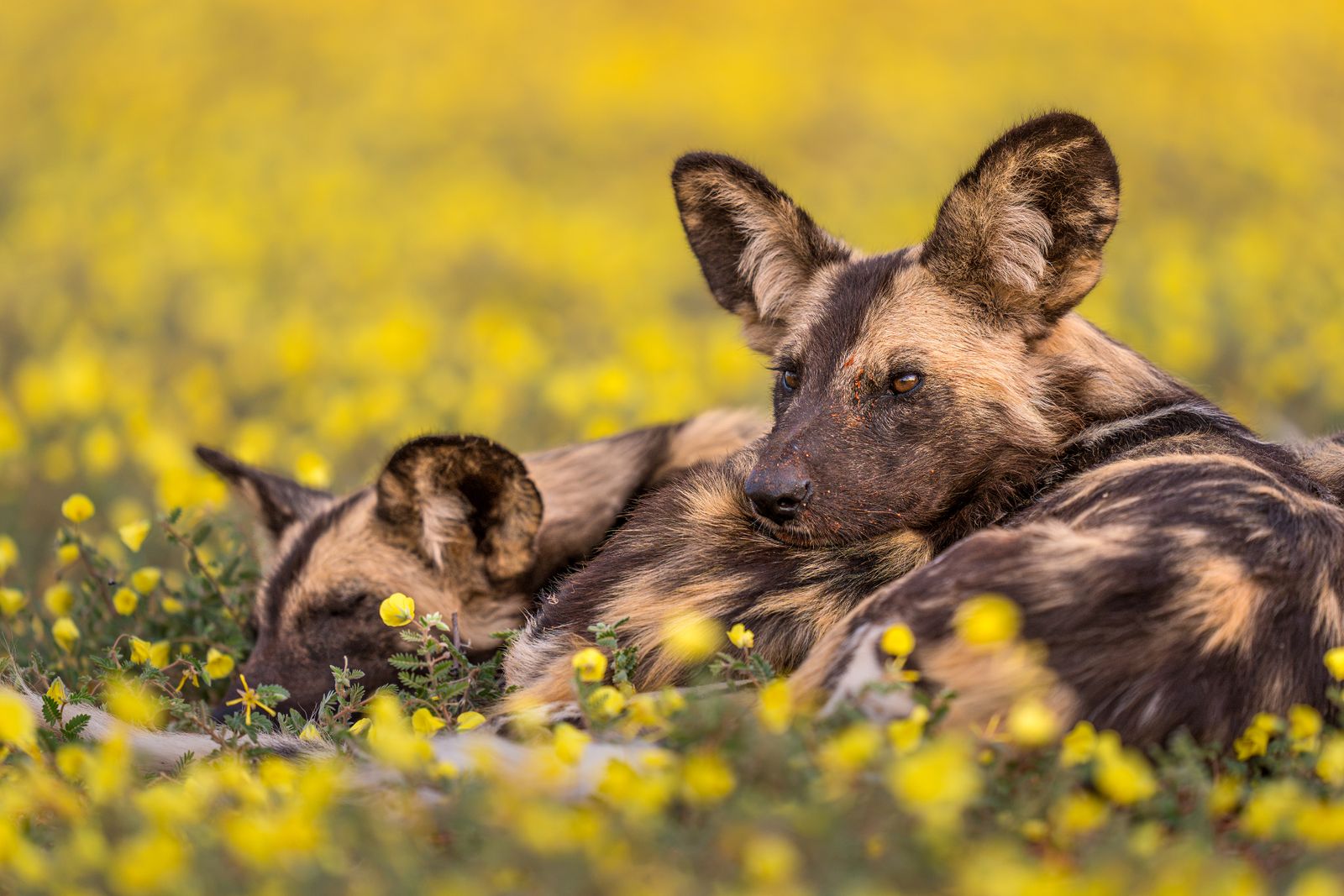
The sisters represent a small but important part of the estimated 6,600 African wild dogs remaining worldwide. According to the World Wildlife Fund, African wild dogs are among the planet’s most endangered carnivores. Also called painted dogs or Cape hunting dogs, they look like lanky mongrels assembled from a collection of safari animals: oversized, round ears; large paws; slender legs; and fluffy white tails.
Every African wild dog has a distinct coat pattern made up of black, gold and white patches. Their markings are as individual as fingerprints, with a colorful appearance that resembles Abstract Impressionist art more than the familiar patterns of zebras, snakes or leopards.
/https://tf-cmsv2-smithsonianmag-media.s3.amazonaws.com/filer_public/9c/f3/9cf35056-d825-45ea-9b12-136e581402e6/20240318-mw308144.jpg)
Marcus Westberg
/https://tf-cmsv2-smithsonianmag-media.s3.amazonaws.com/filer_public/c4/1f/c41f7754-a07d-40ab-a507-6c5de9465c92/20240318-mw308221.jpg)
Marcus Westberg
African wild dogs are among Africa’s most effective predators, successfully killing prey in roughly 80 percent of hunts. Lions, by comparison, succeed in about 30 percent of their attempts. But this hunting ability has also made wild dogs unpopular with some landowners. Private game reserves may kill them to protect valuable game animals, while subsistence farmers often view them as a threat to livestock.
A 2021 study published in Ecology and Evolution found that human-related causes—including deliberate killing and diseases transmitted by domestic dogs—accounted for 44 percent of wild dog deaths at study sites in Kenya, Botswana and Zimbabwe over a 15-year period.
Habitat fragmentation creates another serious challenge. When protected areas are not connected, wild dogs may be unable to travel far enough to find unrelated mates. Without conservation intervention, isolated populations can lose genetic diversity and struggle to reproduce.
Yet there is much to admire about these highly social carnivores. Ask an African wild dog researcher what makes the species special, and playfulness is likely to be high on the list. Briana Abrahms, who studies wild dogs in Botswana, has watched pups toss balls of elephant dung back and forth like a game of football.
Neil Jordan, a biologist at Australia’s University of New South Wales, discovered that African wild dogs may also use a form of group decision-making. Before a hunt, pack members hold energetic gatherings known as rallies. At dusk, one or two dogs rise from the shade, pull back their ears and imitate stalking prey. They bark, chatter, urinate, twist their tongues and play with one another.
“And then they kind of snowball socially, so then more get involved, and more get involved. It’s like a big merry-go-round, and they’re all running around crazy,” Jordan says. The dogs may repeat the performance several times before finally departing. They typically leave only after producing rapid nasal exhalations that sound like sneezes.
Researchers are still unsure whether the sneezing directly signals the pack’s decision to move or simply occurs at the same time as another form of communication. African wild dogs are also unusually cooperative. Pups eat first, and when a pack member is injured, ill or too pregnant to hunt, another dog may regurgitate food for it. In a wild dog pack, survival depends on caring for one another.
While the three sisters sleep in the trucks, I sit in a nearby hut with Eugene Greyling, an Endangered Wildlife Trust field officer involved in their transport. We are at the entrance to the Welgevonden Game Reserve, home to the enclosure where the dogs will spend their first weeks in South Africa.
South Africa’s African wild dogs are distributed among four main populations. One is held in private zoos. Another lives in Kruger National Park, the only location in the country with enough wild dogs to maintain genetic stability without outside assistance. A third population ranges freely across a patchwork of public and private land in the Waterberg.
The fourth is known as a “metapopulation.” These dogs are managed across several reserves, including Welgevonden and the Tswalu Kalahari Reserve, South Africa’s largest privately owned nature reserve. The Endangered Wildlife Trust works with these reserves to establish new packs, maintain genetic diversity and expand African wild dog habitat.
Did you know? Where do African wild dogs fit in the canine family tree?
-
DNA evidence suggests that African wild dogs diverged from wolves, jackals and coyotes roughly 1.7 million years ago, making them one of the oldest branches of the dog family.
/https://tf-cmsv2-smithsonianmag-media.s3.amazonaws.com/filer_public/1b/d7/1bd7db72-3c3c-4131-8101-34b98c9b2109/20240318-dji_0053.jpg)
Marcus Westberg
/https://tf-cmsv2-smithsonianmag-media.s3.amazonaws.com/filer_public/d0/a7/d0a7d38b-81c5-4e5a-8c54-ef6bb08e6571/20240318-mw107418.jpg)
Marcus Westberg
/https://tf-cmsv2-smithsonianmag-media.s3.amazonaws.com/filer_public/06/69/0669c7d7-2040-4261-97ab-e3e44e7d587f/20240318-mw208855.jpg)
Marcus Westberg
African wild dog packs typically contain five to 20 individuals and have complex social hierarchies, Greyling explains. The alpha female and alpha male are generally the only breeding members. For the population to grow, young dogs must leave their birth packs and form new groups.
Sisters often disperse together in search of unrelated males, while brothers may travel in another direction. Conservationists monitor these movements closely, tracking both the dogs and their genetics. In fragmented landscapes, dispersing animals can become stranded without suitable mates.
The three sisters had encountered potential mates in Mozambique, but the males were too closely related. Moving the females to South Africa offered a chance to create a healthier, genetically diverse pack.
“We had to think hard about how to manage that, because technically the dogs had done everything right,” says Cole du Plessis, coordinator of the range-expansion project. “If you told people 20 years ago that we were going to be flying wild dogs under sedation to other countries—it’s just quite crazy.”

/https://tf-cmsv2-smithsonianmag-media.s3.amazonaws.com/filer_public/e0/7a/e07a7c04-615e-49ae-9161-6e7f8d26a33b/20240318-mw208884-2.jpg)
Marcus Westberg
At Welgevonden, Greyling and I are joined by Reilly Mooney, a biologist and director of the Waterberg Wild Dog Initiative. Mooney came to South Africa from Wisconsin to study primates. When the Covid-19 pandemic halted her usual research, she attended a community meeting about free-roaming dogs that had largely been left unmanaged.
The situation was tense. Local residents wanted someone who could connect communities with conservation organizations, and Mooney stepped into that role. Her first task was to determine how many wild dogs lived in the region. Their distinctive coats made individual identification possible.
“We can say with pretty good confidence that in this entire Waterberg area, there are only 27 wild dogs,” she says.
In the hut, Greyling receives a call from Joseph Hlako, his EWT colleague monitoring the sedated dogs. As the trust’s conflict mitigation officer, Hlako works at the intersection of wildlife conservation and local communities.
Hlako grew up in the region and has relatives who farm. He speaks Northern Sotho and several other South African languages, giving him valuable insight into how conservation programs can work with local residents.
Building trust is essential, he says. “A familiar face works better than any face.”
After Greyling leaves the hut, he returns with troubling news: One of the dogs appears to be overheating. He wants to move her to the enclosure immediately so she can be cooled. Mooney and I follow him across the highway, past cattle and dense bush, to the wild dog boma—a fenced area built from shipping containers and specialized equipment.
The enclosure may look simple, but every feature was designed for African wild dogs. A concrete barrier extends four feet underground because the animals are powerful and persistent diggers. Separate sections allow males and females to remain apart while becoming familiar through the fence.
Each section also contains a feeding post. Wild dogs usually eat while facing a person, making them difficult to tranquilize safely. By securing food to a post backed by a small wooden wall, handlers encourage the dogs to stand with their backs toward them. The animals naturally lift their hindquarters while eating, creating a safer position for a veterinary dart.
/https://tf-cmsv2-smithsonianmag-media.s3.amazonaws.com/filer_public/47/78/4778cec2-ef2d-4602-95b3-55a711ffe270/20240330-mw303435.jpg)
Marcus Westberg
/https://tf-cmsv2-smithsonianmag-media.s3.amazonaws.com/filer_public/d6/66/d6669b89-a4cd-436a-9887-536a83ee6a9f/20240320-mw209627.jpg)
Marcus Westberg
As we help Greyling and Hlako remove a crate from the pickup, a dusty paw slips through one corner. The temperature is still close to 90 degrees Fahrenheit, even though afternoon is fading. Mooney and I watch from inside a shipping container as Hlako moves the truck into the shade.
One by one, the conservation workers open the crates and wait for the dogs to emerge. The first sister walks unsteadily. The second appears more alert, although Mooney points out that she would normally sprint away from people and the crate.
The sisters stand together in the grass, lift their noses and rotate their large, satellite-dish ears. Then they settle beneath a thorn tree. The long journey, capture and relocation have taken their toll.
As sunset approaches, I prepare to leave before the reserve gates close. The overheating dog lies beside a water source but does not stand. She is breathing with her mouth open, and Greyling tries to reassure us that she will recover. His voice, however, reveals his concern.
Later, Greyling tells me that the dog has died. It is the first such loss he has experienced while overseeing a relocation. Du Plessis says the cause was capture myopathy, sometimes called “broken-heart syndrome,” a potentially fatal condition brought on by extreme physical and psychological stress.
The dog had endured hours of attempts to dart her in hot weather. Other contributing factors may have included an underlying medical problem or the presence of predators such as hyenas before the move. Du Plessis focuses on the factors conservationists can improve.
“I would never accept the loss of a dog as fine,” he says. But if one of the surviving sisters produces puppies and contributes 20 to 30 dogs to the population during her lifetime, “then it makes it seem a little bit better.”
A year later, du Plessis updates me on the two surviving sisters. After two months in the Welgevonden boma, he moved them to Rietspruit, a small private reserve connected to Kruger National Park.
Du Plessis knew of an unrelated male living about nine hours away in KwaZulu-Natal Province. He tranquilized the male and transported him to Rietspruit, where the bonding process went smoothly.
“We had this new pack of three,” he says. “They were hunting successfully. Everything was really good. And then in October last year, that male was killed by a lion on the reserve.”
Several months later, du Plessis learned of two brothers that had dispersed from another pack in search of mates. He brought them to the boma and waited for the sisters to arrive. A few days later, the collared females appeared near one of the reserve’s lodges.
Du Plessis attached two hay bundles carrying the males’ scent to the back of his vehicle. He then made “hoo-calls,” imitating the sounds African wild dogs use to locate one another. The females emerged and followed the vehicle.
“We were at one point going 60 kilometers an hour [about 37 miles per hour] while these females were keeping up, trying to get to this ball of grass,” he says. “It was one of the coolest things I’ve done in my wild dog career.”
Relocating African wild dogs is only one part of successful conservation. Their range must continue to expand, and education and conflict-reduction efforts must involve surrounding communities. Over the past three decades, the amount of land protected for wild dogs has increased by 1.5 million hectares, and the number of packs has grown by 30.
“The genetic diversity within those packs is very good,” du Plessis says. “If we can keep this strong and working, and other organizations are doing their restoration efforts and community conservation efforts, it’s creating the space where we’re ready to jump when the time is right.”
/https://tf-cmsv2-smithsonianmag-media.s3.amazonaws.com/filer_public/c4/45/c445d2f0-20be-4dd8-9f59-024d96928984/20240318-dji_0090.jpg)
Marcus Westberg
/https://tf-cmsv2-smithsonianmag-media.s3.amazonaws.com/filer_public/cf/5f/cf5ff866-bca7-4c65-9691-28456316c697/20240320-mw209604.jpg)
Marcus Westberg
Not far from the enclosure, du Plessis drops the scented hay and drives away, trusting the females to follow it to the males. They do. At the fence, the dogs immediately begin interacting—ducking beneath one another and dipping their heads in characteristic courtship behavior.
Du Plessis decides to release the males. Instead, the females rush into the boma, and all four dogs refuse to leave. He allows them to remain together in the enclosure for three weeks while they become familiar with one another.
By the time du Plessis and I speak, the females have entered estrus and the males are guarding their potential mates. If all goes well, puppies may arrive within a few months.
One of the sisters does become pregnant. The four dogs build a den, behavior that usually occurs only a day or so before a female gives birth. But tragedy strikes again. A leopard kills the pregnant female, and her puppies die because they are too young to survive without her milk.
The remaining three dogs flee the park. The two brothers are later killed in a snare line, while the surviving sister eventually joins another pack.
I ask du Plessis how he continues working despite so many setbacks. “To me it’s about population trend,” he says. “Even if half of them make it, the point is the trend is growing.”
In 2025, African wild dog conservation projects supported by the organization in South Africa, Mozambique and Malawi recorded 150 puppies. With an estimated 700 breeding pairs and just 6,600 wild dogs remaining in the wild, du Plessis considers that number significant.
“You have ebbs and flows, but at the end of each year, if you’re either stable or increasing, for an endangered species, you’re doing pretty well,” he says.
Source: www.smithsonianmag.com