


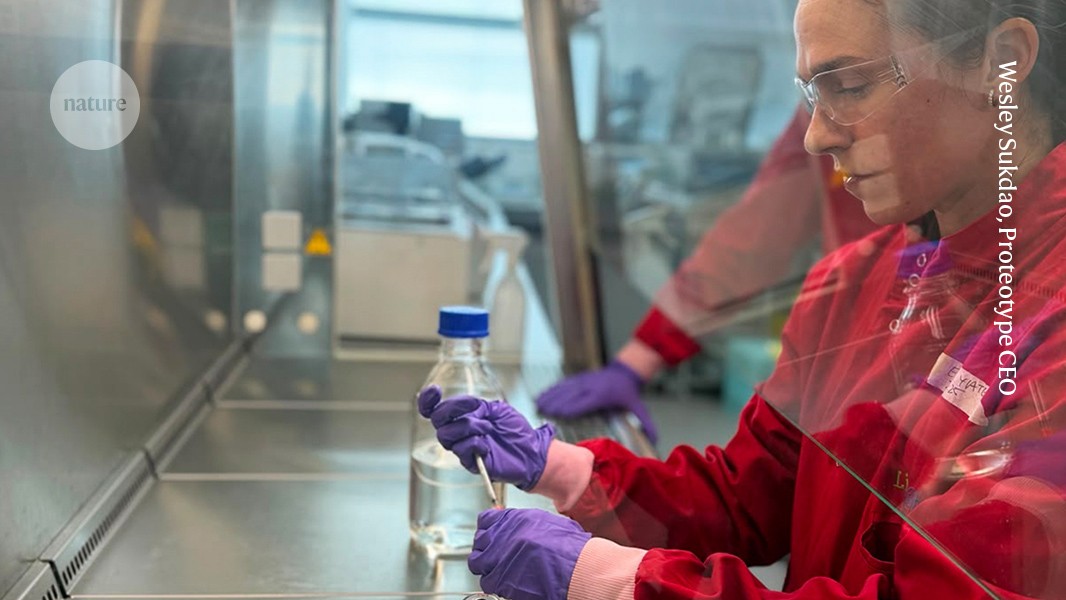
Emma Yates, chief scientific officer at Proteotype Diagnostics, wants more funding and support for founders taking parental leave.
Credit: Proteotype CEO, Wesley Sukdao
A report from the Organization for Economic Co-operation and Development (OECD) estimates that around 25 million women across the world’s developed economies are denied the opportunity to start and grow businesses.1 Women who do launch companies are also often less ambitious in their growth plans than male founders, the report found.
According to Bridging the Economic Gap for Women Entrepreneurs, the gender gap in startup funding is particularly severe in science, technology, engineering and mathematics (STEM). Examining research published from 2013 onwards, with a focus on recent evidence, the OECD report found that companies founded by women receive only around 2% of global venture-capital investment.
Female entrepreneurs are approximately 63% less likely than men to secure venture-capital funding and, on average, receive just 70% of the amount awarded to male entrepreneurs. The report warns that these barriers can also discourage women from seeking loans or investment. One estimate suggests that if women had started and expanded businesses at the same rate as men, the UK’s gross domestic product could have been 12% larger in 2017.

How I honed my biopharma trading and business development skills after completing my Ph.D.
A second report on venture-capital allocation paints a similar picture. Of the $289 billion invested globally in 2024, just 2.3% went to all-female founding teams, while 83.6% went to all-male teams. Mixed-gender founding teams received 14.1% of the total.
The report, published by the London-based entrepreneurial support community Founders Forum Group, also found that women are more than twice as likely as men to be asked risk-focused questions when raising capital. During pitch presentations, women are interrupted nearly five times more often than men. Female founders take an average of 7.4 months to raise funding, compared with 5.2 months for male founders.
These findings will resonate with many women in science entrepreneurship and with those who support them. Four women spoke to Nature about navigating funding and building science-based businesses in an ecosystem that can often feel hostile.
Overcoming self-doubt as a female founder
“Most of our conversations with investors have been constructive and professional,” says Emma Yates, chief scientific officer at Proteotype Diagnostics in Cambridge, UK. She co-founded the company in 2019 with her husband, who is its chief executive and chair.
“There were several moments when I felt assumptions were being made that a male founder might not have faced,” Yates says. “Some investors were also uncomfortable with the husband-and-wife founding team.”
Proteotype Diagnostics is developing affordable early cancer-detection methods based on the body’s immune response. The company has raised approximately $6.89 million in private investment and grants. Its test is currently undergoing clinical trials, with final results expected at the end of the year. Yates expects the company to begin seeking Series A funding — its first substantial round of venture capital — after the results are available.
Yates believes that female founders can sometimes become their own worst critics, delaying fundraising until they have extensive evidence to support an idea.
“In science, we are trained to be cautious and let the evidence speak for itself,” she says. “In fundraising, you also need to communicate the scale of the opportunity before you remove every uncertainty. That was a learning curve for me.”
Ultimately, Yates says, “The bigger question now is whether female founders can enjoy the same benefits of questioning and access to growth capital.”
Career advice from industry scientists
In 2025, Yates won a £75,000 (US$101,000) Women and Innovation Award from Innovate UK, the country’s national innovation agency. She used the funding to complete manufacturing validation for Proteotype’s diagnostic kit.
Other programmes provided valuable business-development support. “The most helpful support was very specific,” Yates says. It helped the team plan clinical studies, build its technical evidence base, communicate with investors, develop its commercial strategy and coordinate these activities with the science.
Yates welcomed her first child in 2022. “Typically, at that point you want job security and enough maternity leave for a year,” she says of standard parental-leave arrangements in the UK. At the time, Proteotype remained heavily dependent on its founding team.
“Within five weeks, we were able to do video calls,” she says. “Especially for founders of science-based companies, the choice is often not a clear binary between taking complete time off and returning fully to work.”
Yates wants innovation grants and founder-support programmes to provide temporary operational cover and childcare during parental leave.
“For early-stage science companies, this type of support can make the difference between maintaining momentum and founders feeling they have to return before they are ready,” she says.
The transition from academic research to company leadership has been transformative for Yates. “I’m a different person from when I started,” she says. “I know how to lead teams, collaborate with investors and clinical stakeholders, and make decisions under uncertainty — all skills that science-based entrepreneurship requires.”
Funding, motherhood and the pressure of perfectionism
Henriette Maaß, co-founder and chief executive of NanoStruct in Würzburg, Germany, says the company’s formation was supported by a relocation grant from the German Federal Ministry of Economic Affairs and Energy.
NanoStruct uses gold nanostructures to detect small amounts of contaminants, including bacteria, in the food industry. The grant enabled Maaß to leave her project-management role at a semiconductor company in 2021 and return to Julius Maximilian University of Würzburg, where she had earned a PhD in physics two years earlier. There, she teamed up with former colleague Enno Schatz, now NanoStruct’s chief technology officer, to develop the idea that led to the company’s launch.
Additional grants, including a €75,000 (US$86,000) award from the European Union’s Women TechEU programme, helped NanoStruct continue operating. The initiative supports startups founded or co-founded by women who hold senior management positions and own at least 25% of the company. NanoStruct now employs 10 people and is seeking investment to bring its product to market.

Henriette Maaß, co-founder and CEO of NanoStruct, used government and European Union funding to start and sustain the company.
Credit: Enno Schatz
Maaß was pregnant when she began seeking seed funding for NanoStruct in 2025. She was concerned about how potential investors and colleagues might respond, but wanted to remain the company’s chief executive.
“I was actually a little apprehensive about this, but I wanted to stay as CEO of the company,” she says. She eventually began to see a positive side: being open about motherhood could help her identify investors who supported a CEO who was also a new parent.
Maaß often attends meetings with her baby. “There is no one-size-fits-all advice,” she says. “Find your own way to do both roles. Don’t expect yourself to be perfect.”
Moving from academic research to business leadership
For Kitiya Vongkamjian, chief executive of Unique Phage-Based Solutions (UniFAHS), the key challenge was making a rapid transition from academia to business leadership.
In 2020, Vongkamjian co-founded the Bangkok-based biotechnology company with Charita Wongpukdee, now the company’s chief marketing officer. UniFAHS uses phage technology to target major foodborne pathogens.
“We have to go from researchers to founders, and the ecosystem is very different in the two sectors,” Vongkamjian says. She believes that making the transition requires courage from researchers.
Vongkamjian received a Leadership in Innovation Fellowship from the Royal Academy of Engineering, which included a two-week entrepreneurship course. At the end of the programme, participants presented their innovations to a judging panel.
“It taught me all the skills needed to move from research to commercialization,” Vongkamjian says. The fellowship also provided mentoring during the first two years of the spin-off’s development. Additional funding came from her “three Fs” — friends, family and fools — along with commercialization support from the startup incubator at Prince of Songkla University’s Southern Regional Science Park in Hat Yai, Thailand.
Vongkamjian held an academic position at the university from 2012 to 2020. Her current institution, Kasetsart University in Bangkok, has also supported her work.

Meet the founder of a biotech company inspired by a child’s rare disease
In Asia, venture-capital funding is often “out of reach” for women, Vongkamjian says. That may help explain why UniFAHS did not progress as quickly as some companies founded by men.
“People want to know if you’re really a businessperson or if you’re really just a researcher,” she says.
Vongkamjian has also noticed that women often talk less publicly about their achievements. She is reluctant to post about her company’s milestones, but says: “When you go on LinkedIn and compare female founders with male founders, you see more posts from men.” In 2025, a group of women posted under a male alias and reported that women’s LinkedIn posts tend to receive less traffic than men’s.
In 2024, UniFAHS completed a $1.4 million funding round to expand into markets across Southeast Asia and South Asia. Some of the investment came from ADB Ventures, a fund known for supporting women entrepreneurs.
The company now employs 20 people. Vongkamjian has retained her food-microbiology laboratory at Kasetsart University, where she continues research that will benefit UniFAHS. She expects the company’s research and development to move entirely into its own laboratories as it grows.
Source: www.nature.com