


China’s AI Talent Is Staying Home as the Gap With the US Narrows
As computer scientist Lu Yi neared graduation from a top Chinese university earlier this year, he faced a difficult choice: should he move to the United States for a PhD in artificial intelligence, as many high-achieving Chinese students have done, or stay in China?
The United States pays AI scientists high salaries, has access to the world’s best hardware and is home to some of the most advanced AI laboratories. But “the chasm is getting closer and closer,” Lu says. He changed his name because he was concerned about speaking publicly about what he considered a sensitive issue.
China’s AI research sector is advancing rapidly. Chinese universities are producing more AI researchers than US universities, and graduates are increasingly choosing to remain in China or return after spending time in the United States. China-based researchers now dominate global AI publications, while companies such as DeepSeek and Moonshot AI are developing models with capabilities that are not far behind those of US rivals, but at a fraction of the cost.
At the same time, stricter visa regulations have made the United States a less attractive destination for foreign researchers. Lu has seen friends’ visa requests rejected or delayed. “That’s worrying,” he says. In the end, he decided to remain in China.
China’s AI ecosystem differs from California’s Silicon Valley in several ways. The boundaries between academia and industry are more blurred in China, while access to computing resources is much more limited. This creates both opportunities and challenges. Chinese companies have been accused of copying US advances in a catch-up race, but they are also developing technologies that make AI models more efficient.
“Some people definitely think the United States is still the best place in the world to build a life and do this research, but there are more people who have doubts about that,” says Scott Singer, co-director of the China AI Initiative at the Carnegie Endowment for International Peace in Washington, D.C.
The astonishing development of Chinese science and how it will change the world
China is producing more AI talent than any other country
China is training more AI talent than any other country, according to Digital Science, a company operated by Holtzbrinck Publishing Group, which publishes Nature and Springer Nature. The data, updated from a study published by the company last year,1 shows that many Chinese AI researchers are at the early stages of their careers. China has fewer older AI research stars than the United States (see “Active AI researchers”).

Source: Digital Science
To examine the origins and locations of elite researchers, analysts have studied the authors of papers presented at the prestigious NeurIPS conference. A study published in September by Carnegie China, a Singapore-based research centre affiliated with the Carnegie Endowment, found that 57% of authors at the 2025 conference earned their bachelor’s degrees in China, up from 46% three years earlier.
The United States still attracts researchers for graduate-level study, retaining about one-fifth of Chinese undergraduates, according to the study (see go.nature.com/4yfsl4v). But the country’s appeal appears to be waning.
Among researchers with bachelor’s degrees from China who publish at NeurIPS, 69% were still based in China in 2025, up from 57% in 2022. China’s ability to retain domestic AI talent is higher than Europe’s, at 60%, but lower than the United States’, at 89% (see “Career paths for AI talent”).

Source: Carnegie China
Another indicator of the shift is the number of Chinese students studying in the United States. Some 63,000 Chinese students at all levels studied mathematics and computer science there in 2024–2025, a 20% decrease from five years earlier.
Grace Hsiao, an independent AI and technology analyst based in Hong Kong, says the decline is partly linked to geopolitical tensions between the United States and China spilling over into research. Many Chinese people now feel “less comfortable and more hostile” in the United States, she says.
All the Chinese students interviewed by Nature cited visa issues as their main concern when travelling to the United States. Visas are increasingly delayed, and the US government is seeking to limit how long they remain valid, a policy that is being challenged in court. New visa rules could affect re-entry even for existing students, leaving some Chinese citizens based in the United States too worried to visit their home countries.
Are US-based AI researchers moving to China?
The data is less clear on whether AI researchers already in the United States are moving to China. Media reports often focus on high-profile returnees, such as Moonshot founder Yang Zilin, who earned a doctorate from Carnegie Mellon University in Pittsburgh, Pennsylvania, in 2019 and founded a Beijing-based company in 2023. But the wider picture is more nuanced.
A Carnegie Endowment study suggests that the United States can still retain prominent AI researchers (see go.nature.com/3vxhdic). Among a sample of NeurIPS authors, 87% of Chinese-born researchers who were in the United States in 2019 remained there in 2025.
However, a Digital Science survey that tracked changes in the affiliations of all actively publishing AI researchers suggests that the overall direction of travel is for the United States to lose talent to China.
Will China’s latest AI models finally be on par with their US rivals? What scientists think
Research-paper data also shows China gaining ground. An analysis of academic papers related to AI found that China has surpassed the United States in publication volume and growing influence. The Digital Science study found that China dominates AI-related academic output and patents by volume and citations.
Major universities and AI companies are distributed across China, with hubs in Beijing, Shanghai, Hangzhou and Shenzhen. The study found that 156 research institutions each publish more than 50 AI papers a year.
Research quality is improving, too. For the first time in 2025, the NeurIPS conference had more lead authors based in China than in the United States or Europe, according to an analysis by The Economist (see go.nature.com/4i1ka6e).
Other statistics, however, tell a different story. The United States produces more impactful patents and more notable AI models than China, according to the Stanford AI Index 2026.2 Chinese companies are also more likely than US start-ups to publish scientific papers, according to a preprint published in July. Publication data could therefore present a biased picture of AI advances.3
Chinese academics also report facing intense pressure to publish in order to advance their careers.
Fundamentally, the United States still produces the world’s most advanced AI systems. OpenAI and Anthropic, both based in San Francisco, California, are at the top of the leaderboard for system capabilities. “China is probably three to seven months behind the US model frontier,” Singer says.
‘Robot Olympics’ reveals rapid progress and flaws in humanoids
China’s AI strategy focuses on efficiency
One reason for the gap is that China has far fewer of the computing chips needed to train and operate cutting-edge AI models. Since 2022, the United States has restricted exports of powerful graphics processing units, or GPUs, to China because of national-security concerns.
Chinese companies are developing their own high-performance chips, but none yet rivals those used by US companies. China is also generally less cash-rich. Private AI investment in the United States is expected to be more than 23 times higher than in China in 2025, according to a Stanford University report. Hsiao says this lack of resources is the main bottleneck for Chinese companies.
Limited access to computing power and funding is shaping research strategies. Chinese companies, for example, are devoting fewer resources to a process known as recursive self-improvement, Lu says. This involves using AI to create a better model, but success is not guaranteed and the process consumes GPU time. Hsiao says US companies have more freedom and funding to pursue speculative research directions.
At the same time, computing constraints are forcing Chinese researchers to “come up with more computationally efficient algorithms and training methods,” says Zilan Qian, who studies Chinese AI development at the London-based nonprofit GovAI.
Hangzhou-based DeepSeek, for example, has developed its own “sparse attention” mechanism. This reduces the amount of computation required to train or use a model by identifying the most important tokens and performing calculations only on them.

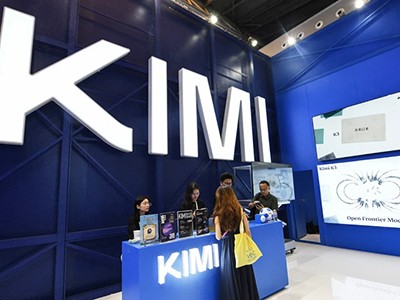
Visitors fill the Moonshot AI stand at the World Congress on Artificial Intelligence in Shanghai in July 2026.Credit: Hector Retamal/AFP via Getty
Another widely debated issue is the extent to which Chinese companies are catching up with US models through a process known as distillation. This involves training a model using the output of a “teacher” AI to achieve a similar level of capability. In a more sophisticated approach that avoids direct emulation, a teacher model scores and helps improve the responses of a smaller model.
In September, the US government said that distillation formed the “core” of development by Chinese AI companies. Although no company has publicly acknowledged using the practice, “the understanding in the industry is that there is definitely distillation going on,” Hsiao says.
In August, however, Zhang Yiming, founder of Beijing-based technology company ByteDance, which develops the Doubao chatbot, publicly condemned the practice. He instructed staff to avoid distillation in favour of pursuing “long-term goals.”
Source: www.nature.com