


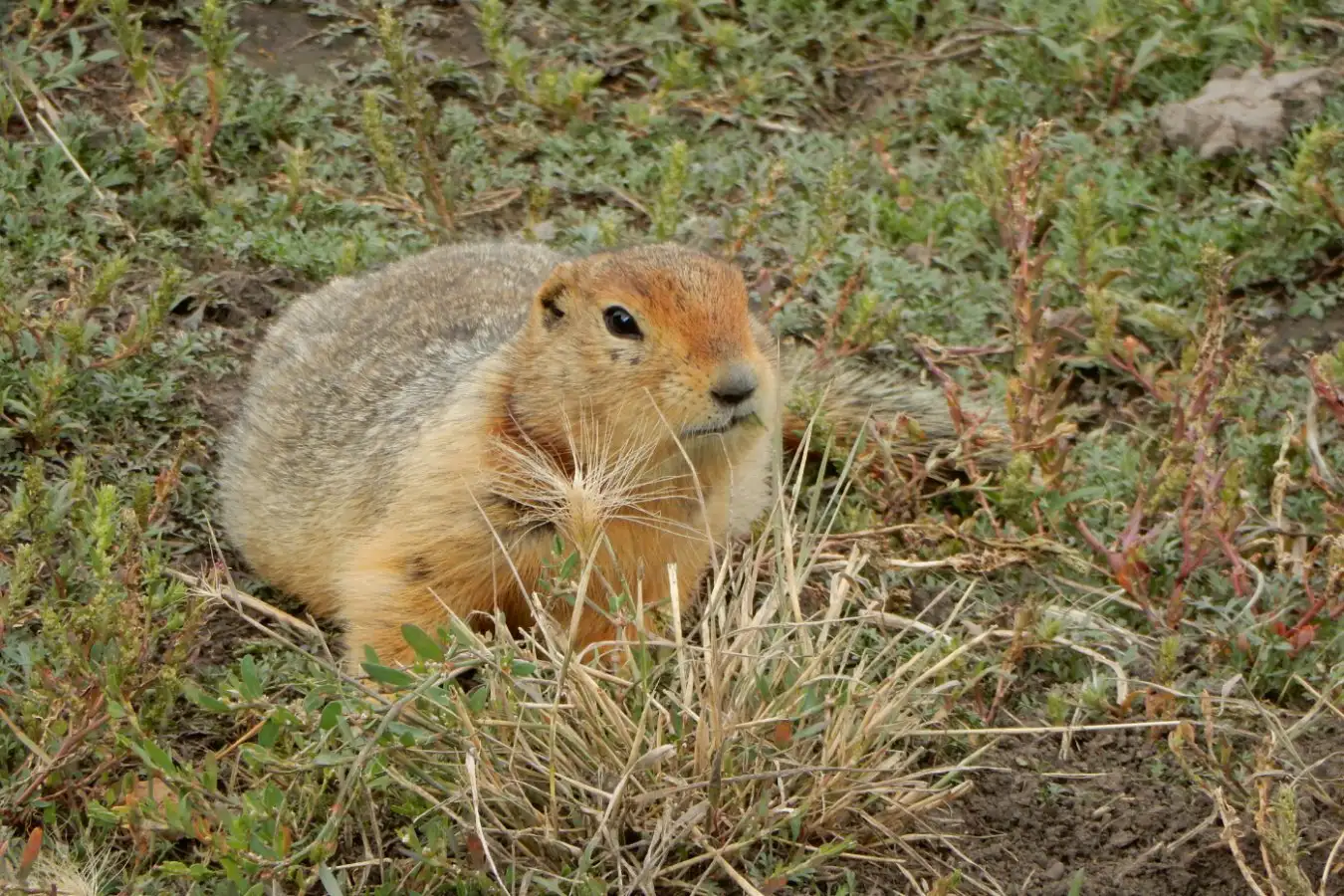
Arctic ground squirrels gather food from various sources to store in their burrows.
Yukon Government
Recent discoveries from DNA samples preserved in frozen feces have unveiled an intricate ecosystem that thrived 700,000 years ago, featuring species such as woolly mammoths, bison, horses, and large felines.
The Arctic ground squirrel (Urositels parii) is a 40-centimeter-long rodent native to the frigid regions of North America and Siberia, once connected through land bridges in a vast area known as Beringia.
“Squirrels hibernate for about eight months each year. During their four months of activity, they must forage extensively and stockpile resources in their burrows,” explains Tyler Murchy from the Hakai Institute in Campbell River, Canada.
This behavior results in burrows filled with significant stores of feces and food, effectively making them “nature’s archivist,” Murchy adds. To explore this archive, he and his team analyzed preserved feces, referred to as saprolites, from 13 Arctic ground squirrel burrows in central Yukon.
These burrows are estimated to be between 30,000 to 700,000 years old. The research team extracted DNA from various organisms found in feces measuring approximately 1 to 2 centimeters long.
The findings included microorganisms, over 200 plant species, insects, and a range of animals like woolly mammoths, horses, gray wolves, steppe bison, and lynx. One notable species was the American cheetah or possibly a cougar. “This diverse array represents the life that existed in the Bering Ice Age ecosystem,” Murchy states.
You might assume that ground squirrels primarily consume nuts and seeds, but this is a misconception. “They are highly omnivorous, likened to small bears. Reports exist of ground squirrels feeding on moose and lynx carcasses. Therefore, the presence of these larger animals in coprolites is not surprising,” he asserts.

Ancient fecal pellets left by Arctic ground squirrels discovered in Canada’s Yukon Territory
Duane Froese, University of Alberta
Murchie and his team successfully reconstructed the mitochondrial genomes of various ancient animals using the DNA retrieved from these samples. This included 12 ground squirrels (with one lineage tracing back 700,000 years), three horses, two bison, and even a hare. Remarkably, they also collected enough DNA to piece together the genomes of six woolly mammoths, with further details to be published soon.
“These excellently preserved samples reveal the ecological diversity of Yukon over millennia,” states Kelsey Witt from Clemson University in South Carolina.
Determining whether the DNA of any given species found in coprolites originated from consumption by ground squirrels or from environmental leaching remains challenging. However, given the abundance of DNA in the samples and the scavenging behavior of ground squirrels, it’s plausible that these rodents may have consumed mammoth meat, she notes.
Topics:
Source: www.newscientist.com