


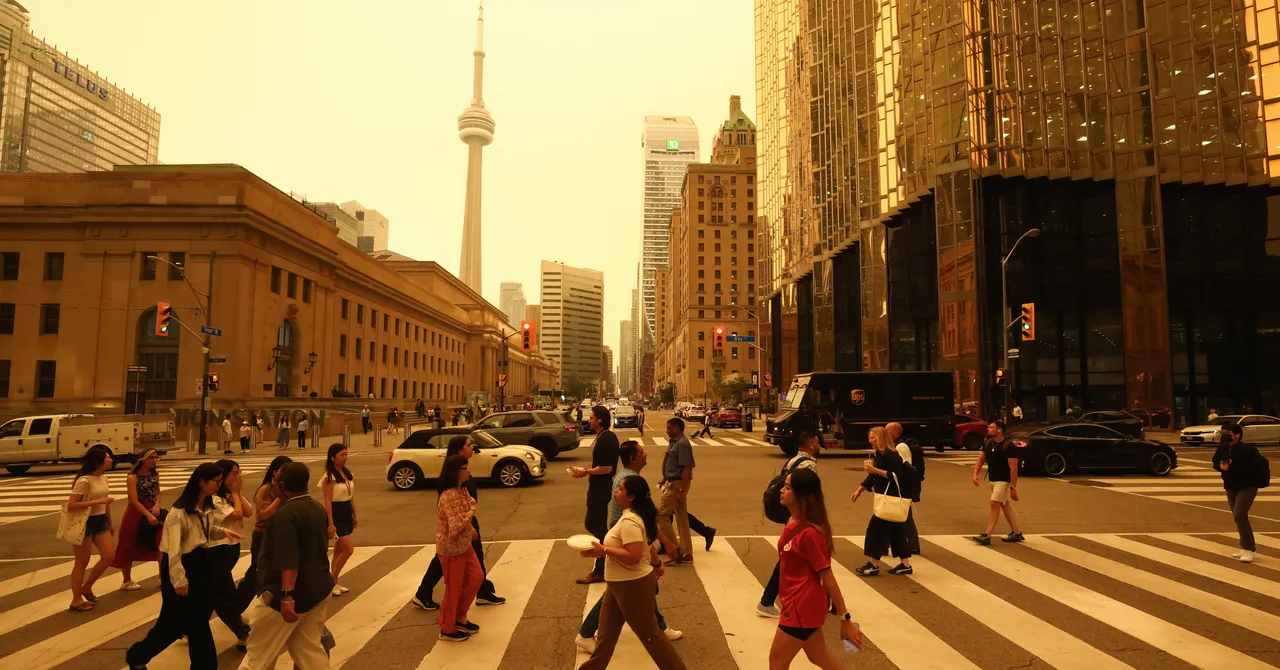
Smoke from Destructive Fires Wildfires in Canada have wreaked havoc across vast areas of the Midwest and Northeast this week, prompting numerous cities in the region to issue urgent air quality warnings.
Given the extreme smoke conditions, even healthy adults should take necessary precautions to safeguard their health. The rising intensity of wildfires across North America, partially driven by climate change, indicates that areas distant from wildfires will also experience adverse effects.
As of Wednesday, over 100 fires were raging uncontrollably across Canada, with hundreds more being monitored and extinguished. Smoke has drifted south and east, casting hazy skies from Minnesota to New York. Striking footage emerged from Toronto, capturing commuters navigating their morning commute under eerie orange skies. The region is also facing a heat wave, with many areas experiencing temperatures exceeding 90 degrees Fahrenheit and heat indexes soaring even higher.
On Wednesday night, New York City’s air quality index reached a record-high of 180, categorizing the air quality as “unhealthy” according to the U.S. Environmental Protection Agency. Other regions fared worse, with Duluth, Minnesota, reporting an astonishing AQI above 500 (AQI levels above 301 are deemed “hazardous” and unsafe for all). Smoke conditions are projected to deteriorate further in various parts of the northeastern United States, including New York, on Thursday.
The wildfire smoke enveloping the area contains tiny particles known as PM2.5. PM2.5 represents particles smaller than 2.5 micrometers, approximately one-thirtieth the diameter of a human hair.
Exposure to PM2.5 can exacerbate various medical conditions, particularly for vulnerable groups. Nicholas Nassikas, a pulmonologist and assistant professor at Harvard Medical School, recommends that patients with pre-existing conditions like asthma or lung disease limit their time spent outdoors. He emphasizes that while children tend to “breathe faster and more often,” older adults are also at significant risk due to complex health issues and potential exposure in poorly ventilated homes or senior facilities.
Even healthy individuals are advised to take precautions when the air quality index rises above 100, according to Jennifer Stowell, an assistant professor at the University of Maryland School of Public Health. “If you need to be outdoors for an extended time, wearing an N95 mask is highly advisable,” she shared. Currently in Boston, where the AQI reached 110 on Wednesday, Stowell has opted out of any outdoor events until later in the evening.
Similarly cautious, Dan Westervelt, an associate professor of climate physics at Columbia University, states, “I’ll ensure the kids stay indoors today. I won’t engage in any outdoor exercise like running today or tomorrow.”
Rising temperatures driven by climate change have resulted in prolonged wildfire seasons, hotter and drier conditions, and more intense fires. A recent study estimated that wildfire smoke currently claims the lives of 40,000 people annually in the United States, with projections suggesting this number could exceed 70,000 by 2050 if global warming trends continue. As days of poor air quality from wildfire smoke become more common, research into the long-term effects of exposure is ongoing. A similar plume from Canadian wildfires affected the Northeast back in 2023.
“Research consistently indicates that prolonged exposure to elevated levels of air pollution can lead to premature mortality,” asserts Westervelt. “Living in areas with frequent high air pollution can reduce your lifespan by several months.”
Source: www.wired.com