


Close Menu
HitechubHitechub
    What's Hot
    Science

    How Summer Differs Between the Northern and Southern Hemispheres

    Science

    Why Does Your Cat Love Sitting on Your Laptop? Uncover the Surprising Reasons

    Science

    Study Finds Some “Unhealthy” Diets May Enhance Cancer Immunotherapy in Mice

    Important Pages:
    • About Us
    • Privacy Policy
    • Terms & Conditions
    Facebook X (Twitter) Instagram Pinterest
    Facebook X (Twitter) Instagram
    HitechubHitechub
    Thursday, November 26
    • Shop
      • Fashion
        • Mens
        • Womens
        • Accessories
          • Handbags
          • Keychain
          • Masks
          • Money clicps
          • Neck Pillow
          • Rings
          • Towels
          • Wallets
        • Jewelry
        • Watches
        • T-shirts
        • Hawaiian shirts
        • Vests
        • Swim trunks
        • Swimsuits
      • Fun
        • Magic cubes
        • Magnifiers
        • Misc
        • Photo books
        • Puzzles
        • Toys
      • Home
        • Cleaning/Care
        • Mailbox covers
        • Mugs
        • Pot Holders
        • Spoon
      • Office and Electronics
        • Chairs
        • Office Supplies
        • IPad cases
        • Laptop stickers
        • Mouse pads
        • Notebooks
        • Pencil bags
        • Pens
        • Phone cases
      • Personalized
      • Pets
      • Sports
        • Cycling
          • Balaclava Mask
          • Bike Bell
          • Bike Computer
          • Bike Fender
          • Bike Grips
          • Bike Kickstand
          • Bike Light
          • Bike Locks
          • Bike Mitts
          • Bike Pumps
          • Bike Repair Stand
          • Bike Seat
          • Bike Trainer
          • Bike Wheels
          • BIKES
            • Folding Bikes
            • Road Bikes
          • Carbon Fiber Bike Products
          • Cycling Mask
          • Kid’ Bike Helmets
          • Inner Tube
          • Motorcycle Bag
          • Nylon Pedals
          • Adult Helmets
          • Photochromic Sunglasses
          • Soft Coolers
          • Suction Cup Bike Rack
          • Tool accessories
          • Winter Cloth
          • Heart Rate Monitor
        • Outdoors/Camping
          • Outdoor Bags
        • Sweatband
    • Technology
      1. AI
      2. Gadgets
      3. View All

      This is the most popular CEO in the world

      Sectors in which “Chat-GPT” is most often used

      Artificial intelligence has begun to “swallow” professions

      The unusual robot conductor of a concert in Seoul

      Here’s how you can tell if your phone is being tapped

      PlayStation 5 becomes a completely silent console and gets more space

      This is the first phone that can be used to park a car

      Best Gaming Laptops 2023: Powerful Portables for PC Games

      FCC Authorizes SpaceX to Deploy Up to 1 Million Satellites in Orbit

      Top 30 Early Black Friday Deals 2026: Best Picks and Ultimate Buying Guide

      Kagi Announces Gmail Rival After Challenging Google Search

      European Spacecraft Discovers Chaotic Asteroid Impact Site After Deflection Test

    • Science
      1. Space
      2. Wheels
      3. View All

      Space Perspective: A Journey to the Edge of Space

      5 Fascinating Facts About Space

      Space Exploration: Unveiling the Wonders of the Universe

      Toyota wants to make a new generation battery with a range of up to 1,200 km

      Meet Toyota’s lunar “baby” that could make exploring the Moon easier

      What does a night drive look like with one of the most beautiful cars in the world: the Rolls-Royce Ghost

      Find Shelter on Resolution Island: Complete Guide for Visitors

      Coherent Fermion-Parity Oscillations in Coupled Minimal Kitaev Chains

      Iowa Explosion Lead Contamination Concerns Persist Despite Official Assurances

      Einstein’s 120-Year-Old Theory May Be Missing a Major Clue About the Big Bang

    HitechubHitechub
    Home » Arctic Sea Ice Expected to Reach Alarming Low Levels Again in 2026
    Science

    Arctic Sea Ice Expected to Reach Alarming Low Levels Again in 2026

    Share Facebook Twitter Pinterest WhatsApp
    Share
    Facebook Twitter LinkedIn Pinterest WhatsApp

    Arctic Sea Ice Is Shrinking, Thinning and Becoming Younger

    Nearly 50 years of satellite observations reveal alarming changes in the Arctic: sea ice is declining in both summer and winter, while much of the ice that remains is younger and thinner.

    The Arctic Ocean is a vast expanse of frozen seawater that expands and contracts with the seasons. Ice typically accumulates during the long, dark winter, reaches its maximum extent in March and retreats during the warmer months to a minimum in September.

    Although this seasonal cycle has continued for thousands of years, satellite measurements show that the amount of Arctic sea ice has decreased significantly at both ends of the cycle.

    Arctic sea ice reached one of its lowest September levels in 2026

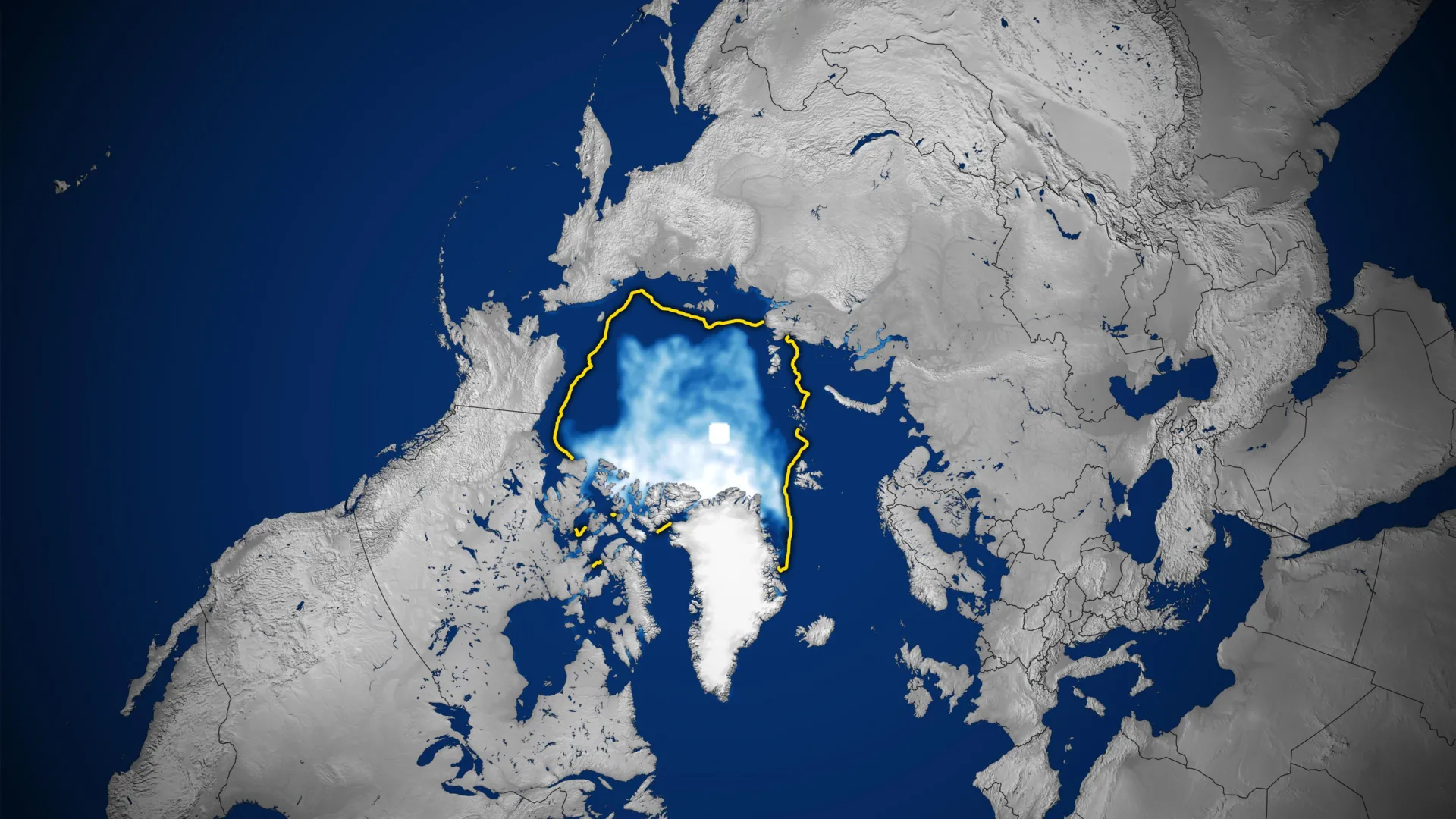
    In 2026, Arctic sea ice reached its annual minimum extent on September 12, covering approximately 4.6 million square kilometers (1.78 million square miles). According to NASA and the National Snow and Ice Data Center (NSIDC), this tied the lowest levels recorded in 2008, 2010 and 2025. It was also the 10th-lowest September extent since satellite monitoring began.

    The map compares Arctic sea ice conditions in September since 1990, when coverage is typically at its lowest, with conditions in March of the following year, when ice approaches its annual maximum. The sequence continues through March 2026.

    Decades of Arctic sea ice loss

    Satellites have continuously tracked the seasonal expansion and retreat of Arctic sea ice since late 1978, providing scientists with nearly 50 years of observations. The record shows a long-term decline that accelerated during the 2000s, with ice levels remaining unusually low.

    Every summer from 2007 through 2026 ranks among the 20 lowest September sea ice extents in the satellite record. The smallest extent ever observed occurred in September 2012.

    However, the rate of summer ice loss varies from year to year. During the past decade, September sea ice extent has remained relatively stable rather than continuing its earlier rapid decline. Scientists emphasize that short-term weather conditions can strongly influence how much ice melts each summer.

    For example, increased cloud cover in the Arctic in recent years has reduced the amount of sunlight reaching the ice, helping to limit further melting. NASA researchers have identified this as a factor contributing to the recent slowdown in melting. Despite this temporary stabilization, September sea ice extent remains far below historical averages.

    The Arctic is losing its oldest and thickest sea ice

    The changes involve more than the total area covered by sea ice. Scientists have also recorded major changes in the ice itself, which is becoming younger and thinner.

    Historically, much of the Arctic contained multiyear ice—ice that survived at least one summer melt season. This ice could persist and accumulate over several years, making it generally thicker and more resilient than ice formed during a single winter.

    Satellite observations now show significant losses of multiyear ice. As a result, the North Pole is increasingly covered by thin first-year ice. This ice forms during the colder months but is more vulnerable to melting when summer returns.

    The decline is also evident in winter, when Arctic sea ice typically reaches its maximum extent. The March 2026 annual maximum statistically tied the March 2025 maximum as the lowest winter peak in the satellite record.

    Could the Arctic Ocean become almost ice-free in summer?

    Natural climate patterns influence Arctic sea ice from year to year. One example is the Arctic Oscillation, a pattern of atmospheric circulation that affects temperature, wind and ice conditions across the region.

    However, natural fluctuations alone cannot explain the sustained decline recorded by satellites since 1978. Rising global temperatures, along with natural climate patterns, are contributing to the continuing loss of Arctic sea ice.

    Scientists predict that the Arctic Ocean could be essentially free of sea ice during at least one summer by the middle of the 21st century. Such an event would bring significant changes to a region that has supported extensive seasonal ice sheets for thousands of years.

    How satellites measure Arctic sea ice through clouds

    Scientists use satellites equipped with passive microwave sensors to measure Arctic sea ice extent. These instruments detect microwave energy naturally emitted by Earth’s surface, allowing researchers to distinguish frozen seawater from the surrounding open ocean.

    Sea ice emits more microwave energy than liquid water, creating a contrast that satellites can detect. Unlike visible-light imagery, microwave measurements can pass through clouds, allowing researchers to monitor the Arctic consistently even when storms or persistent cloud cover obscure the surface.

    Continuous satellite observations began in 1978 with NASA’s Nimbus 7 spacecraft. Additional measurements came from the Defense Meteorological Satellite Program (DMSP), which began in 1987, and NASA’s Aqua satellite, which provided observations between 2002 and 2011.

    In 2025, researchers began incorporating observations from the Japan Aerospace Exploration Agency’s GCOM-W satellite, continuing the long-term effort to measure changes in Earth’s polar ice.

    The satellite map also includes a white circular area at the North Pole known as the “Pole Hole.” This area falls beyond the historical coverage of satellite sensors, meaning direct measurements were not available. When calculating total sea ice area, scientists assume that the region is covered by ice.

    Image by Michala Garrison using data from NASA Earth Observatory and the National Snow and Ice Data Center.

    Source: www.sciencedaily.com

    Share. Facebook Twitter Pinterest LinkedIn WhatsApp
    Previous ArticleNVIDIA Expands Nemotron Family with High-Efficiency Super VL and Bolt AI Models for Data Centers and Desktops
    Next Article AI vs. Human Penetration Testing: Which Is More Effective?

    Related Posts

    Science

    Find Shelter on Resolution Island: Complete Guide for Visitors

    Science

    Coherent Fermion-Parity Oscillations in Coupled Minimal Kitaev Chains

    Science

    Iowa Explosion Lead Contamination Concerns Persist Despite Official Assurances

    Science

    Einstein’s 120-Year-Old Theory May Be Missing a Major Clue About the Big Bang

    Science

    Physicists Use Gravity to Send Unblockable Messages Through Brick Walls

    Science

    Engineering Signaling Centers for Human Trunk Morphogenesis In Vitro

    Science

    NASA Expands Supplier Program With New Mentor-Protégé Agreements

    Science

    Single-Cell Variant-to-Enhancer-to-Gene Map of Coronary Artery Disease Genetics

    Add A Comment
    Leave A Reply Cancel Reply

    Stay In Touch
    • Facebook
    • Twitter
    • Instagram
    • Pinterest
    Top Picks
    Technology

    NASA’s Long-Lived Mars Orbiters: How They Have Operated for Decades

    NASA’s Mars Odyssey and Mars Reconnaissance Orbiter (MRO) have operated at Mars for far longer…

    How Stress Hormones May Help the Brain Repair Itself

    XPRIZE Wildfire Winners Detected the Fire Within 10 Minutes but Couldn’t Stop It

    OpenAI Bots Interfere With US Government Agencies, Including the SEC and Census Bureau

    Smart Pet Feeder Outage Leaves Pets Without Food, Pet Owners Say

    Most Popular
    Science

    How Cannabis Causes Anxiety: What Happens in the Brain

    Technology

    Away Series 3 Luggage: Safety-Focused Design for Secure Travel

    Categories
    • AI (9)
    • Gadgets (6)
    • Science (3,595)
    • Space (3)
    • Technology (3,238)
    • Wheels (3)
    Our Picks
    Technology

    Lyft CEO Claims ‘We’re a Better Alternative to Uber’

    Technology

    Criminal IP Appoints Reconn as TI and ASM Distributor Across the Middle East and Africa

    © 2026 Hitechub.
    • Home
    • About Us
    • Privacy Policy
    • Terms & Conditions

    Type above and press Enter to search. Press Esc to cancel.

    GDPR Cookie Banner

    We are using cookies to give you the best experience on our website.

    You can find out more about which cookies we are using or switch them off in .

    Ad Blocker Enabled!
    Ad Blocker Enabled!
    Our website is made possible by displaying online advertisements to our visitors. Please support us by disabling your Ad Blocker.