


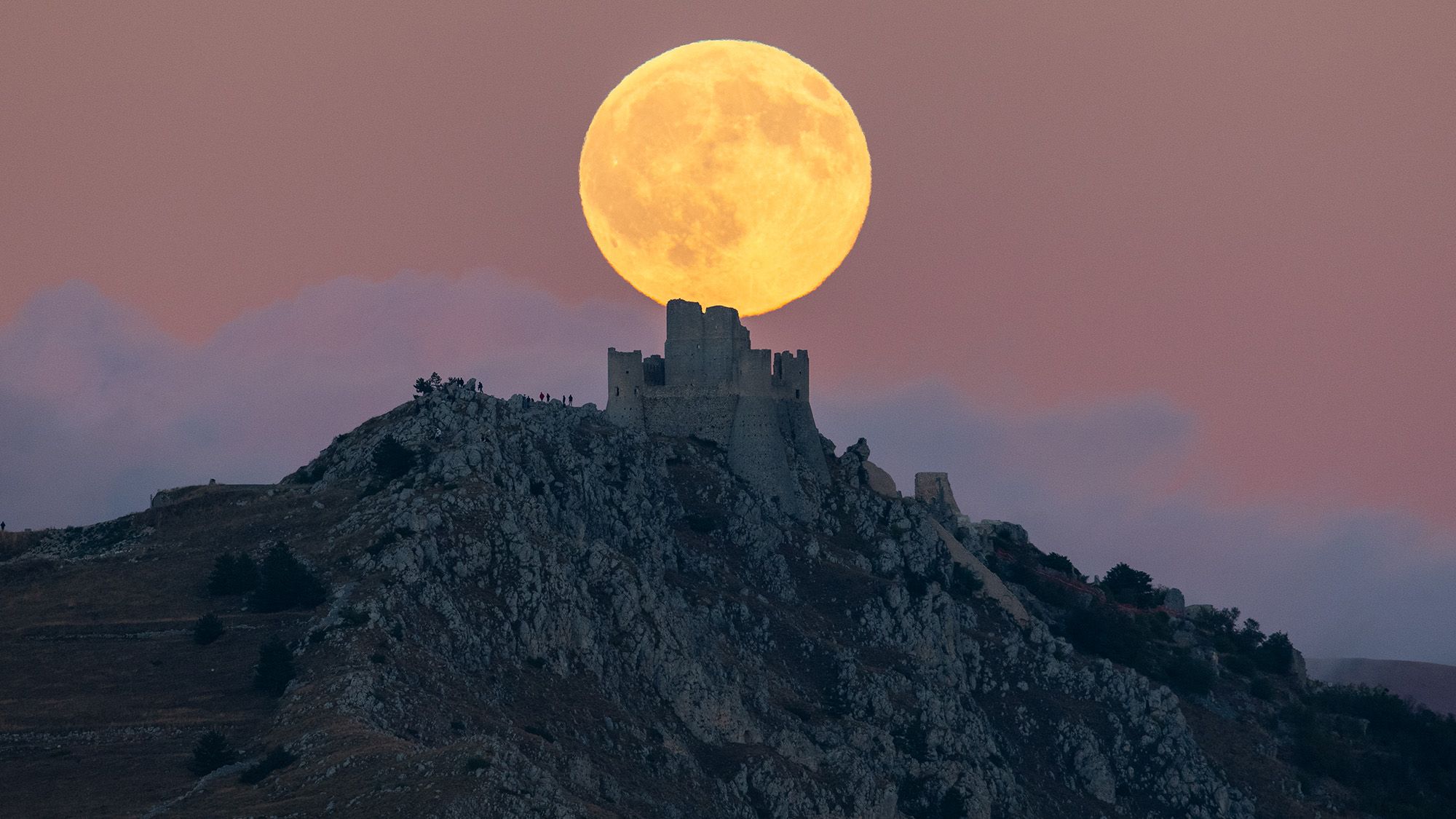
November’s full moon, known as the “Beaver Moon,” will rise in the eastern sky at dusk on Tuesday, November 24, 2026. It will be the first of three consecutive supermoons and the final full moon of autumn in the Northern Hemisphere. The sequence will culminate with December’s supermoon, which is expected to be the closest full moon to Earth since 2018.
When to see the Beaver Moon
The Moon will reach full phase at 9:53 a.m. ET on Tuesday, when it will be below the horizon for North American observers. The best opportunity to see it will be that evening at moonrise, as the Sun sets in the west and the Moon rises in the east.
At moonrise, the Moon will appear against a relatively bright twilight sky, which can make its size and color easier to perceive. It will also look full on Monday and Wednesday, but Tuesday evening should provide the best chance to watch it rise at dusk.
Why it is called the Beaver Moon
The name “Beaver Moon” refers to the time of year when North American beavers traditionally build dams at night to prepare for winter. Other names for November’s full moon include the Frost Moon and Snow Moon. Time and Date and the Native American Research Center provide further information about the names associated with this Moon.
Three consecutive supermoons
According to EarthSky, the Beaver Moon will begin a series of three consecutive supermoons. A supermoon occurs when a full moon coincides with the Moon being relatively close to Earth in its elliptical orbit.
The average distance between Earth and the Moon is 238,900 miles (384,472 kilometers), but that distance changes throughout the lunar orbit. When a full moon occurs near perigee—the closest point in the Moon’s orbit—it appears slightly larger and brighter than usual.
- Beaver supermoon: November 24, 2026, at 224,170 miles (360,768 kilometers)
- Cold supermoon: December 24, 2026, at 221,667 miles (356,740 kilometers)
- Wolf supermoon: January 22, 2027, at 222,229 miles (357,644 kilometers)
November’s Beaver Moon will be the smallest of the three upcoming supermoons. December’s Cold Moon is expected to be the closest, largest and brightest full moon of 2026. It will also be the closest the Moon has come to Earth since January 2, 2018, according to astrophysicist Fred Espenak.
Source: www.livescience.com