


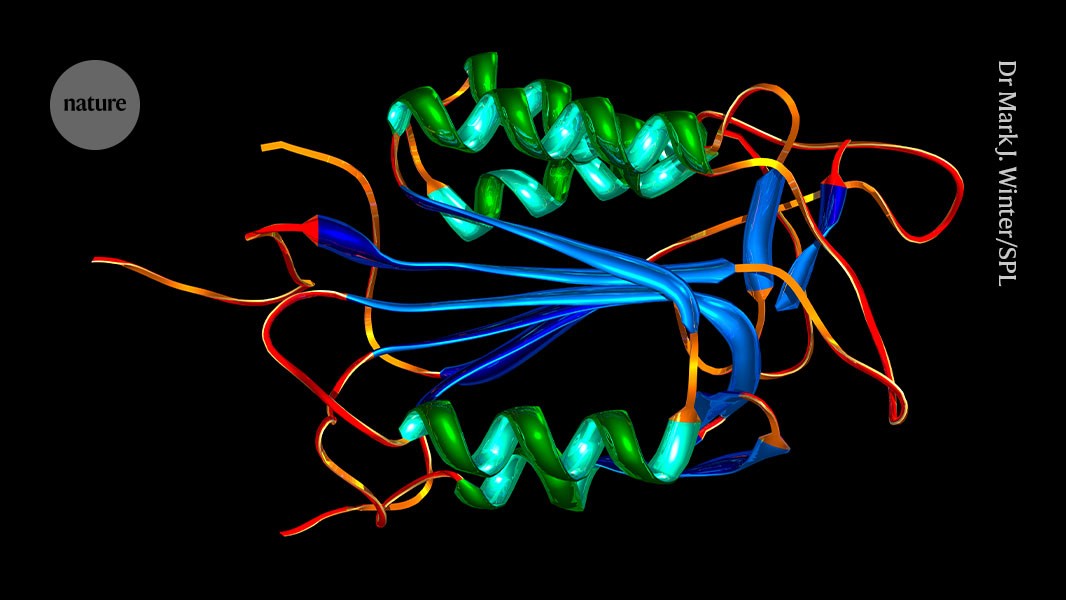
Some studies have shown that proteins such as caspase-3 (pictured) are expressed in cell lines that should not be able to produce them. Credit: Dr. Mark J. Winter/Science Photo Library
Scientific investigators have identified 230 reports in 221 research papers describing proteins appearing in genetically modified cell lines that lack the genes needed to produce them. The findings have prompted journals to retract or revise papers, although researchers warn that the problem is probably much larger.
“This problem is not going away,” says Thierry Souci, a cancer geneticist at Uppsala University in Sweden. Souci notes that several other examples of the same issue appeared in a paper that has since been retracted but were not included in the latest analysis. “This is just the tip of a huge iceberg.”
Genetically modified cell lines
A cell line is a group of cells derived from a single source and cultured for laboratory experiments. Some cancer cell lines have been genetically modified so that mutations or deletions remove genes that normally control cell division. The resulting cultures divide continuously, allowing researchers to study tumour progression and test potential treatments.
MCF-7 is one such cell line. It lacks the gene for caspase-3, a protein involved in cell death. In 2009, researchers warned that several studies using MCF-7 had reported caspase-3 expression in Western blots, an imaging technique that identifies proteins according to their molecular weight.1

Sleuth identifies dozens of studies that used the wrong antibodies
The latest analysis was published as a preprint on October 21 on the Zenodo data repository.2 Sholto David, a scientific investigator based in Arbroath, UK, found that the problem had persisted and spread to other cell lines.
David compiled a list of 20 commonly used cell lines with genetic mutations or deletions that prevent them from expressing particular proteins. He searched the literature using Google text and image searches for Western blot images that unexpectedly showed those proteins. He also examined a collection of 140,000 papers, mostly biomedical, that he had previously downloaded and screened for image-integrity and other problems.
He identified 230 reports of so-called phantom proteins in 221 papers published since 2004. The most common error was the reported detection of caspase-3 in MCF-7 cells, which appeared in 49 papers. The cell-death protein BAX was reported in Jurkat cells in 47 papers, while the signalling protein STAT3 was reported in PC-3 cells in 35 papers.
Errors, contamination or paper mills?
David suggests several possible explanations for these apparently impossible protein-expression patterns. They could result from honest mistakes, such as misidentifying a cell line or contaminating it with another cell line. Alternatively, the antibody used in the Western blot might not have been specific and could have bound to a different protein with the same molecular weight.
David says he encountered the unusual protein-expression results while working on a project that alerted researchers to hundreds of studies that had used incorrect antibodies.
Some papers could also have been produced by paper mills, companies that manufacture and sell scientific papers. David says that some papers in his collection contain features associated with such operations, including duplicate images and text templates resembling those in other papers. He says it is not clear what proportion of the papers belongs in this category.
Nature contacted several authors of papers containing the anomaly for comment, but none responded.

Science detectives raise concerns about numerous biotechnology papers
Source: www.nature.com