


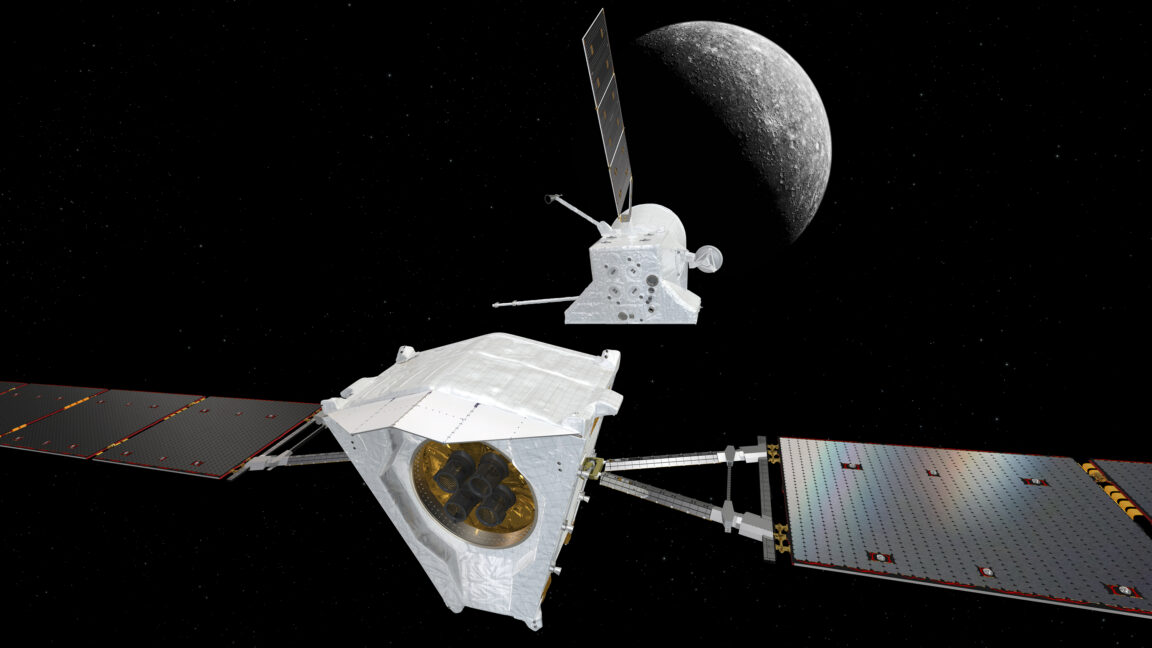
BepiColombo no longer needs its propulsion module and will separate from it before entering orbit around Mercury in November. The European Space Agency (ESA) mission is unusual because it consists of three spacecraft traveling together: the European Mercury Transfer Module, the European-built Mercury Planetary Orbiter, and Japan’s Mercury Magnetospheric Orbiter, known as Mio.
Thursday’s separation means the European and Japanese orbiters will continue their journey toward Mercury together. The two spacecraft are scheduled to separate in December, shortly after reaching their first orbit around the planet. Each orbiter carries specialized scientific instruments for studying Mercury, while the transfer module will be discarded because it is no longer needed.
Surveillance cameras aboard the BepiColombo Mercury Transfer Module captured this view of Mercury’s cratered surface during a flyby on January 8, 2025.
Credit: ESA/BepiColombo/MTM
Separating in Mercury’s harsh environment
Engineers have never before attempted to dismantle a spacecraft formation in an environment as challenging as the region around Mercury. BepiColombo’s Mercury Transfer Module separated 39 million miles (63 million kilometers) from the Sun—less than half the distance between Earth and the Sun—amid extreme temperatures and powerful solar radiation.
Ignacio Tanco, ESA’s director of inner Solar System mission operations, said the maneuver was “akin to launching a new spacecraft” and carried a “considerable risk” that something could go wrong. After separation, the remaining spacecraft had to take over power generation, propulsion, navigation, pointing, and thermal control. Operating so close to the Sun made each step especially demanding.
“This is something we can only confirm after separation if it worked, and we plan to use some new sensors and mechanisms as part of the attitude control system,” Tanco said.
Several of BepiColombo’s scientific instruments, including its highest-resolution cameras, were blocked by the transfer module during the journey to Mercury. “These devices will first see light only after the transfer module is released,” Tanco said.
Source: arstechnica.com