


When a fertilized mammalian egg divides, it produces two seemingly identical daughter cells. Yet these early cells soon begin to follow different developmental paths: some generate the embryo’s organs, while others form the extraembryonic tissues that support development.
In 2025, researchers used a cutting-edge method called single-cell proteomics (SCP) to show that this division of labor is already established in the two first-generation cells.1 Nikolai Slavov of Northeastern University in Boston, Massachusetts, who co-led the study with cell biologists Magdalena Zernicka-Goetz and Tsui-Feng Chou of the California Institute of Technology in Pasadena, found that the protein profiles of these two cells—known as “alpha” and “beta”—reflect distinct properties and developmental fates.
“Beta cells were more likely to give rise to healthy embryos than alpha cells,” Slavov says, although alpha cells typically contribute to extraembryonic tissue. The researchers were able to trace the cells’ distinct identities back to fertilization, highlighting the power of single-cell proteomics for studying early embryonic development.
Where do proteins go inside cells? Mapping the hidden lives of molecules with next-generation methods
Single-cell proteomics could also help answer important questions about cancer. Researchers increasingly recognize that many clinically significant events in tumor development begin in individual cells hidden within a complex tumor environment. “Single-cell proteomics may help us understand why patient outcomes vary with tumor evolution, immune responses and cell differentiation—all of which are shaped by cellular heterogeneity,” says Yu-Ju Chen, a mass-spectrometry researcher at Academia Sinica in Taipei.
Until recently, many protein researchers considered the idea of profiling thousands of proteins in individual cells to be unrealistic. “It’s almost on record that I said, ‘It won’t happen in my lifetime,’ because it seemed so far away,” says Matthias Mann, a proteomics researcher at the Max Planck Institute for Biochemistry in Martinsried, Germany.
Over the past decade, however, single-cell proteomics has become not only possible but practical and scientifically valuable. Mann now uses the technology to investigate diseases ranging from liver disease to Alzheimer’s disease. Nevertheless, barriers remain. SCP requires expensive instruments, specialized expertise and highly precise methods for handling the tiny quantities of protein found in individual cells.
Why protein analysis at the single-cell level matters
Although biology has entered the single-cell era, most studies still focus on the transcriptome—the collection of RNA molecules inside a cell. Measuring gene expression in individual cells can reveal a cell’s identity and physiological state. However, RNA measurements do not always predict which proteins a cell contains.
Not every RNA molecule is translated into protein, and many factors control when and how much protein is produced from a particular transcript. Because proteins carry out most cellular functions, examining the proteome can provide a more direct view of cell biology. The mechanisms of several diseases, including Alzheimer’s and Parkinson’s disease, are closely linked to abnormal protein accumulation. “The proteome reflects the current state of the cell,” Mann says.
Focus on single-cell proteomics
To study the proteome, researchers have traditionally pooled thousands or millions of cells before analyzing them with mass spectrometry (MS). The technique breaks proteins into ionized fragments, which are separated and measured according to their mass and charge. This molecular “fingerprint” allows researchers to identify more than 10,000 proteins in a typical bulk sample.
Bulk analysis, however, provides an average measurement and can conceal important differences between individual cells. “Do the measurements really reflect what is happening in all cells, or are dramatic changes limited to a small population?” asks Jesper Olsen, a mass-spectrometry researcher at the University of Copenhagen. “These are questions we have not been able to address effectively before.”
How single-cell proteomics works
In some respects, single-cell proteomics should be simpler than single-cell transcriptomics. Proteins are generally more stable and abundant than RNA. “With RNA, you count 0, 1, 2 or 3 copies in most cases. For proteins, you count 100, 500 or 10,000,” Slavov says.
However, transcriptomics researchers can use PCR amplification to increase the RNA signal from a cell. No comparable amplification method exists for proteins, so scientists must extract meaningful information from only hundreds of picograms of material.
Obtaining a reliable signal from such a small sample requires an extremely sensitive mass spectrometer. Sample preparation creates another challenge. “The raw sensitivity was there, but the sample preparation was optimized for bulk-level analysis,” says biochemist Ryan Kelly of Brigham Young University in Provo, Utah.

Matthias Mann’s deep visual proteomics strategy adds spatial information to single-cell proteomics.Credit: Axel Griesch/Max Planck Institute of Biochemistry
In 2018, Slavov and his team demonstrated an important advance in single-cell protein analysis.2 They developed a sample-preparation and analysis workflow called SCoPE-MS, or single-cell proteomics by mass spectrometry.
The method chemically labels proteins from individual cells and combines them with an excess of proteins from unlabeled “carrier” cells. This approach reduces protein loss from the target cells and improves protein identification. Using SCoPE-MS, the researchers detected more than 1,500 proteins across eight individual cells. “We basically increased the sensitivity by about four orders of magnitude,” Slavov says.
Slavov recalls that the findings were initially met with skepticism, but other research groups soon reproduced the results. That same year, Kelly and his colleagues published an independent single-cell proteomics method based on a device called a nanoPOTS chip. The platform processes tiny samples in nanolitre-scale droplets and identified 670 proteins in a small number of individual cells.3
“The whole point of the early papers was to show that this is a real signal from a single cell,” Kelly says. “That is no longer in question.”
Single-cell proteomics gains momentum
Since those early studies, single-cell proteomics has advanced rapidly. Jennifer Van Eyck, a clinical proteomics researcher at Cedars-Sinai Medical Center in Los Angeles, California, says her team can now consistently identify between 1,500 and 2,000 proteins per cell. “The biology we’re seeing is incredible,” she says.

Proteomics sets up single cell and single molecule solutions
Deeper protein coverage is also becoming possible. In 2025, two independent studies analyzed more than 5,000 proteins per cell, and that figure has already been surpassed. Olsen, who led one of the studies,4 says his group is exploring experiments capable of identifying up to 7,000 proteins in individual cells.
Karl Mechtler, a proteomics researcher at the Institute of Molecular Pathology in Vienna who co-supervised the other study,5 says that researchers can identify as many as 8,000 or 9,000 proteins in some larger cells.
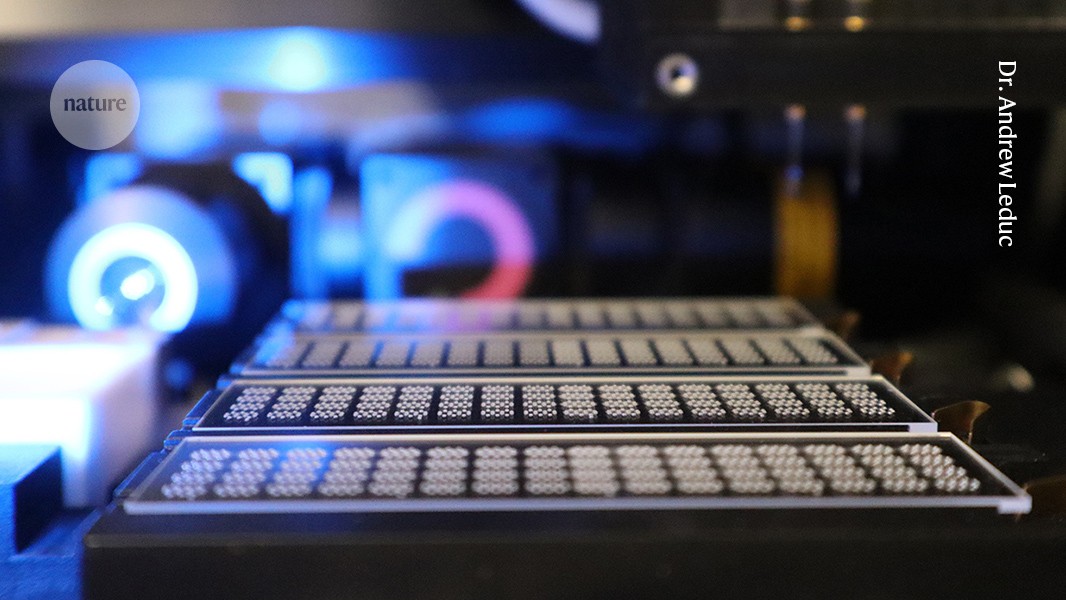
Many single-cell proteomics laboratories now use cellenONE, a device commercialized by Cellenion in Lyon, France. The system isolates individual cells from cultured samples and tissues while capturing images of them. Researchers can record each cell’s shape and size—important information because cell volume and protein content can vary substantially.
Downstream processing has also improved, reducing sample loss and limiting cross-contamination that could distort results. Chemical protein labeling was central to Slavov’s 2018 study, but many laboratories are adopting simpler, faster label-free methods.
For example, Kelly’s team developed a single-step workflow in 2023 that has become a widely used protocol.6 Chen and Academia Sinica collaborator Hsiung-Lin Tu later integrated the complete sample-preparation process into a compact microfluidic device. Known as the SciProChip, the platform performs the required steps in nanoscale liquid volumes.7 “This chip has significantly improved sensitivity, reproducibility and quantitative accuracy,” Chen says.

SciProChip uses microfluidics to capture, count and process individual cells for proteomic analysis.Credit: Hsiung-Lin Tu and Yu-Ju Chen
Advances in mass-spectrometry equipment are accelerating the field. Popular instruments include Thermo Fisher Scientific’s Orbitrap Astral system, based in Waltham, Massachusetts, and Bruker’s timsTOF Ultra series, based in Billerica, Massachusetts. These platforms use different technologies to detect and quantify proteins that were difficult to measure with older instruments. Each costs approximately US$1 million.
“We will be able to quantify more proteins within a single cell with greater sensitivity, deeper coverage and higher throughput,” Slavov says. He adds that older, more affordable instruments remain effective for profiling abundant proteins.
Speed remains the greatest challenge. Most single-cell proteomics workflows process only a few hundred cells per day—several orders of magnitude fewer than many transcriptomics experiments. The bottleneck is largely caused by the need to separate cellular peptides by size before mass-spectrometry analysis.
Increasing throughput can also reduce the amount of biological information captured. Kelly says his team sees a significant decline in proteome coverage when increasing the processing rate from 288 to 500 samples per day.
Single-cell proteomics takes center stage
Multiplexing offers one possible solution. The technique allows researchers to label individual cells, pool them for processing and later separate their signals during data analysis. Slavov’s 2018 labeling strategy uses mass-spectrometry-resolvable tandem mass tags, enabling dozens of samples to be analyzed simultaneously.
However, labeling can complicate sample preparation and data interpretation. “Ultimately, the identification rate you get from peptides is actually very low compared with experiments without labels,” Olsen says.
Source: www.nature.com