


The United States has invested over five decades and hundreds of millions of dollars into keeping the flesh-eating screwworm at bay. However, this notorious pest has now made its return.
Subscribe to read this story without ads
Get unlimited access to ad-free articles and exclusive content.

This pest can consume the tissues of any warm-blooded animal but poses a significant danger to livestock, often leading to fatal outcomes for cattle. Some bioethicists have debated the morality of intentionally eradicating the screwworm species.
“Certain species deserve eradication consideration, and I believe the screwworm qualifies,” remarked Gregory Koebnick, a senior research fellow at the Hastings Center for Bioethics.
Recently, the Department of Agriculture confirmed the detection of New World screwworms in Texas calves. This marks the first natural infestation in U.S. cattle since 1982. A second case was reported shortly after, found approximately six miles from the initial discovery. This alarming resurgence marks a setback in the ongoing containment efforts in the U.S., reigniting a battle it had previously fought.
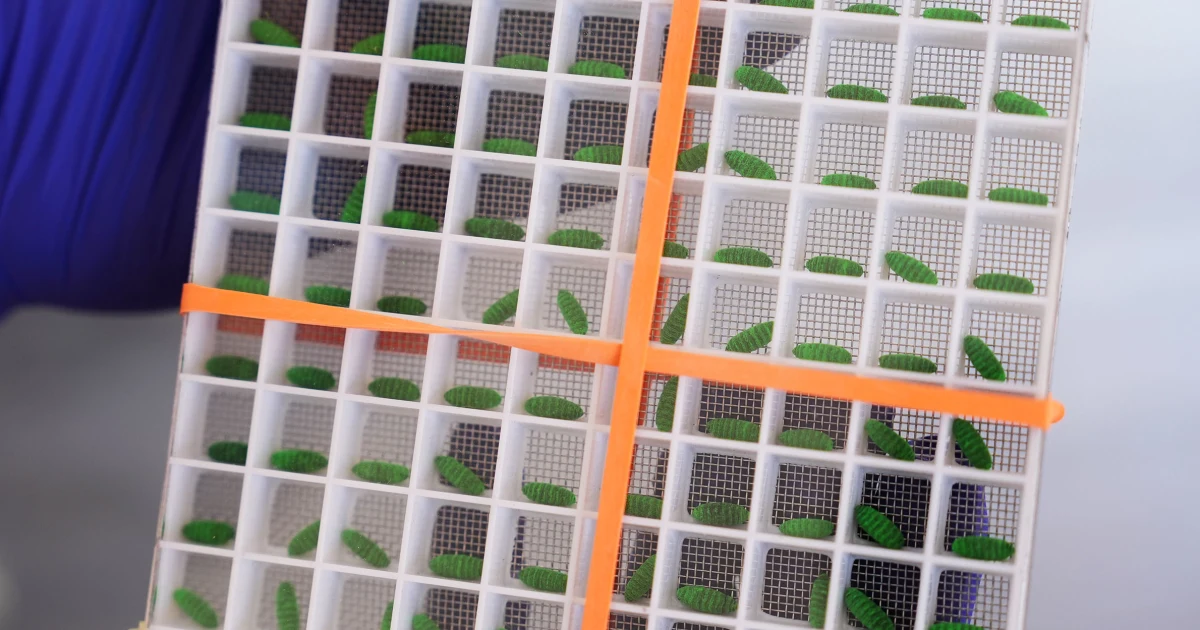
Experts anticipate that the U.S. will employ similar strategies used in the late 1950s, which included an aggressive fight against the proliferation of screwworms. Given that female screwworms mate only once, the plan involves mass-producing sterile males and releasing them into the wild to create a reproductive dead end.
“It’s an effective strategy,” asserted Chad Cross, a professor of parasitology at Texas Tech University’s College of Veterinary Medicine. “It succeeded in the past, and I expect it to yield results again.”
He emphasized the urgency of swift action in response to the new Texas cases to prevent further spread.
Notably, the screwworm fly is a type of black fly that thrives in the southern U.S. These flies are attracted to decaying wounds, where females lay 200 to 300 eggs that develop into larvae capable of burrowing into flesh.
“The larvae emerge from the eggs, feeding on the flesh of warm-blooded animals,” explained Philip Kaufman, a professor of entomology at Texas A&M University. “They pose a risk to domestic animals, many wild species, and even humans.”
Screwworm larvae, also known as maggots, possess unique hooks that enable them to penetrate animal flesh and burrow deeper. As they proliferate, they create open, rotting sores on the animal’s surface, with the stench often attracting other fly species. Such infections are typically fatal unless the larvae are removed and the animal is treated with insecticides and antibiotics.

Brandon Bell/Getty Images
While infections in humans are uncommon, they can be excruciatingly painful.
“Tissue is consumed, whether it’s muscle, fat, or skin,” Kaufman noted. “It’s highly improbable that someone wouldn’t notice this issue.”
Screwworms are typically found in the southernmost U.S., but can adapt to milder climates if temperatures are conducive.
“They can flourish in the Midwest during favorable weather conditions, but they cannot survive winter,” Kaufman stated. “South Texas and South Florida are unlikely to experience cold enough temperatures to eradicate the virus.”
Historically, these regions were the primary habitats for screwworms until the 1960s when the U.S. escalated efforts to combat them. Over the next four decades, facilities in Florida, Texas, and Central America were established, producing and releasing hundreds of millions of sterile flies weekly.
The sterile flies are irradiated and released in large numbers to blanket infected areas. Their presence makes it statistically improbable for wild female screwworms to find non-sterile males. Without viable mates, reproduction cannot occur.
This strategy proved effective, and by 1982, when infections reached zero, the U.S. continued operations in Mexico and Central America, driving the screwworms further south.
“By around 2004, we had successfully eradicated them past the Panama Canal,” Kaufman said.
However, over time, there was a decline in investment in the production and spraying of sterile insects in areas previously cleared of screwworms.
“As new facilities opened farther south, existing ones in northern areas were shuttered, leading to the closure of the Texas facility, followed by those in Mexico and Nicaragua, leaving only the Panama facility operational,” Kaufman added. “That plant is aging and showing wear.”
For approximately 20 years, the Darien Valley—a roadless rainforest on the Panama-Colombia border—served as the geographical limit of the screwworm’s range. However, in 2023, outbreaks began to spread northward, first reaching Panama and Costa Rica, then Mexico, and now the United States.
“What triggered this return?” Kaufman asks, adding, “No one truly knows.”
Regardless of the reason, the U.S. is reinvesting in containment efforts. The USDA is constructing a $750 million facility in Texas expected to produce around 300 million sterile screwworms weekly, tripling current production levels and matching the output from the 1960s. However, this facility will not be operational until at least the end of 2027. Full-scale generation takes time.
Until these facilities become operational, the risk of outbreaks remains high. Infestations can cause Texas alone an economic hit of around $1.8 billion annually due to livestock deaths, veterinary costs, treatments, and additional labor. According to USDA estimates for 2024.
The objective is to eliminate the screwworm fly from the U.S. and Central America entirely. However, some researchers believe that complete extinction of the species might be worth considering. A group of bioethicists, conservation biologists, and scientists convened in 2024 to discuss the feasibility of enhancing sterilization techniques and utilizing genetic modifications to introduce lethal genes into the screwworm gene pool, potentially leading to extinction. This group’s findings were published in Science magazine last year.
The researchers argue that screwworms inflict immense suffering on livestock entrusted to human care. The paper notes that infections caused by this species are gradual and painful for both animals and humans, raising questions about the ecological value the species may provide.
Kebnick, the bioethicist, pointed out that the group comprises individuals committed to preserving the web of life and conserving species. Yet, “we concluded that in certain instances, eradication may be justified.”
While their discussions were largely speculative, the genetic modification methods available for screwworm eradication remain untested on a large scale and are not ready for practical application. If such methods become viable, Kebnick cautioned that it would entail a significant decision with potential precedents.
“These techniques are not yet prepared for deployment,” he stated.
Source: www.nbcnews.com