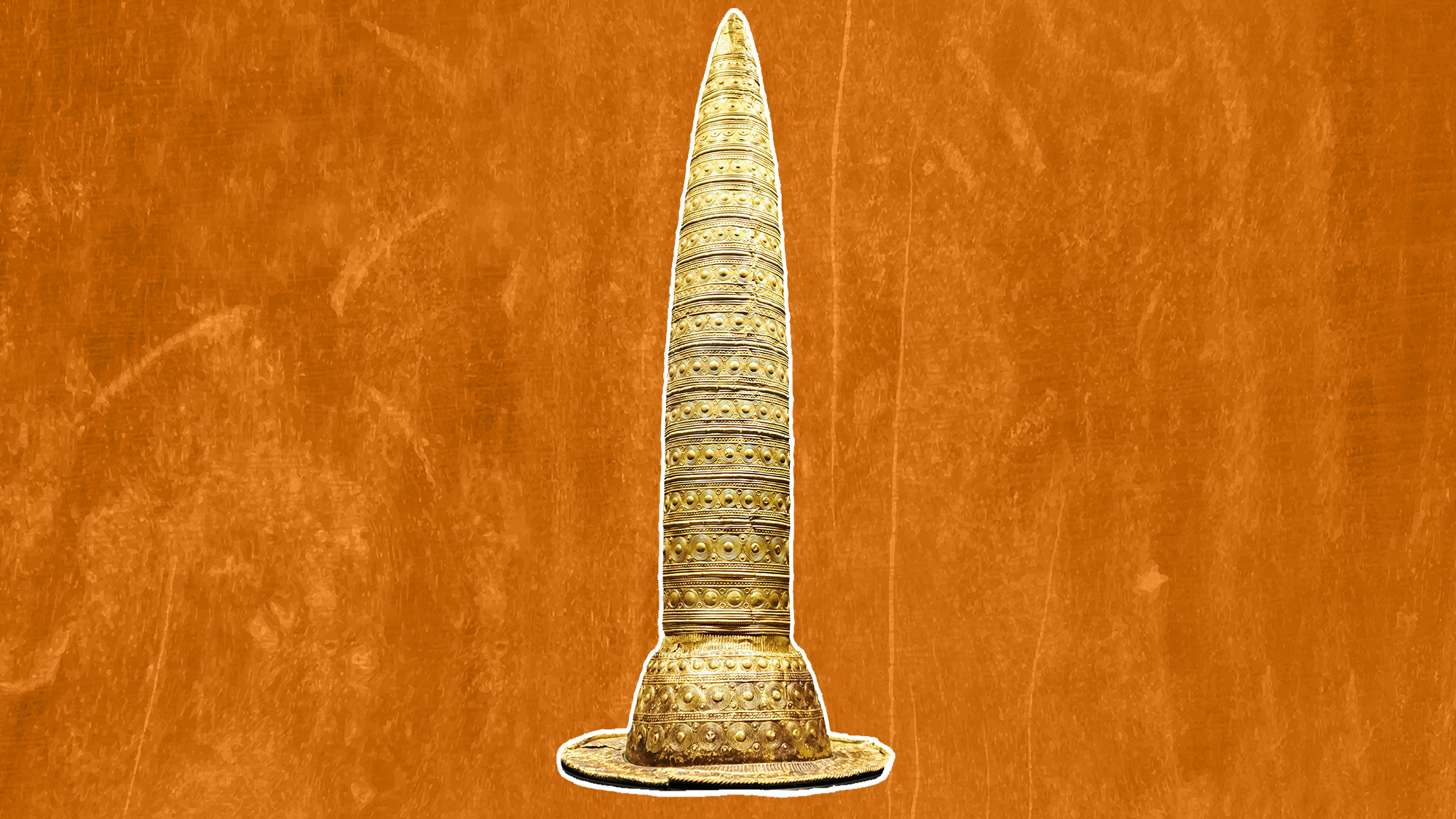
Berlin Gold Hat: The 3,000-Year-Old Bronze Age Calendar
The Berlin Gold Hat was crafted around 3,000 years ago from a single sheet of gold. Its intricate symbols may represent an ancient calendar.
(Image credit: Alamy)
QUICK FACTS
Name: Berlin Gold Hat
What it is: A tall, conical Bronze Age hat
Where it is from: Likely southern Germany
When it was made: Approximately 1000 to 800 B.C.
The Berlin Gold Hat is a tall, conical headpiece made from a single sheet of hammered gold. Archaeologists believe it may have been worn by a Bronze Age priest during ceremonies connected to the sun. It is the best-preserved example of just four known Bronze Age gold hats discovered in Central and Western Europe.
Today, the Berlin Gold Hat is housed in the collection of the Museum of Prehistory and Early History in Berlin. The museum acquired the artifact in 1996 after it appeared on the antiquities market. Because its original discovery location is unknown, researchers have used the other three Bronze Age gold hats — found in southern Germany and western France — to help determine its likely origin.
The hat measures approximately 29 inches (74 centimeters) high and weighs slightly more than 1 pound (480 grams). A flat bronze band decorates its base, while bronze wire runs around the brim. A lining made from wool or felt may once have been worn beneath the thin gold sheet to provide support, although no lining survives.
Latest Videos FromLive Science
The most remarkable feature of the Berlin Gold Hat is its repeating decoration. Concentric circles, disks, ovals and other symbols cover the surface in horizontal bands. Archaeologist Wilfried Menghin proposed in a 2008 study that these motifs encode numerical values linked to an ancient calendar.
According to this interpretation, individual decorative bands represent different numbers. When combined, they could help calculate lunar months and solar years, convert lunar dates into solar dates and possibly predict lunar eclipses. If correct, the artifact would show that Bronze Age communities in Europe possessed detailed astronomical knowledge.
“The person who wore this hat was the carrier of secret and very special knowledge,” Matthias Wemhoff, director of Berlin’s Museum of Prehistory and Early History, said in a translated 2018 video.
Wemhoff suggested that the hat’s wearer may have been a priest who climbed a mountain at sunrise. The polished gold surface would have reflected the first rays of sunlight, creating a dramatic spectacle for those taking part in the ceremony.
Although no written records confirm the existence of a Bronze Age sun cult in Europe, other extraordinary discoveries point to the importance of the sky and celestial cycles in prehistoric societies. These include the Trundholm Sun Chariot and the Nebra Sky Disk, both of which demonstrate how ancient people observed and represented the sun, moon and stars.
For more remarkable archaeological discoveries, explore our Astonishing Artifacts archives.