


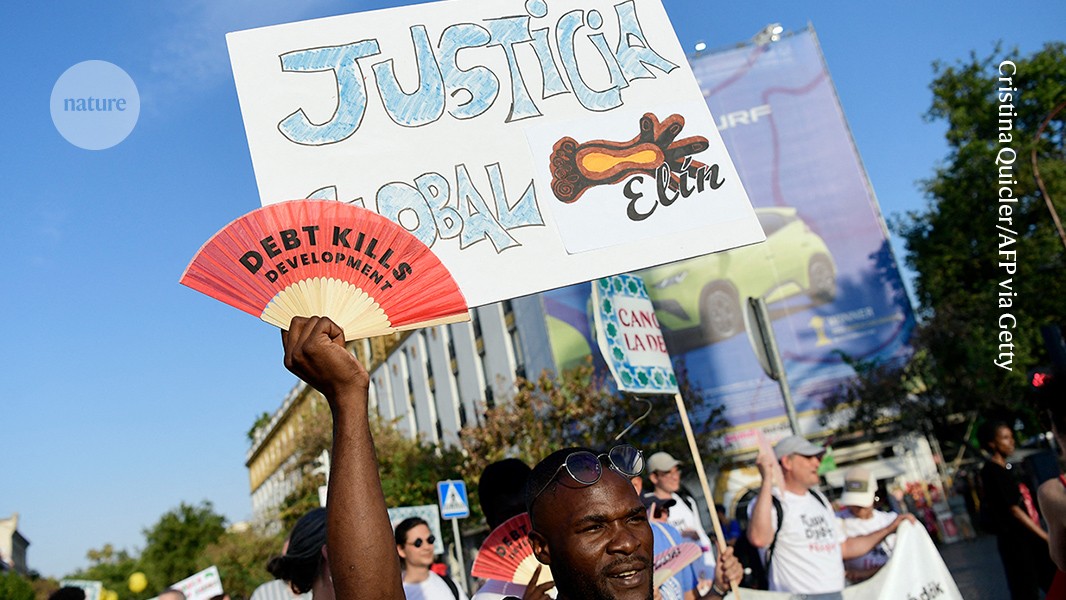
Low- and middle-income nations are urging the UN for solutions to burgeoning debt crises and wealth inequality.
Credit: Cristina Quickle/AFP via Getty
Envision a future where nearly 90% of the global workforce works half the hours yet earns double the income. A scenario where the wealth share of the poorest strata increases while that of millionaires diminishes. Concurrently, our objective is to restrict global warming to 1.8 °C above pre-industrial levels by 2100. This ambitious vision is proposed by researchers at the Paris-based Global Inequality Institute. The Global Justice Report is a modeling study published last month1.
The report suggests implementing a global tax on ultra-wealthy individuals, with proceeds allocated to funds supporting health care, education, and the transition to sustainable development, including shifting from fossil fuels to renewable energy sources. Furthermore, it advocates for the introduction of a new international currency to eliminate some of the economic advantages that rich nations currently enjoy at the expense of poorer nations.
An additional report submitted to the United Nations last month takes this even further. The Roadmap for Going Beyond Growth to Eradicate Poverty2 aims to break free from the “growth trap,” challenging the notion that continuous increases in gross domestic product (GDP) are essential for progress. This initiative has garnered support from over 1,000 signatories, including Nobel laureate and economist Joseph Stiglitz from Columbia University.
“There’s a growing realization that merely pursuing growth with the hope of alleviating poverty and inequality is not a viable strategy,” stated Olivier de Schutter, the outgoing UN special rapporteur on extreme poverty and human rights, and lead author of the report.
Yet, many economists criticize the report, with some outright dismissing its claims. Nature spoke to researchers with divergent perspectives on the role of economic growth in addressing poverty and climate change.
Can Economic Growth Eliminate Poverty?
Numerous economists contend that economic growth is crucial for poverty eradication.3 They argue that growth generates jobs and increases incomes, leading to higher tax revenues that governments can invest in essential services like health care and education. Over the past three decades, the number of people living in extreme poverty has dropped significantly, attributed largely to economic growth in East and South Asia. “China’s growth has been the primary driver of global poverty reduction this century,” observes Eoin McLaughlin, an economic historian at Heriot-Watt University in Edinburgh, UK.
However, the two reports propose that it is feasible to eradicate poverty and diminish inequality without solely depending on GDP growth. The roadmap presents 80 policy measures, including a job guarantee program to help governments employ those struggling to find work, particularly in areas like care and recycling. It recommends several tax reforms, including a wealth tax on the ultra-rich and enhanced taxes on environmentally harmful activities.
Andrew Fanning, an environmental economist at the Donut Economics Action Lab in Cadiz, Spain, supports the roadmap’s argument that poverty can be eradicated without the need for excessive growth, at least beyond the infrastructure necessary for a good quality of life—including roads, schools, hospitals, and adequate housing. “Once those needs are met, growth is not essential,” he asserts.
Can Growth Continue without Harming the Planet?
Some economists propose “green growth,” a concept advocating that countries can enhance GDP while minimizing environmental impact through cleaner technologies. For example, China’s economy continues to grow at a high rate, even as carbon dioxide emissions have plateaued and begun to decline.
However, De Schutter points out that many environmental impacts beyond greenhouse gas emissions can worsen with continuous growth. This encompasses the broader concept of planetary boundaries—natural limits related to biodiversity loss and alterations in the water cycle that cannot be transcended without destabilizing Earth’s environment.4 “No nation has managed to grow without violating the limits imposed by our planet,” he states. “Expanding an economy inherently consumes energy and resources, leading to waste and pollution.”
Conversely, economist Diane Coyle from the University of Cambridge in the UK argues that growth in affluent economies becomes less resource-intensive over time. “GDP growth is not synonymous with energy or material use; it includes intangible assets and services, whose share is on the rise,” she explains. “Innovations like new vaccines and more efficient solar technologies contribute to GDP and are certainly beneficial.”
What’s the Path: Degrowth or Postgrowth?
Source: www.nature.com