


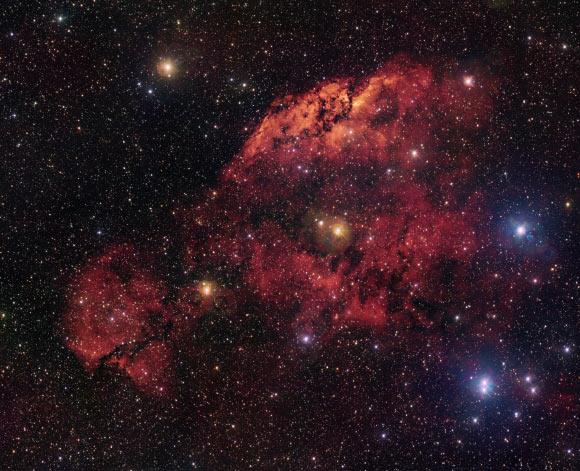
Astronomers utilizing ESO’s VLT Surveying Telescope have captured breathtaking images of the lesser-known nebulae, Gum 10 and Gum 11.
This VST image illustrates two nebulae, Gum 10 and Gum 11, situated south of the constellation Papis. Image credit: ESO / VPHAS+ Team.
“What shape do you see? Is it a chicken pecking at seeds, a dragon’s head, or perhaps something entirely different?” asked ESO astronomers in their statement.
“These intriguing shapes emerge from the clouds of interstellar dust and gas known as Gum 10 and Gum 11.”
“Although mainly visible from the southern hemisphere, these nebulae are part of a larger region where new stars are formed.”
Located approximately 10,760 light-years away in the constellation Leo, Gum 10 is also referred to as RCW 19 and spans about 155 light-years in diameter.
Gum 11 (or NGC 2579), is situated around 4,000 light-years away in the same southern constellation.
“Gum 10 is the dominant and brightest cloud that fills most of the image,” noted the astronomers.
“In contrast, Gum 11 is a fainter and more isolated cloud located in the lower left quadrant of the image.”
The stunning images of these nebulae were captured by the VLT Surveying Telescope (VST), coinciding with the 15th anniversary of its First Light.
“The vibrant glow results from significant interactions between hydrogen and the hot, massive stars within each nebula,” the researchers explained.
“These stars emit ultraviolet light, which possesses enough energy to strip electrons from atoms, leading to ion formation.”
“Eventually, these free electrons recombine with hydrogen ions, resulting in the specific red light emission observed in this image.”
“The black lines visible within the nebula are caused by dust that obstructs the light from behind it.”
Source: www.sci.news