


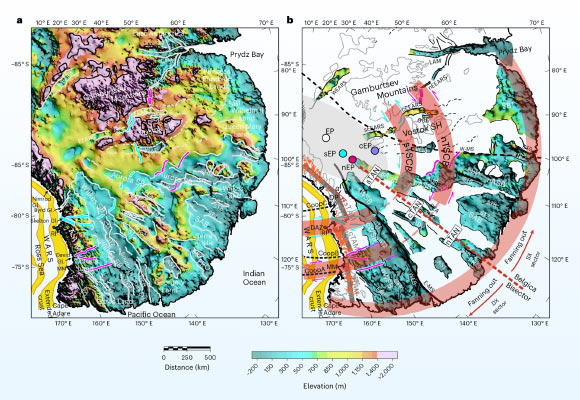
In a groundbreaking study combining seismic, gravity, and topographic data, an international team of researchers from Italy, Switzerland, Germany, and the UK revealed that several prominent subglacial basins in East Antarctica form a single fan-shaped province. This unique geological structure dates back to ancient continental expansion.
A structural frame interpreted as a fault-controlled basin in the newly identified East Antarctic fan basin. Image credit: Armadillo et al., doi: 10.1038/s41561-026-01991-6.
“The Antarctic bedrock is primarily exposed due to the Antarctic Ice Sheet, which covers over 99% of the continent,” stated lead author Dr. Egidio Armadillo from the University of Genoa and collaborators.
“Recently compiled international radio-echo sounding data have unveiled extensive subglacial topographic features with increasing detail, revealing a vast, low-elevation region of East Antarctica that extends from Prydz Bay to the Transantarctic Mountains, reaching as far south as 85 degrees latitude.”
“In this area, the predominant large subglacial basins exhibit a V-shaped configuration and are oriented along a north-south axis.”
“Additionally, the 2,000 km long Antarctic coastline and the continent-ocean boundary margin clearly define the northern sector, taking on a distinct semi-circular arc shape.”
“On a semi-continental scale, the landscape resembles a handheld fan, concentrated near the South Pole.”
“We propose to designate this entire region as the East Antarctic Fan Basin (EAFBP).”
The EAFBP structure incorporates some of Antarctica’s most significant subglacial features, including the Wilkes Basin and the Aurora Basin, which houses Lake Vostok—the largest known subglacial lake on Earth.
Analysis indicates that the EAFBP structure formed through a process termed dispersive rotational extension.
This geodynamic process entails the continental crust spreading from a central origin, characterized by a hand-like pattern where the base of the thumb acts as a fixed point, showing how the fingers stretch and spread. The gap between the fingers mirrors a triangular basin formed during this expansion.
Scientists assert that the EAFBP may represent one of the largest instances of rotational extension ever observed in continental crust.
This structure is likely a result of numerous tectonic events linked to the evolution of the Gondwana supercontinent and the subsequent rift between Antarctica and Australia, potentially influencing this separation.
This discovery prompts further inquiries, particularly related to the age of the structure and the geodynamic mechanisms behind its formation.
However, the implications of this discovery extend beyond historical understanding.
“The configuration of the bedrock concealed beneath the ice sheet continues to shape ice flow dynamics today, influencing the distribution of subglacial basins and lakes,” the authors concluded.
“This could impact the stability of areas within the Antarctic ice sheet that are particularly vulnerable to climate change.”
Refer to the study published in the June 3rd edition of Nature Earth Science.
_____
E. Armadillo et al. A fan-shaped subglacial basin province in East Antarctica formed by rotational extension. Nature Earth Science published online on June 3, 2026. doi: 10.1038/s41561-026-01991-6
Source: www.sci.news