


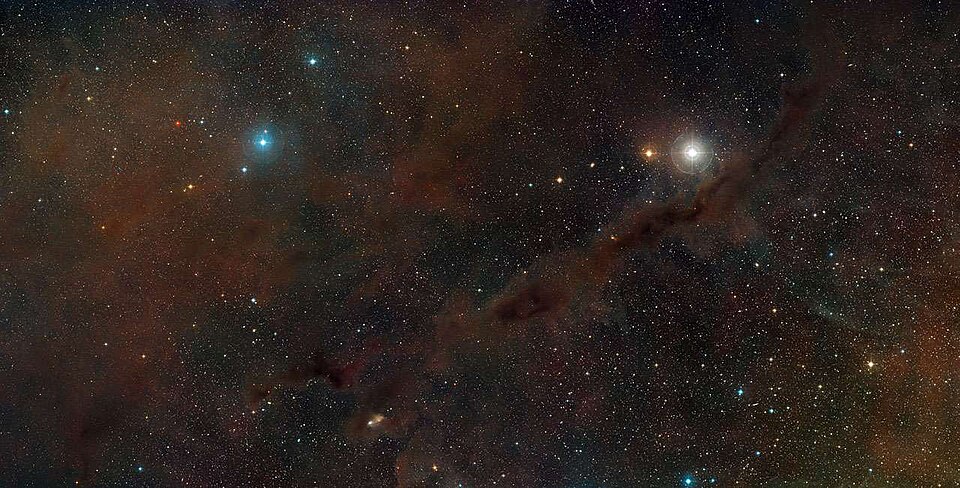
A survey of the Milky Way has identified what researchers describe as a giant spiral-shaped molecular cloud, along with a possible intermediate-mass black hole near its center. The feature, named MWISP-Spiral, was detected through radio observations of three carbon monoxide variants, which trace the large quantities of hydrogen found in molecular clouds. The researchers estimate that the black hole is about 1,500 times more massive than the Sun, although they say additional observations are needed to confirm the interpretation.
Tracing the Milky Way’s molecular clouds
The Milky Way contains celestial objects spanning an enormous range of masses, from comets, asteroids and planets made of rock, gas and ice to stars, white dwarfs, neutron stars and the supermassive black hole at the galaxy’s center.
Most of these objects formed from earlier generations of matter. Scientists believe that giant clouds of cold gas and dust, known as molecular clouds, were among the precursors of the complex galaxy seen today. Dense pockets within these clouds can collapse to form stars and planetary systems. Some stars later shed their outer layers and become white dwarfs, while more massive stars explode as supernovae, leaving neutron stars or black holes behind.
Chinese scientists used the Purple Mountain Observatory radio telescope system to study the Milky Way as part of the broader Milky Way Imaging Scroll, or MWISP, project. During observations made in October 2024 and between February and May 2019, the team detected three variants, or isotopologues, of carbon monoxide that indicated the presence of giant molecular clouds.
Earlier research has shown that these carbon monoxide molecules can trace large quantities of hydrogen. Detecting carbon monoxide therefore gives astronomers a way to locate the otherwise difficult-to-observe hydrogen that makes up much of a molecular cloud.
A cloud with five spiral arms
The researchers processed the radio observations using IRAM/GILDAS software and other data-processing pipelines to map the cloud. They estimated that it lies about 1,650 parsecs from Earth—approximately 50 quintillion kilometers, or 30 quintillion miles, according to the source—and measures about 75 parsecs wide and 90 parsecs high. Those dimensions were approximate in part because the cloud has five spiral arms, a structure that inspired the name MWISP-Spiral.
Because MWISP-Spiral resembles a spiral galaxy, the researchers considered whether it might also contain a black hole at its center. Spiral galaxies commonly host supermassive black holes in their central regions, raising the question of whether a similar object could be associated with this much smaller structure.
A possible black hole at the center
To investigate, the team examined archived radio surveys and observations covering the same region of space. They found a radio source near the center of the cloud, relative to the ends of its five arms. The region around MWISP-Spiral appeared otherwise largely empty, with only eight objects emitting light and no objects emitting visible light.
These findings suggested that the central source could be a black hole. Material falling into a black hole can produce radio emissions, which would be consistent with the observations. The researchers also considered the possibility that the source was a supermassive black hole located completely outside the Milky Way and merely aligned with MWISP-Spiral from Earth’s perspective.
They rejected that explanation after observing that material around the source formed distinct lobes. According to the researchers, this structure is characteristic of an embedded black hole producing high-energy jets.
Further observations are needed
The researchers concluded that the Milky Way contains both a giant spiral molecular cloud and a possible rare intermediate-mass black hole about 1,500 times as massive as the Sun. They recommended further observations of MWISP-Spiral and its central object to confirm the result.
If confirmed, the system could provide an unusual opportunity to study the relationship between black holes and molecular clouds. Research on intermediate-mass black holes could also help scientists understand how the much larger supermassive black holes found at the centers of galaxies develop.
Source: sciworthy.com