


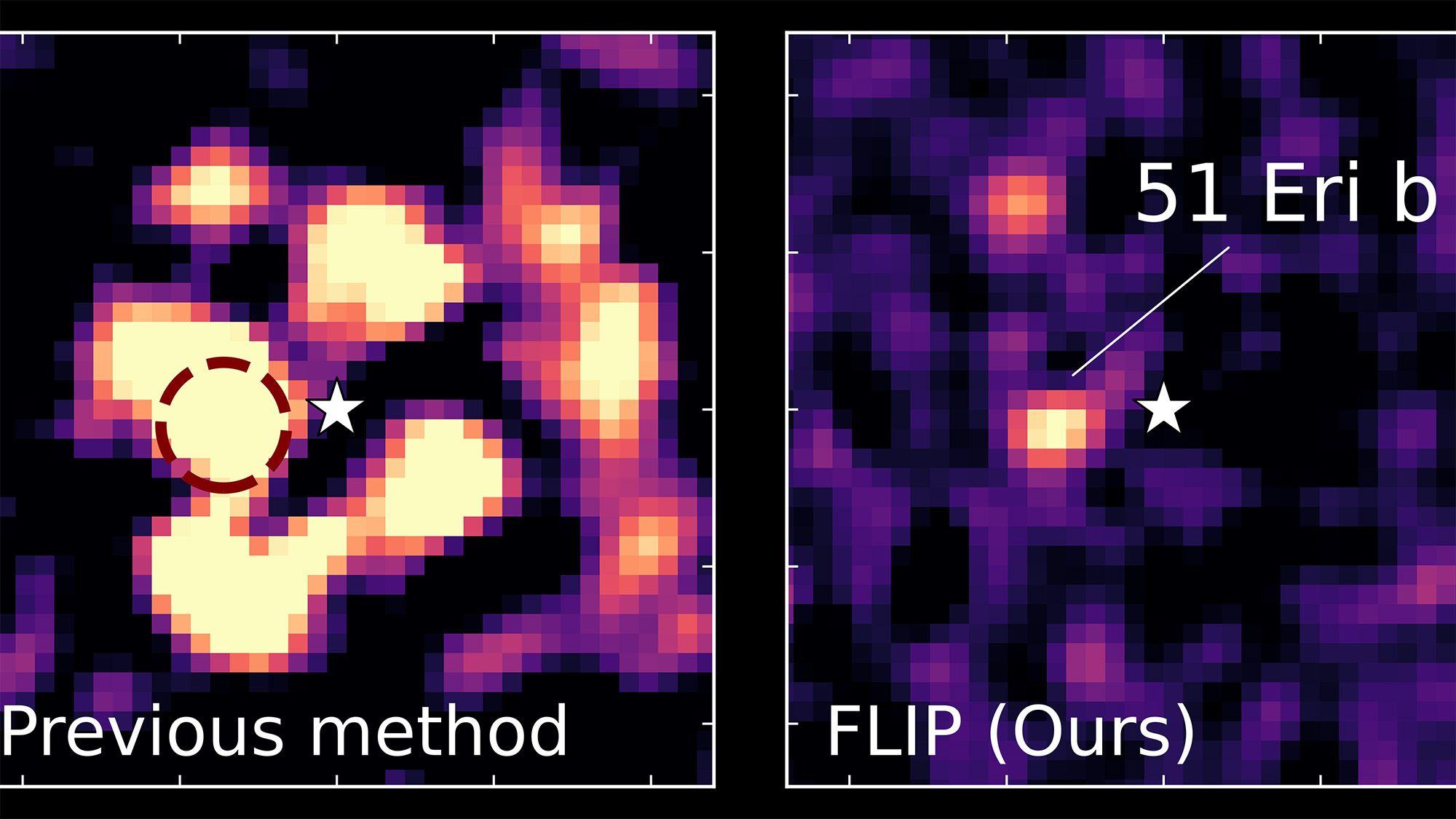
Light from a star can overwhelm the much fainter signal of a planet orbiting it, even in observations made by the James Webb Space Telescope (JWST). Astronomers have now combined physics-based modeling with machine-learning techniques to recover giant exoplanets that were previously hidden in JWST data. The results were published in Nature on November 4, 2026.
Separating planets from starlight
“Planets are a million times fainter than stars,” lead study author Rodrigo Ferrer Chavez, an astronomer at Northwestern University, said in a statement. “So to image exoplanets, we need to remove that glare.”
JWST uses instruments called coronagraphs to block some of the light from a star, much as the Moon can block the sun during a total solar eclipse. However, coronagraphs cannot eliminate all of the glare, and the telescope itself moves as it collects light.
Even extremely stable telescopes experience almost imperceptible vibrations. As a result, the images they capture contain small differences from the patterns the instruments are expected to record. Those discrepancies can conceal even large exoplanets.
A physics-based digital twin
To address the problem, Ferrer Chavez and his colleagues developed a “digital twin” of JWST. The virtual replica models how light passes through the telescope’s detectors while accounting for imperfections caused by motion.
The researchers refined the digital twin using computational models based on real-world physics, combined with machine-learning techniques similar to those used to train artificial-intelligence systems. However, the researchers emphasized that the method itself is not an AI model.
“We already know the physics, so we don’t need AI to understand what’s going on,” study co-author Jason Wang, an astrophysicist at Northwestern University, said in a statement.
The team named the approach “Physically-based learning for imaged planets,” or FLIP.
Recovering a hidden exoplanet
The researchers used FLIP to analyze data from three stars, including 51 Eridani, located about 97 light-years from Earth. The star is suspected to be orbited by a giant exoplanet called 51 Eridani b.
Ground-based telescopes had detected 51 Eridani b, but the planet was obscured by its star’s light in earlier JWST observations. When the researchers applied FLIP, 51 Eridani b emerged from the data.
The study suggests that the technique could help astronomers find more elusive exoplanets, including worlds more similar to those in our own solar system. During the nearly 35-year history of exoplanet searches, most of the planets discovered have been fundamentally different from the planets orbiting the sun. Larger and more reflective worlds are easier for current telescopes to detect.
“That’s not true,” Ferrer Chavez said of the idea that solar-system-like planets do not exist. “They don’t exist. It just means we can’t see them.”
Ferrer-Chavez, R., Wang, J. J., Bowman, Kuala Lumpur, Freeman, W. T., Pueyo, L., Fung, BY, and Perrin, M. D. (2026). Image of an exoplanet below the telescope’s stability limit. Nature, 659(8139), 58–62.
Topics: James Webb Space Telescope
Source: www.livescience.com