


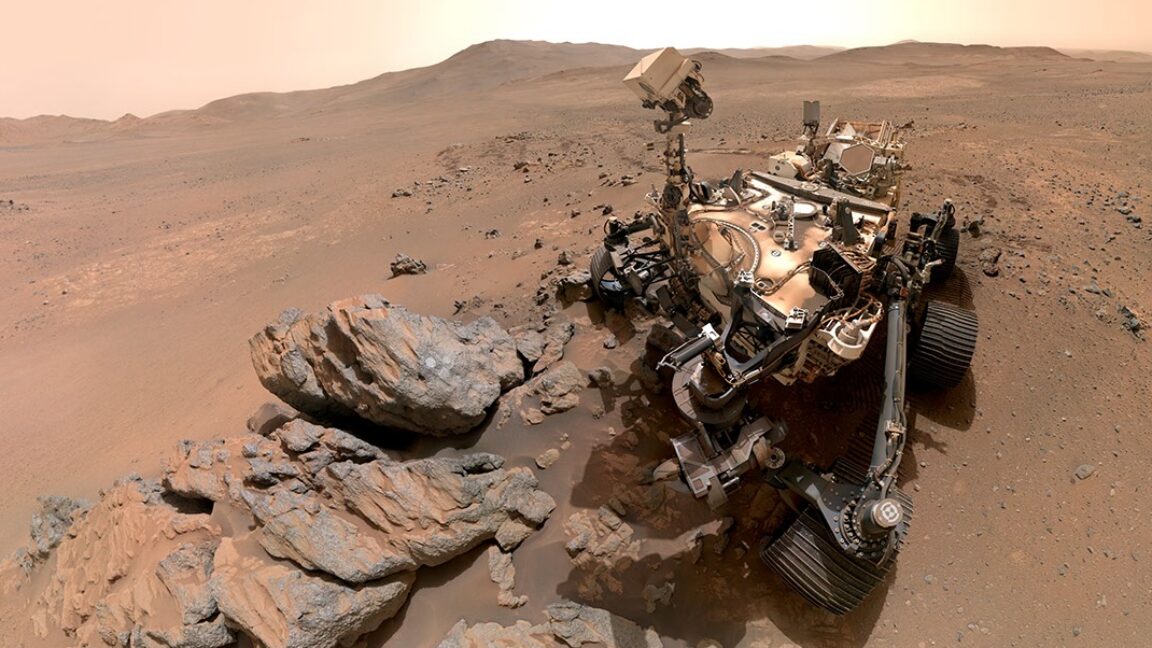
NASA’s Mars missions face contrasting situations: the Perseverance rover has set a record for the greatest distance traveled on another planet, while the Mars Odyssey orbiter is struggling with a failing reaction wheel that could sharply reduce its remaining operational life. Engineers are troubleshooting the aging spacecraft and hope it can return to science operations by the end of November.
Perseverance rover breaks Mars driving record
Perseverance, NASA’s six-wheeled Mars rover, broke the record for distance traveled on another planet last month. The rover surpassed the 28.06-mile (45.16-kilometer) record set by NASA’s Opportunity rover, which ceased operations in 2018.
Perseverance’s odometer now shows that it has traveled twice its original target distance.
Odyssey faces reaction-wheel failure
The situation is more serious for NASA’s Mars Odyssey orbiter. One of the spacecraft’s four reaction wheels stopped rotating in early November. Another wheel had already failed in 2013, leaving Odyssey with only two working wheels. At least three reaction wheels are required for the orbiter to maintain its proper orientation.
“Without the three reaction wheels, the spacecraft must rely solely on the hydrazine thrusters to maintain direction,” NASA said. Stable pointing is essential for orbiters, which must aim their solar arrays toward the Sun and their scientific instruments toward Mars.
Jeffrey Prout, Odyssey’s project scientist at NASA’s Jet Propulsion Laboratory, said in a presentation earlier this year that the spacecraft was already low on propellant before the latest reaction-wheel failure. However, mission managers were optimistic that Odyssey could continue operating at least through the end of 2028 because its fuel use was “extremely low.”
That outlook depends on the spacecraft retaining three intact reaction wheels. NASA estimates that without three healthy wheels, Odyssey has enough hydrazine fuel to operate for only one to two months.
Ground teams have had some early success while troubleshooting the unstable reaction wheels, but further testing is needed to determine whether the malfunctioning wheel can be repaired. “The research team hopes that the spacecraft will be able to return to science by the end of November.”
An aging Mars communications network
Odyssey is one of four orbiting satellites NASA uses to relay data between Earth and the Perseverance and Curiosity rovers on the Martian surface.
Curiosity has operated on Mars for 14 years and continues to collect scientific data. The other three communications relays are NASA’s Mars Reconnaissance Vehicle, which reached Mars in 2006; the European Space Agency’s 10-year-old ExoMars Trace Gas Orbiter; and ESA’s 23-year-old Mars Express spacecraft.
Source: arstechnica.com