


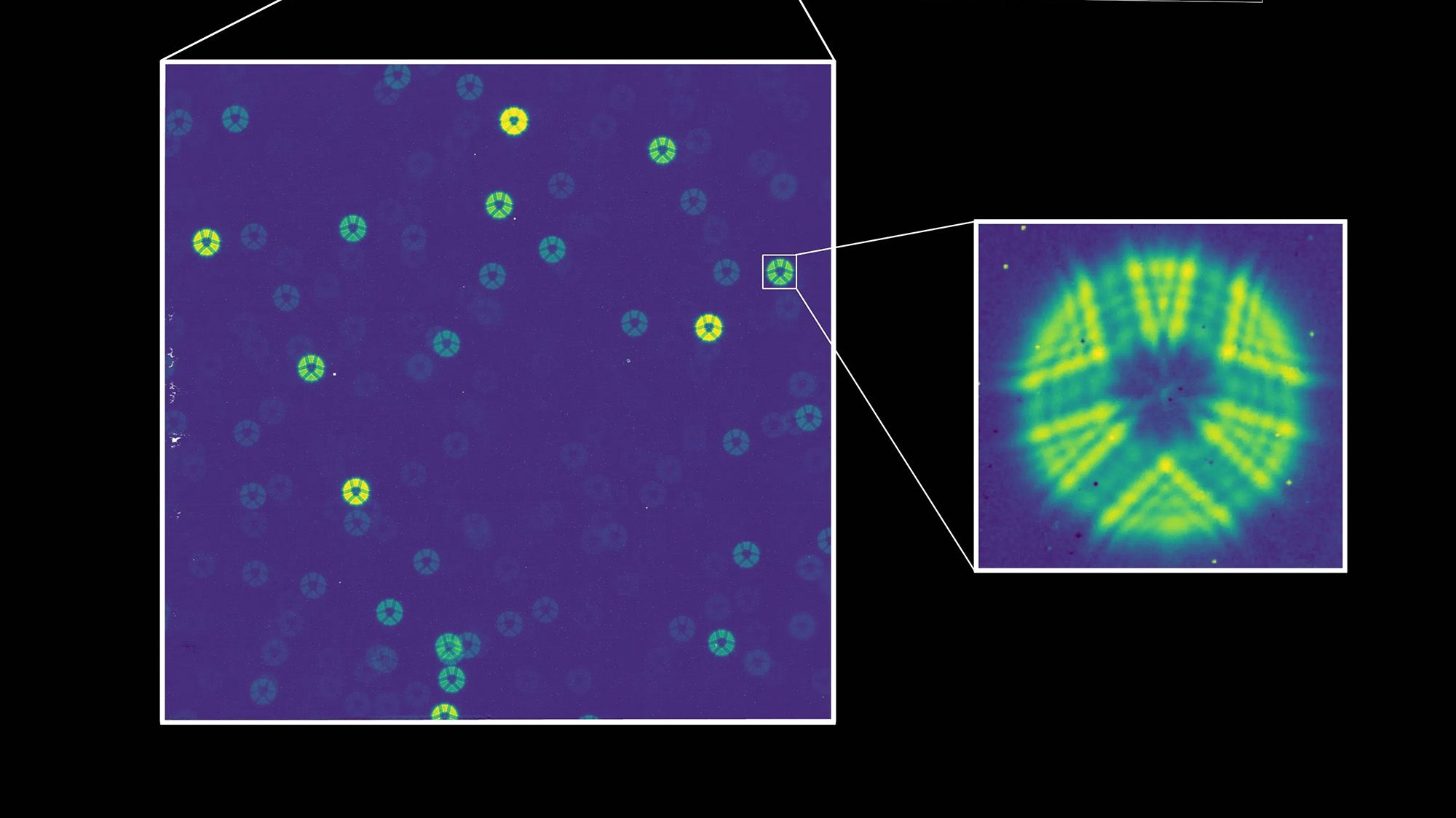
NASA’s Roman Space Telescope Reveals Its First Test Image: Green Rings of Light from Hundreds of Stars
Roman’s first test image shows hundreds of stars as rings of green light. After further tuning, the telescope will be able to capture images as clear as those from Hubble, but across an area 100 times larger.
Image credit: NASA Goddard Space Flight Center, Tyler Desjardins (STScI)
Quick facts
What it shows: Hundreds of stars captured in the Nancy Grace Roman Space Telescope’s first test image
Where: An unknown region of the universe
When it was shared: September 15, 2026
Imagine opening your eyes for the first time and seeing a sky filled with green donuts. That was the view captured when NASA’s Nancy Grace Roman Space Telescope activated its powerful 300-megapixel infrared camera for the first time.
Why Roman’s first image looks like green rings
Roman launched into space on August 30 and is now undergoing a months-long commissioning process. NASA scientists are testing and calibrating the spacecraft’s instruments before it begins its 1 million-mile (1.6 million-kilometer) journey to Lagrange Point 2, or L2.
L2 is an orbital “parking spot” where the competing gravity of the Sun and Earth helps hold a spacecraft in place. The James Webb Space Telescope and other scientific spacecraft also operate in this region.
Roman’s camera system, known as the Wide Field Instrument, or WFI, is not yet fully focused. That is why stars appear as lime-colored loops in the telescope’s debut test image. NASA said the spacecraft’s systems are working normally so far.
“After years of effort to build and test the device on the ground, we now have confirmation that it works in space. This is a major milestone,” Josh Schrider, WFI chief scientist at NASA’s Goddard Space Flight Center in Maryland, said in a statement. “There is much work to do, but we are on the path to breakthrough science.”

Roman will map huge areas of the universe
The rows of wavy squares in the new image are central to Roman’s imaging system. Each square represents one of the telescope’s 18 detectors, which convert photons from distant sources of light into electrical signals that encode images of the universe.
Scientists are preparing Roman to transmit about 1.4 terabytes of data to Earth every day—roughly five to 10 times the storage capacity of an average smartphone.
By early 2027, when Roman is expected to send its first complete science images, the telescope should be able to capture clear and detailed views of the universe. Each Roman image will cover an area 100 times larger than a comparable Hubble image.
What NASA hopes Roman will discover
With this enormous volume of data, scientists hope Roman will help investigate some of astronomy’s biggest mysteries. Long-term surveys of distant galaxies could reveal new objects, improve measurements of the universe’s expansion and provide new insights into dark energy and other cosmic phenomena.
Roman will also search for exoplanets. Its coronagraph can selectively block starlight, allowing scientists to observe objects around distant stars with unprecedented precision and reducing the glare that makes those worlds difficult to see.
These observations could increase the number of known exoplanets from the current total of more than 6,000 to more than 100,000 by the end of Roman’s planned 10-year mission.
Roman’s mission could last far longer than planned
NASA also reported that a successful thruster burn, together with bonus fuel loaded onto the spacecraft during liftoff, could extend Roman’s operational lifetime to 22 years. Like Hubble, which continues to operate beyond its initial mission parameters, Roman could remain a valuable space observatory for decades.
Are you a UFO enthusiast? Test your knowledge with our extraterrestrial life quiz.
Topics
Source: www.livescience.com