



A newly formed data extortion group called Inception is conducting a large-scale campaign aimed at stealing single sign-on (SSO) credentials from organizations around the world, according to cybersecurity firm ReversingLabs. The group appeared publicly on November 17 and listed seven alleged victims, including AMD, PepsiCo, Cigna Healthcare, AutoZone, and Lucid Motors, although none of those companies has publicly acknowledged a breach.
ReversingLabs said it has tracked Inception’s activity since late October. Its investigation identified 21 domains used for SSO phishing, 41 domains believed to be part of the group’s campaign infrastructure, and four additional domains suspected of being related to the operation.
The campaign’s infrastructure impersonates authentication services and dozens of well-known companies. The impersonated brands include Dropbox, Duolingo, Western Union, Indeed, Activision Blizzard, Riot Games, Twitch, Reddit, Nestlé, Anthropic, Nintendo, Starbucks, McDonald’s, Paramount, and NBCUniversal.
However, the presence of these domains does not demonstrate that any of those companies was compromised or targeted. None has recently disclosed a cyberattack or other related incident.
Source: BleepingComputer
A phone-based phishing campaign
ReversingLabs said the campaign appears to rely on phone-based social engineering, or “vishing,” rather than conventional email phishing. The tactics closely resemble those previously associated with the ShinyHunters extortion group.
Inception operates a law-themed website designed to imitate corporate authentication services, primarily Okta and, in some cases, NetIQ/OpenText Access Manager. The fake authentication pages are used to target corporate SSO credentials.
Possible connection to ShinyHunters
Okta released a report yesterday linking Inception to O-UNC-053, a threat cluster previously associated with ShinyHunters. O-UNC-053 has been active since March.
According to Okta, O-UNC-053 continued registering new phishing domains after law enforcement disrupted the ShinyHunters extortion group following the arrest of suspected members and the shutdown of its leak site.
In late October, the cluster launched a law-themed campaign. In mid-November, the Inception leak site went live and announced victims that matched targets associated with the earlier activity.
Okta said the change in leak-site branding was consistent with previous migrations by related actors:
“This gap of publishing on some breach site and then publishing on a new data breach site with a new brand is consistent with previous migrations by Com-related actors.”
Okta added:
“As O-UNC-053 maintained consistent infrastructure and TTPs before and after the DLS publication change, we assessed it as highly likely that the cluster had changed brand affiliation.”
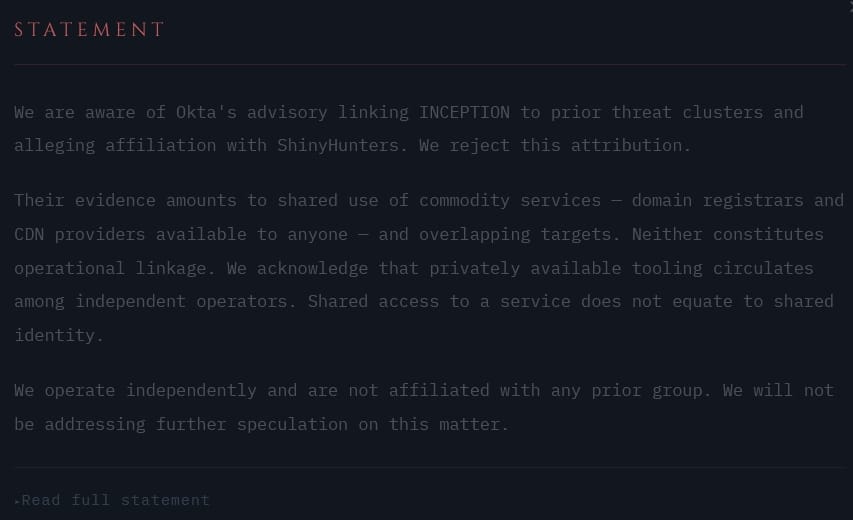
Inception quickly rejected the alleged connection. In a statement posted to its extortion site, the attackers claimed to operate independently and said they were not affiliated with any previous group.
The group also claimed that no operational relationship had been established through overlapping victims or the use of common domain-registration and content delivery network services. It acknowledged that private tools circulate among independent threat actors, arguing that the use of the same tools cannot by itself prove an affiliation.
Source: BleepingComputer
How organizations can reduce the risk
ReversingLabs recommends that organizations enforce phishing-resistant authentication, including FIDO2 security keys and passkeys. Companies should also strengthen identity-verification procedures for help desk requests, where attackers may attempt to persuade staff to reset credentials or bypass authentication controls.
Organizations should carefully review DNS, proxy, and identity-provider logs dating back to October 21, 2026, for signs of suspicious activity associated with the campaign.
ReversingLabs’ campaign analysis contains additional details about the infrastructure and phone-based social-engineering tactics.
Source: www.bleepingcomputer.com