


Could Blended Meat Make Sustainable Eating More Mainstream?
Food manufacturers are a major target for companies developing blended meat products. BMC Ingredients, which collaborated with Perdue on its line of blended nuggets, sells plant-based proteins that can be mixed with meat to add nutrition and flavor.
BMC grows mycelium, a fungus’s root-like structure. Mycelium is the basis of popular meat substitutes such as Quorn, and it also appears alongside mushrooms in Joyn’s 50/Cut products. Shapiro likens the company’s factory to a brewery. Instead of yeast fermenting barley, Neurospora crassa digests starch to produce proteins with a dense fiber network that creates a meat-like chew.
“We grow it for four hours before we harvest it,” Shapiro says. “This is one of the most efficient ways to produce protein on the planet.”
Blended meat moves beyond the grocery store
Joyn is also looking beyond grocery stores. More than half of what U.S. consumers spend on food is for meals eaten outside the home, according to the USDA.
Padric Doherty, who joined Joyn from meat distribution company D’Artagnan as chief growth officer, says the company’s main focus is on large food-service providers, including K–12 schools, college cafeterias and stadiums. These organizations often have sustainability goals while facing pressure to find nutritious and affordable options.
Joyn’s 50/Cut product, when sold in cafeterias, is 5% to 15% cheaper than beef.
Can mushroom burgers drive cultural change?
Can cafeteria mushroom burgers inspire broader cultural change?
Those who support blended meat see it as a bridge between conventional meat and fully plant-based foods. BMC’s Shapiro believes the shift toward blended products reflects how large-scale dietary changes often happen. Nectar’s Cotto compares blended meat to a hybrid car.
“Moving people towards blended products is a way to stimulate demand for some fully plant-based ingredients that currently don’t have the scale to drive prices down. So this is a short-term, long-term approach,” she says.
However, not everyone is convinced that market forces alone will be enough. Nir Zacharias, a longtime food sustainability entrepreneur who brings plant-based options to New York City delis through his company Plantega, is skeptical.
“Too many people in this field believe that if you make meat that doesn’t come from animals, tastes like meat and costs the same, people will eat it,” he says. “I think the plant-based backlash against ultra-processed foods shows that things don’t always have to be that way.”
Zacharias believes blended meat’s greatest impact could be in institutional settings such as schools and medical facilities.
“People in this field believe that as long as they make meat that tastes like meat and is not from animals, people will eat it.”
Nir Zacharias, founder and CEO of Plantega
Can familiar flavor make alternative protein more appealing?
Blended meat may offer enough familiar flavor to make consumers more open to alternative proteins. Some studies have found that thinking about simulated meat can prompt people to reconsider the broader food system.
In the 2010s, Clemens Driessen, a cultural geographer at Wageningen University & Research in the Netherlands, worked on a project that asked people in pubs, supermarkets and other public spaces what they thought about meat grown in a laboratory.
“The first reaction is, ‘Oh, that’s terrible,’” Driessen said. People also tended to think that the meat they already consumed was highly industrialized.
“There’s a train of thought that comes from proposing something so new,” he says.
Provided by 50/50 Foods
The climate case for blended burgers
If this category succeeds, climate change advocates may have to come to terms with imperfect solutions. A life-cycle analysis of the 50/Cut Burger commissioned by Joyn found that the product has half the greenhouse gas emissions of a beef patty.
Based on the company’s claims, that would give it roughly five times the climate impact of an Impossible or Beyond burger. Hedenas, the climate scientist, supports trying solutions that can reduce emissions, even if blended products do not deliver the same reductions as fully plant-based alternatives.
“It’s very difficult to change the way you eat, so I think most good suggestions should be considered,” he says.
Where blended burgers are being sold
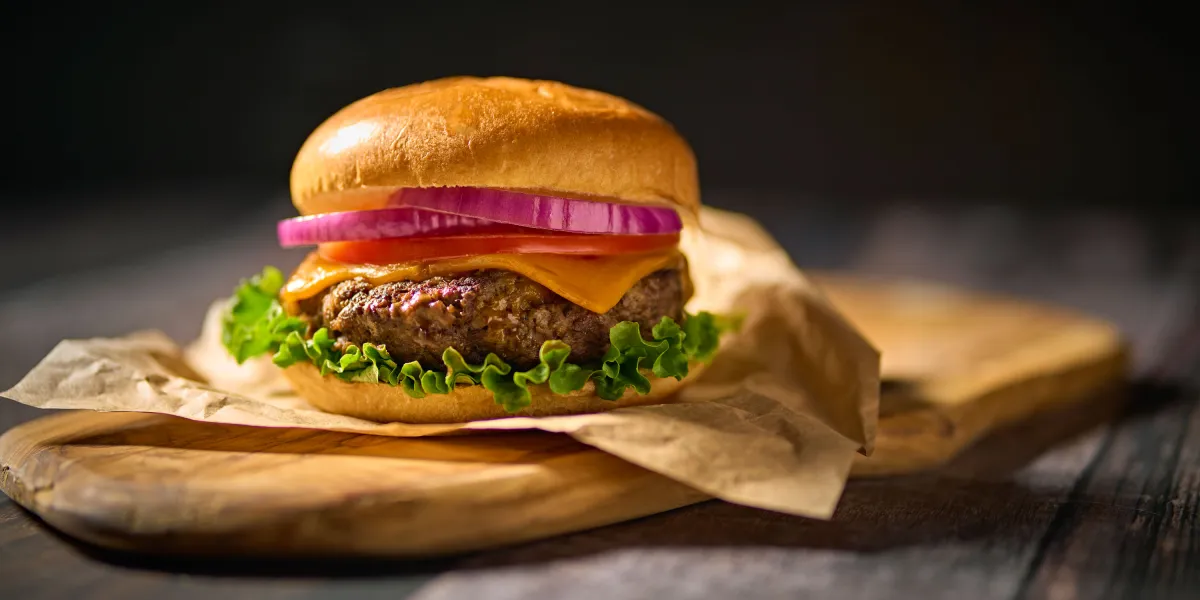
Blended meat products are now appearing on more plates, including in cafeterias, high-end grocery stores and a small hamburger chain. The products are also listed in the catalogs of major distributors such as Sysco.
The Both Burger is available at Disneyland, suggesting that blended meat may be moving from a niche sustainability concept toward more mainstream food-service menus.
Source: www.technologyreview.com