


Uranus and Neptune May Have Formed From Different Cosmic Materials
Although Uranus and Neptune are often called planetary twins, new research suggests that their chemical compositions—and possibly their evolutionary histories—may be far more different than expected.
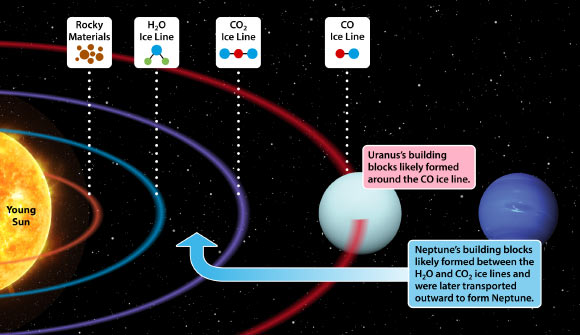
The material that makes up Neptune and Uranus may have come from different regions of the protoplanetary disk around the young Sun. Image credit: SwRI.
“Uranus and Neptune may look like twins today, but their chemistry suggests they are cousins with very different histories,” said Olivier Moussi, a researcher at the Southwest Research Institute.
“The composition of their atmospheres may be related to different regions of the protoplanetary disk in which the planets formed, and the similarities would be a remarkable coincidence.”
Carbon monoxide offers a glimpse beneath the clouds
Both ice giants have been visited only once—by NASA’s Voyager 2 spacecraft in the 1980s—and much of their deep composition remains unknown.
To investigate their hidden chemistry, the researchers used carbon monoxide detected in the planets’ upper tropospheres as an indirect probe. The gas is thought to form deep inside Uranus and Neptune, where it chemically combines with water before being carried upward by vertical mixing.
By modeling this process, the scientists were able to work backward and estimate how much oxygen lies beneath the visible cloud layers.
“While we don’t have direct access to the deep atmospheres of Uranus and Neptune, chemical tracers allow us to examine conditions hidden beneath the visible clouds,” Moussi said.
“The study is particularly useful because carbon monoxide is abundant in the upper troposphere. These data can be used to model the chemical evolution of protoplanetary disks and the origin of their materials.”
Uranus and Neptune show different chemical signatures
For Uranus, the model used new measurements of carbon monoxide from the Atacama Large Millimeter/submillimeter Array (ALMA), which the researchers estimated at approximately 5.6 parts per billion. Neptune’s carbon monoxide levels are about two orders of magnitude higher.
When vertical mixing was allowed to vary with latitude, the researchers estimated that Uranus has an oxygen-to-hydrogen ratio 62 to 177 times higher than the Sun’s. Neptune’s ratio was estimated at 222 to 342 times higher.
The study also estimated a carbon-to-oxygen ratio of approximately 0.06 to 0.52 for Uranus and 0.02 to 0.12 for Neptune.
The scientists then compared these values with a model of the young Sun’s protoplanetary disk—the rotating disk of gas and dust from which the planets formed.
Did Neptune form far from its current location?
The upper limit for Uranus’s carbon-to-oxygen ratio is close to the Sun’s value, while Neptune’s ratio is clearly lower. The result suggests that some of Neptune’s components may have formed near a water-ice line closer to the Sun.
Uranus’s lower values may be compatible with material that formed inside the methane-ice line.
“Neptune’s chemistry is difficult to reconcile with the idea that Neptune was drawn from the same storehouse of cosmic material as Uranus and formed where we see it today,” Moussi said.
“Instead, our model led us to believe that its components traveled a long way to where Neptune could accrete them. In short, two superficially similar worlds may have arrived at their current positions through two very different evolutionary paths.”
Why future missions to Uranus matter
The lack of direct access to the atmospheres of Uranus and Neptune continues to limit scientists’ understanding of their compositions, interiors and geological histories.
“Our discoveries have implications far beyond Neptune and Uranus, and even far beyond our solar system,” Moussi said.
Planets comparable in size to Uranus and Neptune are common around other stars, making the two ice giants important benchmarks for understanding how planets form and evolve across the galaxy. Future missions, including NASA’s Uranus Orbiter and Uranus Explorer, scheduled to launch within the next decade, could provide crucial new data.
The study was published in Astronomy & Astrophysics.
_____
T. Briand et al. 2026. “Contrasting the C/O ratios of Uranus and Neptune through disequilibrium chemistry: clues to different evolutionary paths?” A&A 714, A364; doi: 10.1051/0004-6361/202660770
Source: www.sci.news