


Myanmar Earthquake Reveals How the San Andreas Fault Could Intensify Shaking During “The Big One”
A devastating 2025 earthquake in Myanmar could help scientists better predict where the strongest shaking would occur if a major earthquake struck California’s San Andreas Fault.
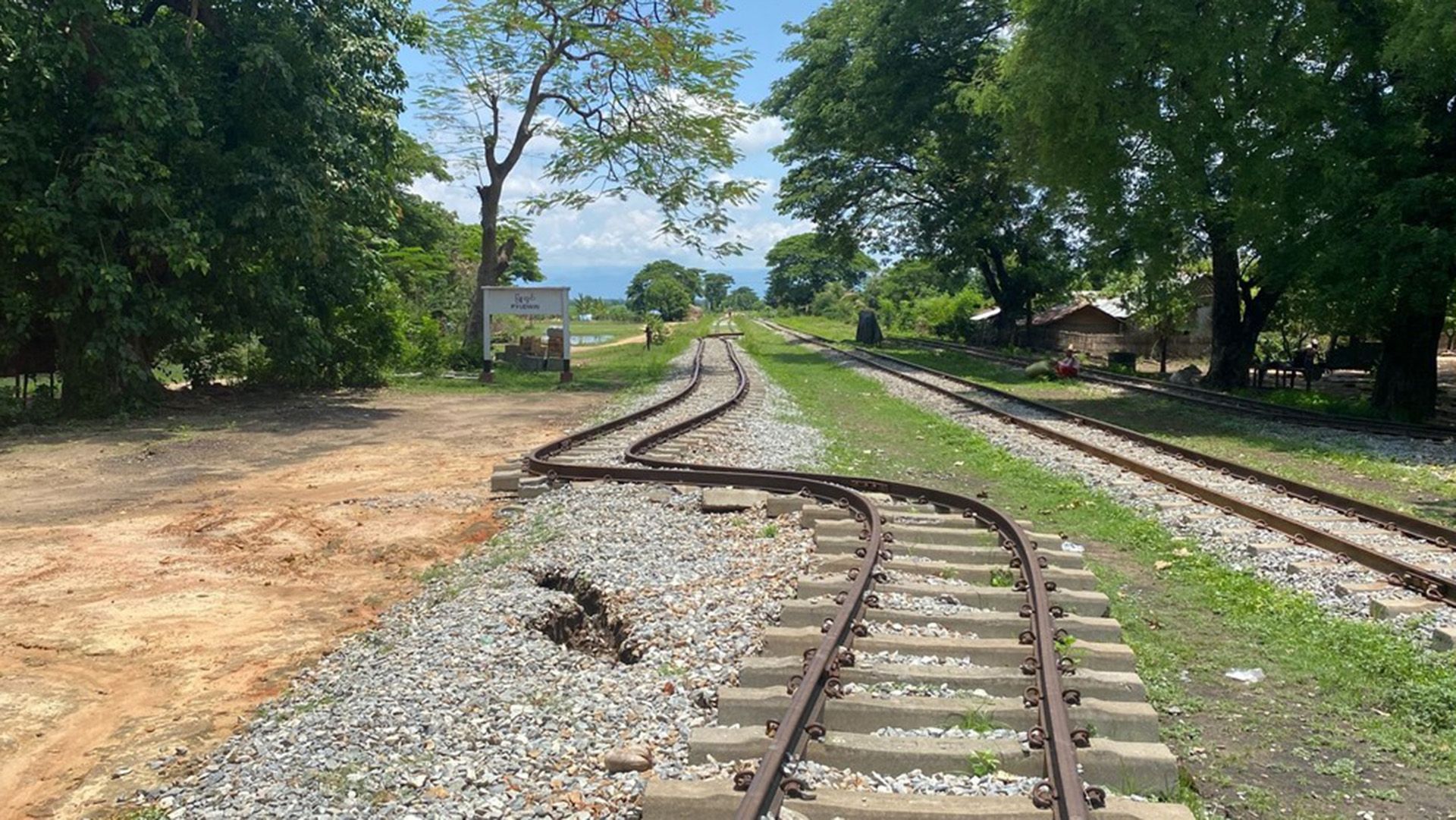
The magnitude 7.7 earthquake struck near Mandalay on March 28, 2025, shaking buildings as far away as Bangkok, about 830 miles (1,330 kilometers) away. At least 3,700 people died, according to the Asian Disaster Reduction Center.
A new study combining detailed satellite data with unique video of the ground rupture found that the fault had a twisted, almost spiral-like shape. That unusual geometry influenced how the earthquake ruptured and where the strongest shaking occurred.
A rare video captured the ground splitting apart
The Sagaing Fault in Myanmar is similar to many strike-slip faults around the world that threaten populated areas, said Alice Agnes Gabriel, a geophysicist at the Scripps Institution of Oceanography at the University of California, San Diego, and a co-author of the study.
The Sagaing Fault has similarities to California’s San Andreas Fault, which is also tilted and could produce an earthquake of approximately magnitude 7.8, according to the U.S. Geological Survey.
“The idea is that while we can’t predict when or where an earthquake will occur along a particular fault, we may be able to predict certain aspects of an earthquake,” Gabriel told Live Science.
Gabriel and her colleagues use powerful supercomputers to model earthquake scenarios. The accuracy of those models depends on the quality of the data available to researchers.
For the Myanmar earthquake, scientists had an unusually valuable source of information: security video showing the ground cracking and rupturing. According to the researchers, the footage captured a fault breaking at the surface in a way that had never been recorded on video before.
The Myanmar fault was tilted underground
The researchers’ model showed that the Sagaing Fault is not a vertical plane underground. Instead, the fault dips westward at its northern end, is nearly vertical in the center and dips eastward at its southern end.
Earthquakes generally produce stronger shaking in the direction that a fault dips, Gabriel said. Along California’s San Andreas Fault, the dip is toward the inland high deserts.
That means the high-desert side of the San Andreas Fault could experience more intense shaking than the coastal side if a major earthquake behaved similarly to the Myanmar event. The San Andreas Fault has also been accumulating strain for more than a century, raising questions about whether its geometry could influence future shaking in a comparable way.
Why Los Angeles could still face severe shaking
Gabriel cautioned that people living near dangerous faults should continue preparing for strong shaking. Local conditions can significantly affect how an earthquake is experienced.
For example, Los Angeles sits on top of a sediment-filled basin. During a large earthquake, that soft sediment can amplify ground movement, causing the ground to shake like jelly.
These local variations mean that understanding a fault’s overall shape is not enough to predict exactly how every community will be affected.
Locked sections of the Sagaing Fault stored strain for 186 years
The researchers also examined whether features of the Mandalay earthquake could have been anticipated using monitoring data collected before the event.
They knew that some sections of the Sagaing Fault were “locked,” meaning the rocks on either side of the fault were stuck together even as the tectonic plates continued moving. These locked sections had accumulated strain for 186 years.
The study found that the path, shape and speed of the rupture could be modeled using detailed information available before the earthquake, including the fault’s geometry deep underground and how long parts of the fault had remained locked.
Could the same approach improve San Andreas earthquake forecasts?
Similar modeling could potentially be applied to the San Andreas Fault and other major faults around the world. Previous research has also examined characteristics such as fault simplicity and maturity, which may help scientists understand how different faults could rupture.
Researchers are now updating their models of what a major San Andreas earthquake might look like. The results could help the public prepare, improve building codes and inform emergency managers.
“This shows how this long-term fault monitoring data can be leveraged,” Gabriel said.
Study reference: Ulrich, T., Zou, X., Marchandon, M., Schliwa, N., Tan, F., Gabriel, A.-A., Fan, W., Shearer, P., Thant, M., Tin, T. Z. H., Lindsey, E. O. and Fialko, Y. (2026). “On the predictability of slip, rupture shape, and velocity of the 2025 M7.8 earthquake in Mandalay, Myanmar.” Nature Communications, 17(1).
Source: www.livescience.com