


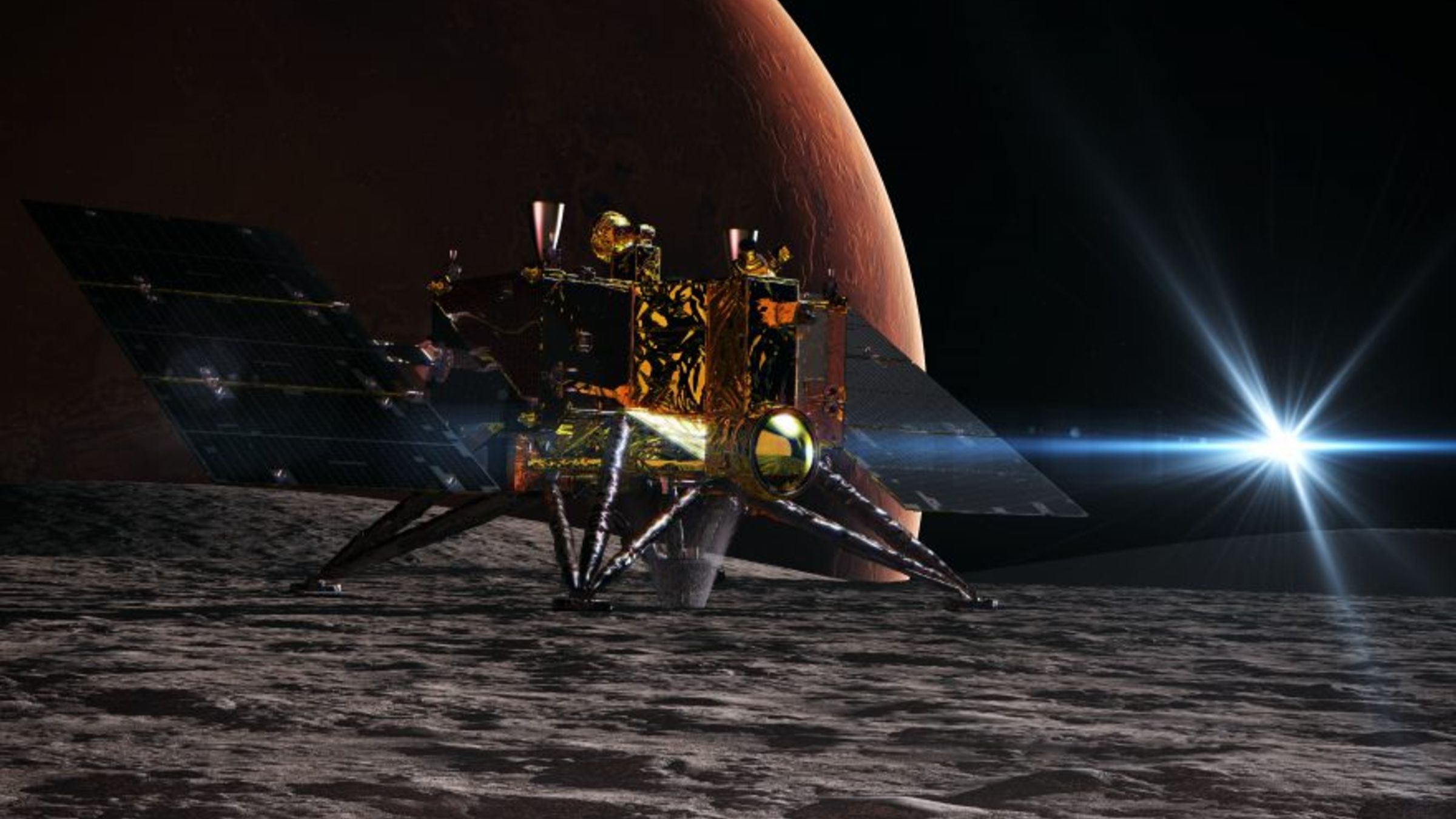
Japan Launches Historic MMX Mission to Return Samples From Mars’ Moon Phobos
JAXA’s Martian Moons Exploration probe will study Phobos and Deimos, collect samples from Phobos and return them to Earth in 2031.
Japan has launched a first-of-its-kind sample-return mission to Mars. The historic mission could help solve a decades-old mystery: how Mars’ two small moons, Phobos and Deimos, formed.
The Japan Aerospace Exploration Agency’s (JAXA) Martian Moons Exploration (MMX) probe is an international project built with help from NASA, the European Space Agency (ESA) and other partners. Over the next few years, the spacecraft will study the Red Planet’s twin moons, photograph them up close and attempt to collect rocky material from Phobos.
If successful, MMX will return the samples to Earth in 2031. The material could reveal whether Phobos and Deimos are captured asteroids, remnants of an ancient impact on Mars or something else entirely. It could also provide new clues about Mars’ ancient history and the early solar system.
Image credit: NASA/JPL/University of Arizona
“This mission marks a transformative leap in our capacity to investigate the Martian system,” Sonia Fornasier, an astronomer at the Paris Observatory and a project scientist for MMX’s infrared spectrometer instrument, told Live Science. She added that the mission “ranks very high” among the missions sent to the Red Planet.
How will the MMX mission study Mars’ moons?
JAXA launched the MMX spacecraft aboard an H3 rocket from Tanegashima Space Center in Kagoshima prefecture at 3:41 p.m. EDT Monday, Oct. 19 (4:41 a.m. Tuesday local time). The mission had originally been scheduled to launch in 2024 but was delayed because of initial concerns about the H3 rocket.
The camper-van-sized spacecraft separated from the rocket’s fairing just over an hour after liftoff. On Wednesday, Oct. 21, JAXA announced that MMX had passed its “initial critical operations phase.” The probe is now on a roughly 140 million-mile (225 million kilometers) journey to Mars that will take about 10 months.
“MMX took its first step today,” Naoki Murakami, general manager of Mitsubishi Electric’s space division, said at a postlaunch news conference, according to The Japan Times. “This marks the beginning of a long, five-year journey.”

Image credit: JIJI Press / AFP via Getty Images
MMX is expected to arrive at Mars in August 2027. It will then enter a “quasi-satellite orbit” around Phobos, circling Mars alongside the moon without being gravitationally bound to it.
After several months of remote observations, the spacecraft will attempt two landings on Phobos. During the first, MMX will hover above the moon and deploy Idefix, a small rover built by the French and German space agencies.
The rover will explore the surface and help mission scientists choose a suitable landing site. Because Phobos has extremely weak gravity, Idefix will need to operate in an unusual environment. The rover weighs about 55 pounds (25 kilograms) on Earth but would weigh only around half an ounce (15 grams) on Phobos, according to ESA.
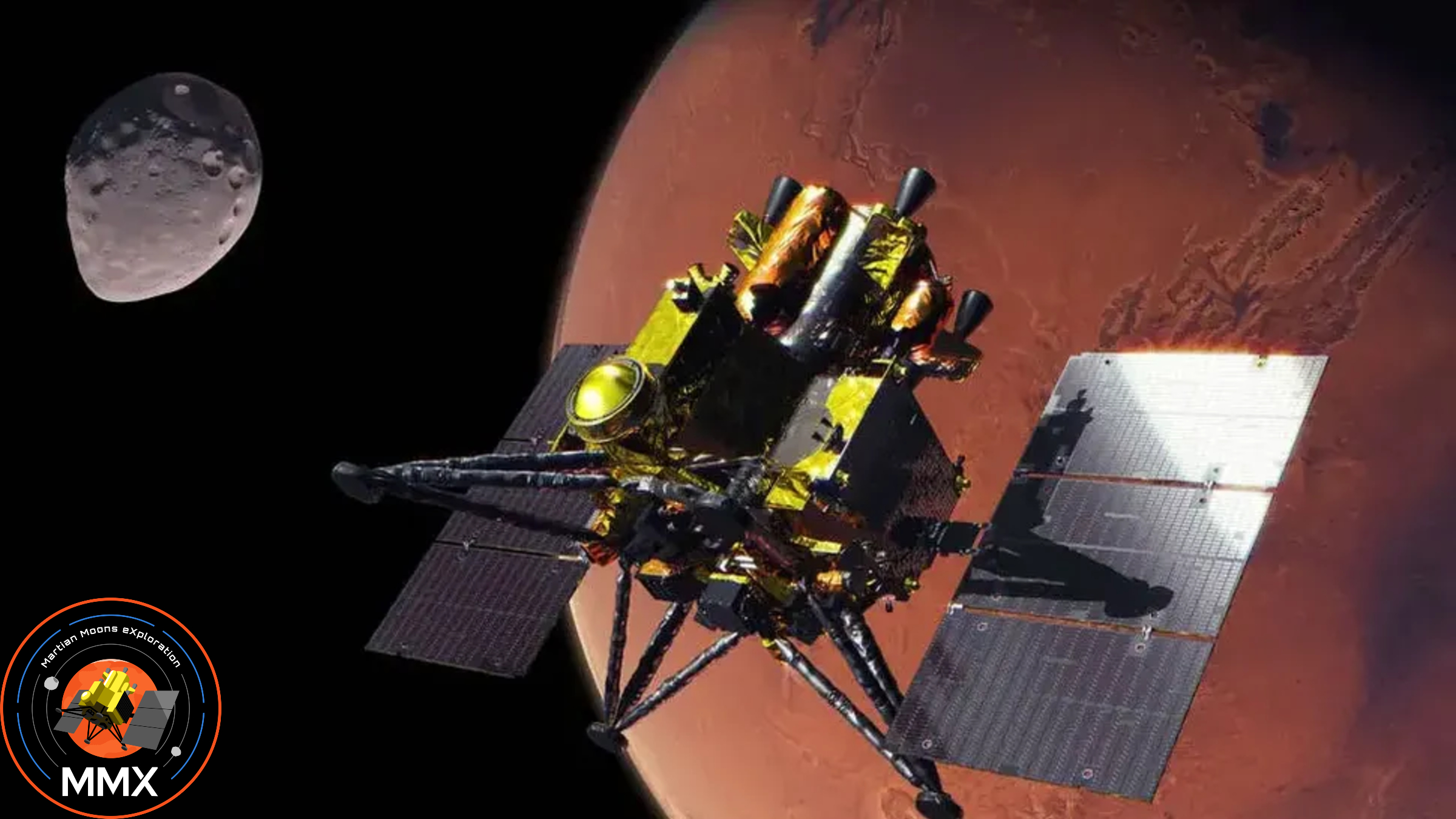
Image credit: JAXA/MMX
Once Idefix completes its initial survey, the main MMX spacecraft will land on Phobos using a four-legged lander module. Mission scientists hope the landing will be more successful than Japan’s “Moon Sniper” and Resilience lunar landers, which crash-landed on the moon in 2024 and 2025, respectively.
Two of MMX’s landing legs contain sampling devices. One will drill into Phobos, while the other will collect material from the moon’s surface. The second device, called the Pneumatic Sampler, or P-Sampler, was built by Honeybee Robotics for NASA.
The P-Sampler is designed to collect material in only a few seconds. “You blink, and it’s all done,” Kris Zacny, vice president of Honeybee Robotics’ Exploration Technology Group, said at a NASA news conference on Oct. 15.
JAXA aims to collect about a third of an ounce (10 grams) of material from Phobos. That would be roughly twice the amount recovered by the agency’s Hayabusa2 mission, which collected samples from the spinning-top-shaped asteroid Ryugu in 2019. Those samples contained materials rich in surprising organic compounds.
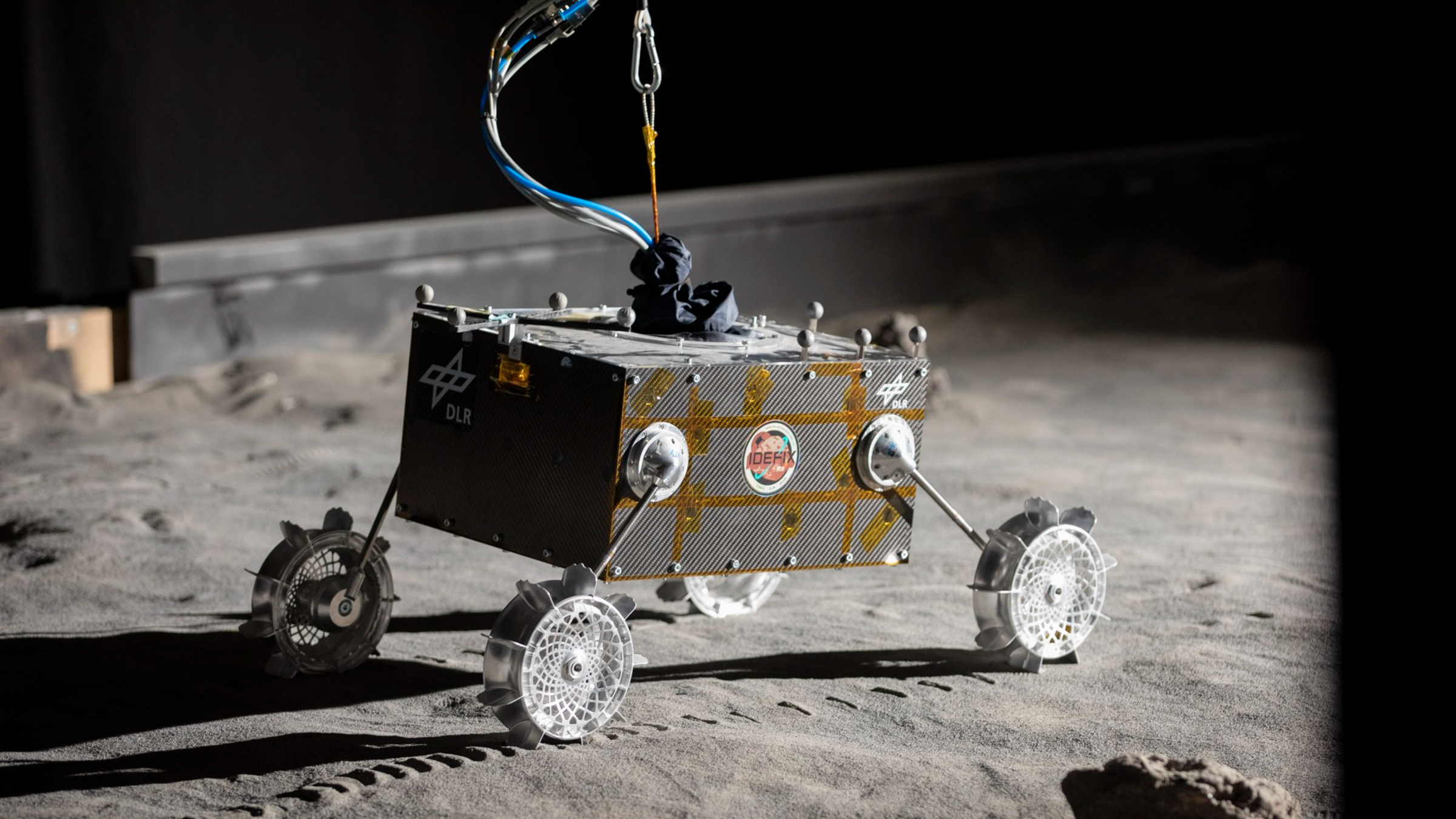
Image credit: DLR
After collecting the samples between late 2028 and early 2029, MMX will make close flybys of Mars’ smaller moon, Deimos. The spacecraft is expected to begin its journey back to Earth in late 2030 — the first return flight ever attempted by a spacecraft sent to Mars.
When MMX reaches Earth in 2031, it will release the samples in a container about 20 inches (60 centimeters) wide. The capsule will fall back to Earth, most likely landing somewhere in Australia, according to ESA.
What are Phobos and Deimos like?
Mars’ two moons were first spotted by American astronomer Asaph Hall in 1877. They are far smaller and more irregularly shaped than Earth’s moon. Phobos is about 14 miles (22 kilometers) across, while Deimos is approximately 7.5 miles (12 kilometers) wide.
The moons also orbit much closer to Mars than Earth’s moon does to Earth. Their names come from Greek mythology: Phobos means “fear” and Deimos means “terror.” They were named after the sons of Ares, the Greek counterpart of the Roman god Mars.
Phobos is dominated by Stickney crater, an impact feature about 6 miles (10 kilometers) wide. The moon is gradually spiraling toward Mars and may eventually be torn apart before reaching the planet’s surface.
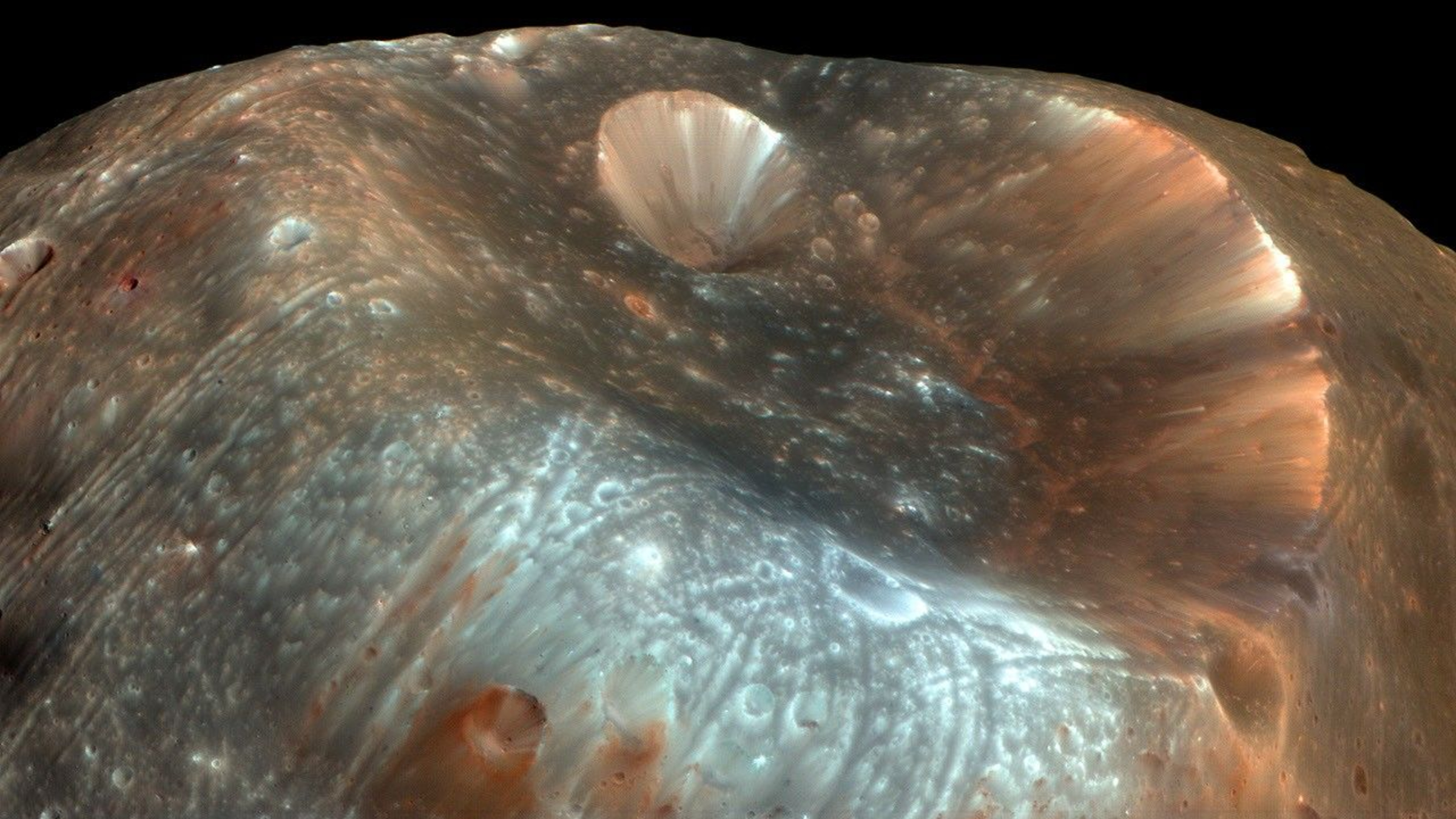
Image credit: HiRISE, MRO, LPL, University of Arizona and NASA
Other spacecraft have flown close to Mars’ moons. The Emirates Mars Mission orbiter studied them, while NASA’s Mars rovers have observed Phobos and Deimos passing in front of the sun in Mars’ sky. However, many questions about the moons remain unanswered.
“Mars is right in our cosmic backyard, and yet we haven’t explored the planet’s moons,” Nancy Chabot, a space exploration expert at the Johns Hopkins Applied Physics Laboratory and deputy principal investigator of NASA’s MEGANE instrument aboard MMX, told Live Science. “MMX will do this!”
How did Mars’ moons form?
The biggest mystery surrounding Phobos and Deimos is their origin. Some researchers believe they are asteroids — or possibly comets — captured by Mars’ gravity. Others think the moons formed from debris blasted into orbit after a massive impact on Mars, in a process similar to the formation of Earth’s moon.
Neither theory is conclusive. Christopher Edwards, a planetary scientist at Northern Arizona University and one of NASA’s participating scientists for MMX, said the moons’ origins “remain enigmatic.”
Capturing the moons as asteroids would be difficult to explain from an orbital-mechanics perspective. But if they formed from an impact-generated debris disk, researchers would expect them to have coalesced into more spherical bodies.
MMX could resolve the debate by combining spacecraft observations with laboratory analysis of Phobos samples on Earth. Data gathered during the mission’s Deimos flybys will also allow scientists to create a detailed characterization of the smaller moon.
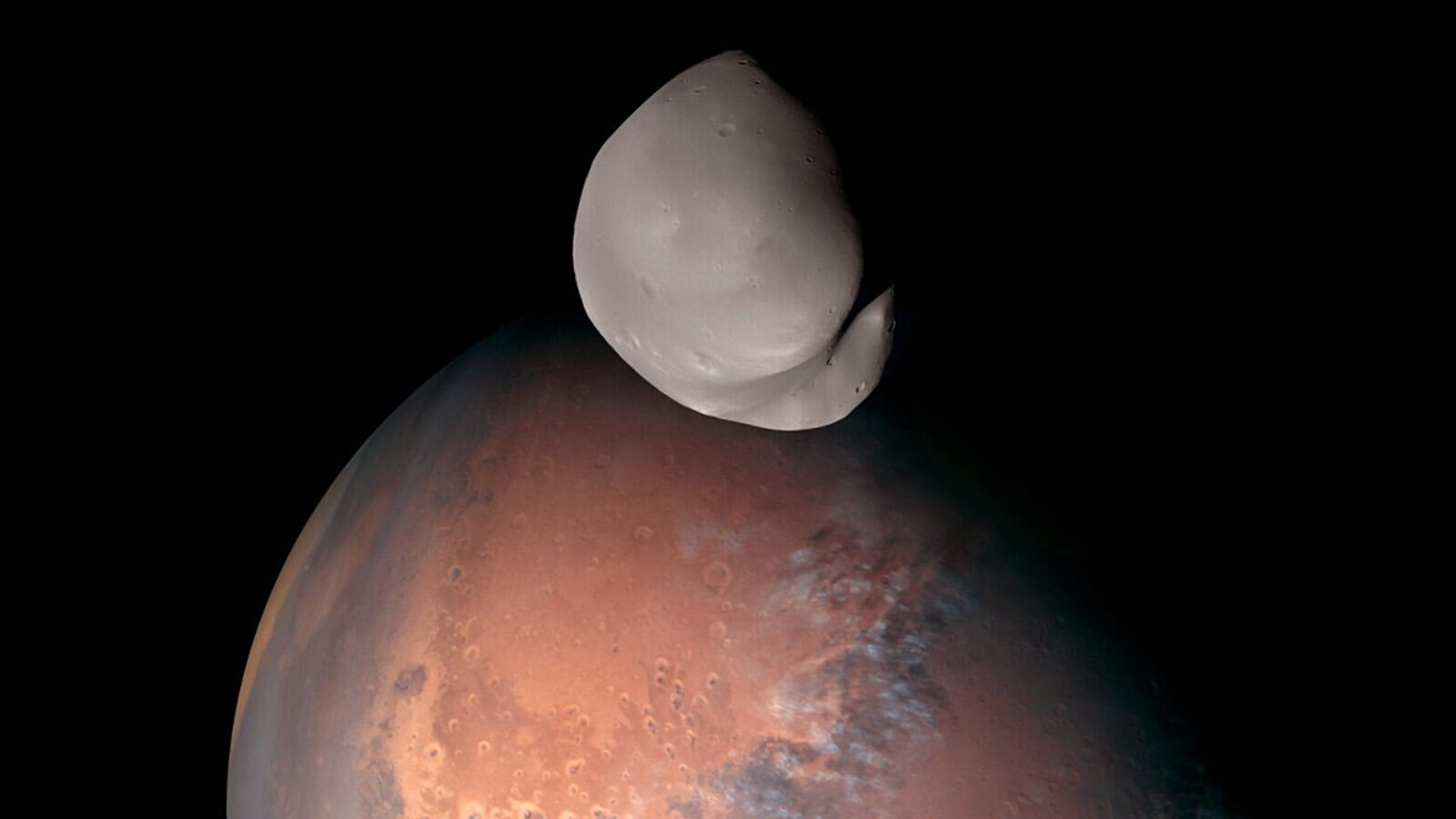
Image credit: Emirates Mars Mission
Fornasier is especially interested in the possibility that Phobos and Deimos are captured asteroids. If so, the moons could contain organic and hydrated materials, which would have important implications for astrobiology and the study of the early solar system.
What could MMX reveal about Mars?
Regardless of how the moons formed, MMX could reveal important information about Mars and the way planets develop and evolve.
“Phobos and Deimos are interesting, but not just in their own right,” Tom Statler, an MMX program executive and scientist in NASA’s Planetary Science Division, said at the Oct. 15 news conference. “Their presence is a key piece of the larger story of the Mars system. By uncovering the moons’ origin, we’ll gain new insights into the history of both Mars and Earth.”
If Phobos formed from material blasted off Mars, the samples could contain actual pieces of the Martian surface. Although Martian meteorites have already reached Earth, atmospheric entry can alter them. Samples collected directly from Phobos could preserve a different record of Mars’ past.
The discovery of Martian material on Phobos would also be significant because NASA canceled its Mars Sample Return program earlier this year. That mission would have brought samples collected by NASA’s Perseverance rover back to Earth. NASA researchers are expected to receive up to 15% of the MMX samples for analysis.
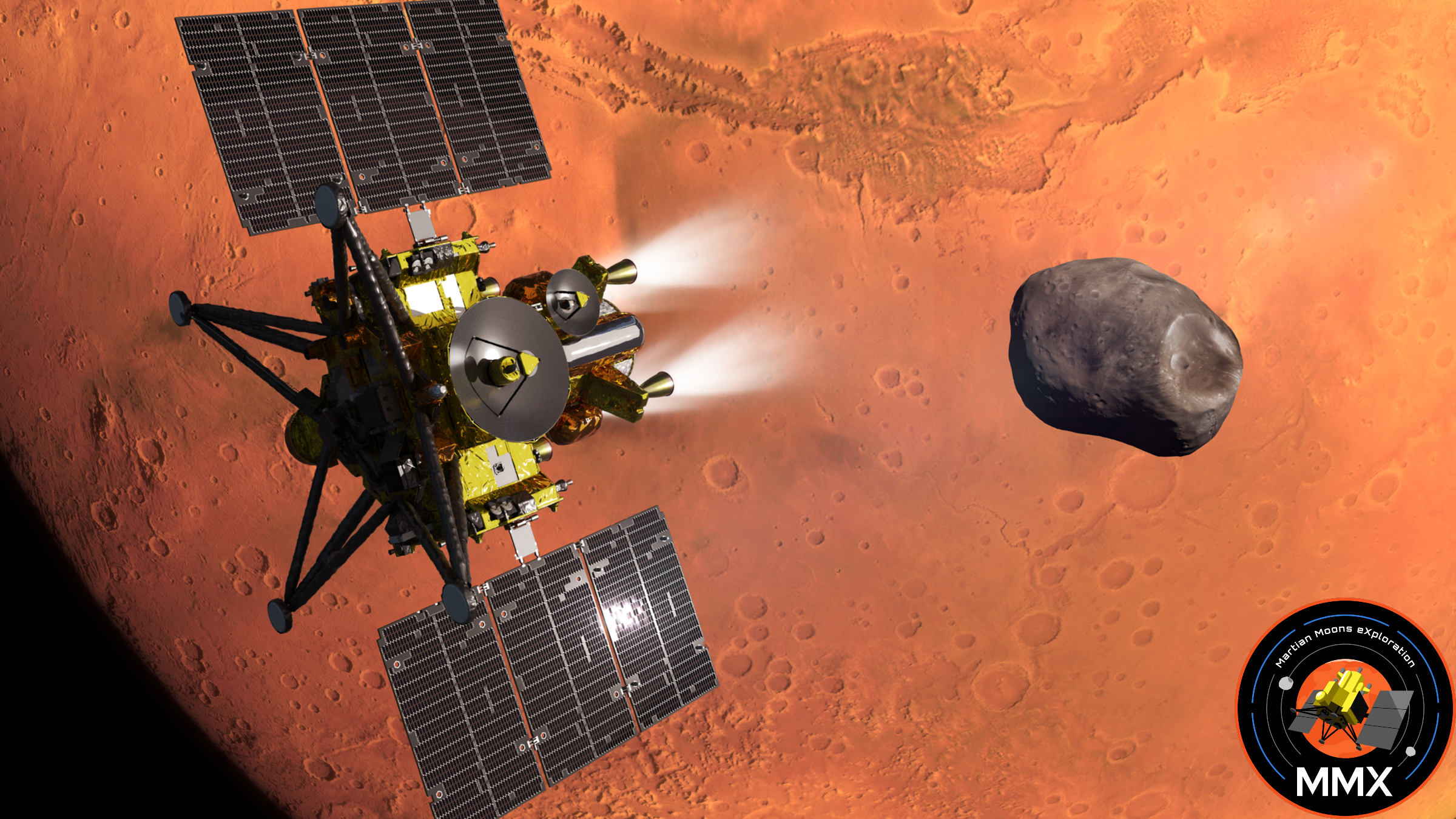
Image credit: JAXA/MMX
During its three-year mission in the Martian system, MMX will also collect data on Mars’ atmosphere. Scientists will focus on dust and water transport, as well as the processes that cause the atmosphere to escape into space.
This atmospheric data could temporarily help fill a gap left by NASA’s MAVEN spacecraft, which stopped returning data to Earth late last year.
Analysis of craters on Phobos and Deimos could offer additional clues about Mars’ history. Some researchers have proposed that the Red Planet once had rings like Saturn or possessed a larger moon that later broke apart.
Researchers hope the mission’s findings will guide future exploration of Mars and possibly help prepare for human missions. “The samples from MMX will bring forth paradigm-shifting science on the Mars system for generations to come, especially as NASA prepares to send the first humans to Mars,” Nicky Fox, associate administrator for NASA’s Science Mission Directorate, said in a statement.
The next planned sample-return mission to Mars is China’s Tianwen-3, which is scheduled to launch in 2028 and aims to land on the Martian surface and retrieve samples directly from the planet.
Source: www.livescience.com