


Average Human Genome Contains 4.3–5.3 Million Genetic Differences, Study Finds
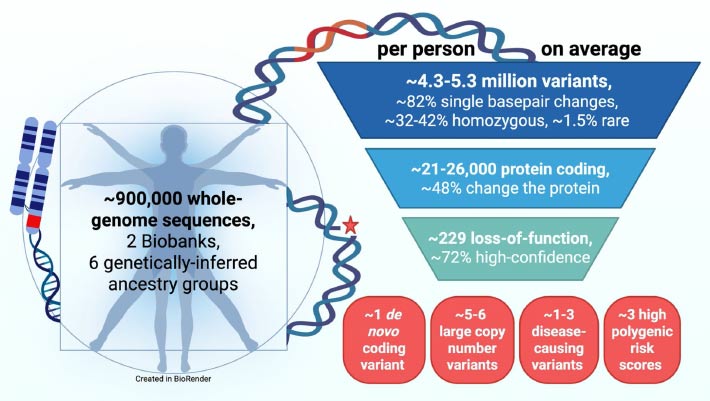
Researchers at the University of Exeter Medical School have created the most comprehensive picture yet of the “average” human genome, analyzing whole-genome sequences from approximately 900,000 adults in the UK Biobank and the US-based All of Us research program.
The average human genome contains 4.3 to 5.3 million genetic differences, of which about 1.5% are rare. Image credit: Wright et al., doi: 10.1186/s13073-026-01792-x.
Genetic variation is the norm
“Whole-genome sequencing has become a very important tool in the diagnosis of genetic diseases, and is increasingly moving towards genetic screening to predict disease,” said Professor Caroline Wright, corresponding author of the study.
“But most people don’t realize how much genetic variation exists across all genomes.”
“In fact, variation is the norm. Our study provides the first overview of what can be expected from the average human genome, and could benefit clinicians and patients around the world in understanding, interpreting, and contextualizing genomics.”
Professor Wright and her colleagues found that the typical human genome differs from the standard reference sequence at approximately 4.3 to 5.3 million sites.
Most of these differences are common within populations, occur outside genes, and are unlikely to have a measurable impact on health. Only about 1.5% of an individual’s genetic differences are rare.
People of African ancestry carry more genetic differences on average
People with African ancestry carried about 1 million more genetic differences on average than people in other groups. The researchers believe that part of this gap may be explained by reference genomes constructed primarily from people of European descent.
The study also found that the average person carries approximately 229 mutations predicted to disrupt a gene’s function. However, only about 72% of these were considered reliable genetic mutations.
Most disease-associated mutations do not cause disease
Among genes associated with inherited monogenic diseases, the average person carries approximately one to three mutations that the ClinVar database classifies as pathogenic or potentially pathogenic.
Most people have a single copy of a recessive disease-associated mutation, meaning they are healthy carriers rather than affected by the disease.
Participants also carried approximately 50 rare “variants of uncertain significance,” whose effects scientists have not yet been able to interpret.
“We found that everyone has a small number of genetic mutations that are associated with disease, but many of them do not actually cause the person to have the disease,” the researchers said.
“Therefore, it is important to consider circumstances such as symptoms, family history of disease, and other clinical and environmental risk factors when interpreting genetic test results.”
New mutations and parental age
Using data from 2,334 parent-child trios, the researchers estimated that each person has approximately 61 new mutations in their DNA. About two additional mutations arise early in development.
Approximately 75% to 80% of the new mutations that could be traced were paternal in origin.
For every year that the father’s age at conception increased, the number of new mutations rose by about 1.2. For every year that the mother’s age increased, the number rose by about 0.4.
Genetic risk scores vary across populations
Polygenic risk scores, which combine the effects of many small genetic variants to estimate disease risk, produced similar findings.
Among 28 common symptoms, the average person ranked in the top 10% for approximately three symptoms.
About one in five participants of European descent scored in the top 1% for at least one condition, compared with approximately one in three participants from other groups. The researchers said this difference probably reflects the poorer performance of scores developed primarily in European populations, rather than actual differences in disease risk.
“Our findings also provide important context for professionals who interpret genetic test results or commission genetic screening programs.”
The study was published in the journal Genome Medicine.
_____
Wright et al. 2026. The average individual genome: A survey of nearly 1 million whole-genome sequences. Genome Medicine 18, 160; doi: 10.1186/s13073-026-01792-x
Source: www.sci.news