


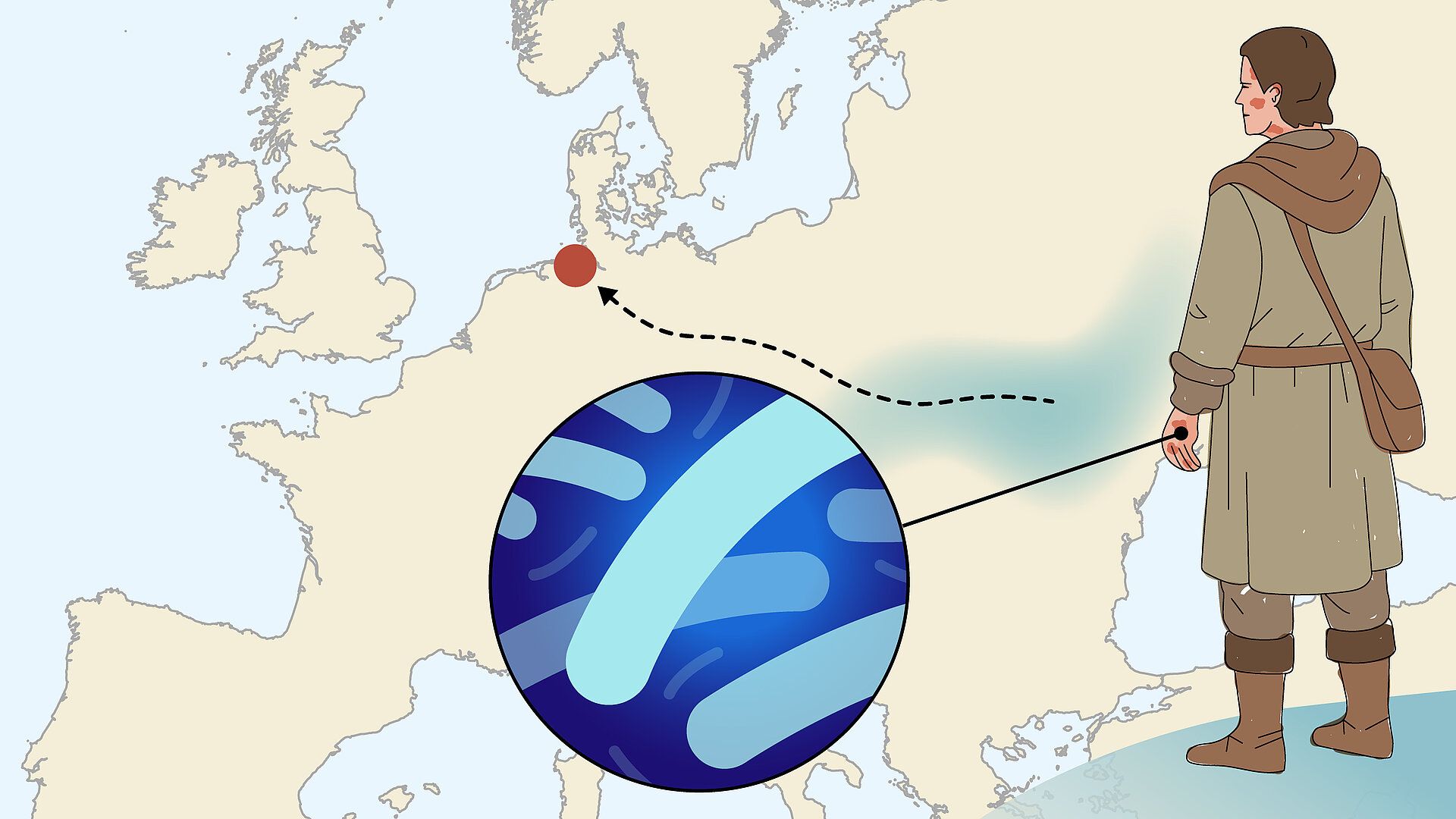
Genetic analysis of more than a dozen people buried at an abandoned Roman-era settlement in northwestern Germany has revealed an unexpected infection in one man: DNA from Mycobacterium leprae, the bacterium that causes leprosy. The rare strain has not previously been identified in central or northern Europe, suggesting that the man traveled widely before his death and may have had connections across the Roman world. His burial in a wooden boat alongside unusually elaborate objects also indicates that he held high status.
A high-status burial at Fallward
Researchers from the Institute of Clinical Molecular Biology (IKMB) at the University of Kiel in Germany analyzed the genomes of people buried at the Fallward settlement, a coastal site that began in the first century B.C. and gradually declined before becoming a cemetery by the fifth century A.D. The work was described in a statement from archaeologists on November 3, while the study was published online October 15 in iScience.
The site contained about 200 cremation burials and 60 inhumation burials first excavated in the 1990s. Among them was a distinctive grave containing a wooden boat more than 13 feet (4 meters) long, enclosed within a roof-like structure.
The boat held the skeleton of a man who was approximately 50 years old when he died between 425 and 450 A.D. His grave goods included a small box shaped like a waterfowl, an ornate chair or throne carved from alder wood, a bronze basin and a maple stool decorated with hunting scenes and runes. Marine artifacts and a well-developed upper arm bone suggest that he may have worked as a fisherman or boatman shortly before his death, according to the researchers.
“Grave goods placed in graves aroused special scientific interest,” study co-author Hauke Jöns, an archaeologist from the Lower Saxony Institute for Historical and Coastal Research, said in a statement. A Roman military belt found with the man suggested that he had distant connections. The researchers said the belt could have been acquired through military service, trade, inheritance or as a war trophy.
A rare leprosy strain
To investigate the man’s origins, the researchers analyzed his DNA. “Genetic analysis confirms that the man buried at Fallward was originally from the Danube region,” study lead author Daniel Myburgh, an ancient-DNA researcher at IKMB, said in a statement. “He was also infected with a very rare leprosy pathogen.”
The team identified bacterial DNA from Mycobacterium leprae in one of the man’s teeth and in a leg bone. Because the leprosy DNA was unusually well preserved, the researchers were able to narrow down the strain. Their statement said it may have originated in Egypt between the fourth and second centuries B.C. and had not previously been found in central or northern Europe.
The man’s skeleton showed no signs of the bone lesions typically associated with leprosy. The disease initially affects the nerves and skin, but can eventually damage bones, particularly those of the nose, jaw, hands and feet.
“Hansen’s disease is a chronic disease,” study co-author Almut Nebel, an IKMB biologist, said in a statement. “Either he had an asymptomatic disease or it was only affecting soft tissue so far. He may have traveled a long distance with the disease.”
Possible links to the Roman world
The researchers do not know exactly what happened during the man’s life. They suggest that he may have served as a mercenary in the Roman army before settling in northwestern Germany and becoming a high-ranking member of the local community. His burial with an alder-wood “throne” may reflect that status.
“The results were particularly pronounced for certain individuals,” study co-author Ben Krause-Kyora and colleagues from the University of Kiel said in a statement. “For example, he may have been a Roman mercenary who later settled between the Elbe and Weser rivers.”
Regardless of whether the man served in the Roman army, traded for the belt or inherited it, his DNA and grave goods point to long-distance connections between northwestern Germany and other parts of Europe. The findings suggest those connections continued even after the fall of the Roman Empire.
Study reference
Myburgh, D. A., da Silva, N. A., Romeyer-Dherbey, J. H., Grefen-Peters, S., Jöns, H., Peek, C., Nebel, A., and Krause-Kyora, B. (2026). “Paleogenomics reveals leprosy in a late ancient burial site in Vorward, northern Germany.” iScience 29(11), 117877.
Source: www.livescience.com