


Researchers have developed a machine-learning technique called FLIP to improve the James Webb Space Telescope’s ability to detect and study exoplanets. By modeling the telescope’s hardware and using gradient descent on real stellar observations, the method reduced noise, improved the signal-to-noise ratio by up to a factor of two in some observations, and increased sensitivity by a factor of 15 for one highly variable star.
Gradient descent is a mathematical optimization technique widely used to tune the billions of parameters in neural networks. Because it is central to training large-scale AI systems, researchers have invested heavily in improving its performance on graphics processing units (GPUs).
The team’s process, called FLIP—a non-acronym for Physics-based Learning for Imaging Planets—applies similar optimization methods to a physical model of the James Webb Space Telescope’s Near-Infrared Camera (NIRCam). Researchers select some possible parameters and use software to optimize the full set.
The process begins with a simulated point-spread function, which describes how the telescope records light from a point source. Gradient descent then optimizes the model using data from real stars. On modern GPUs, the computation takes just over 30 minutes.
Researchers subsequently fine-tune the results using the specific scientific images they are analyzing. This step is important because some variables change from one observation to another.
Improved exoplanet observations
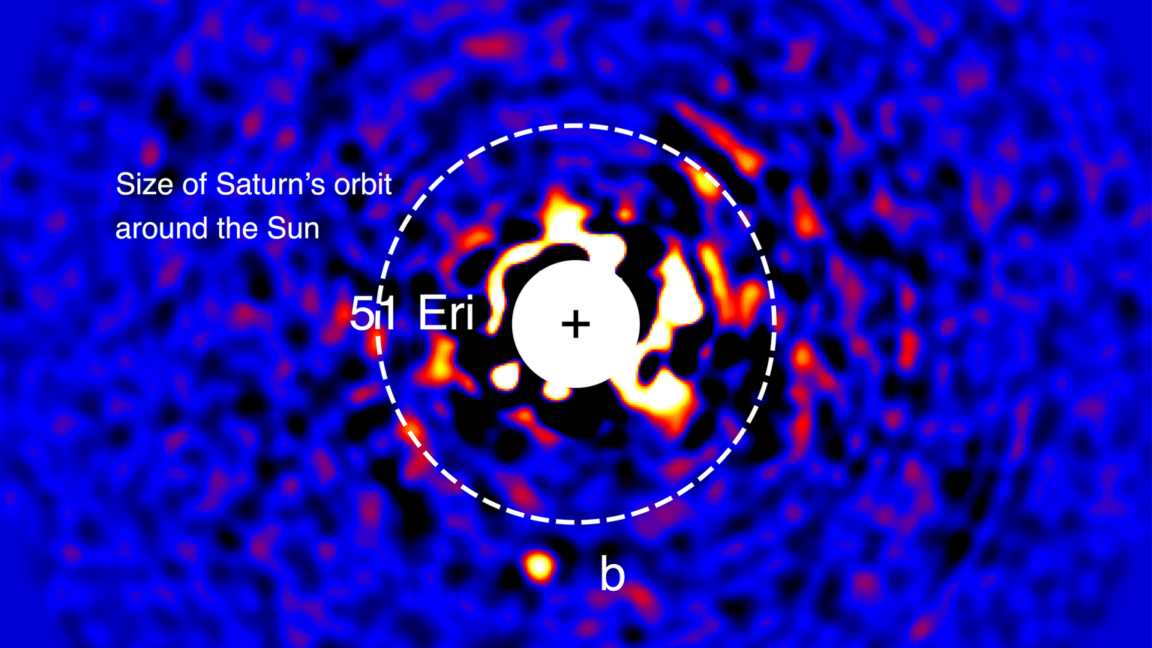
To test the method, the researchers analyzed observations of two stars with known exoplanets, HIP 65426 and Eridani 51. They also studied TYC 5899, a star with no known exoplanets that is known to vary substantially between observations.
These are young stars. Two of them had previously been imaged because they host giant planets that are still warm from the gravitational collapse involved in their formation.
Using Webb’s data and FLIP, the team increased the signal-to-noise ratio by a factor of 1.5 to 2, depending on the observation. For the first time, one of the planets in Webb’s data was detected at a wavelength suitable for identifying carbon dioxide.
For TYC 5899, the technique increased the sensitivity of the observations by a factor of 15.
Potential for finding fainter objects
The researchers say FLIP could do more than improve observations of planets that are already known. Reducing noise could make it possible to detect dimmer objects that were previously invisible, including older or less massive planets.
The team also believes FLIP could be adapted to identify where it is making the largest changes to the model. That information could help reveal what is happening with the telescope’s hardware.
Nature, 2026. DOI: 10.1038/s41586-026-11213-z (About DOI).
Source: arstechnica.com