


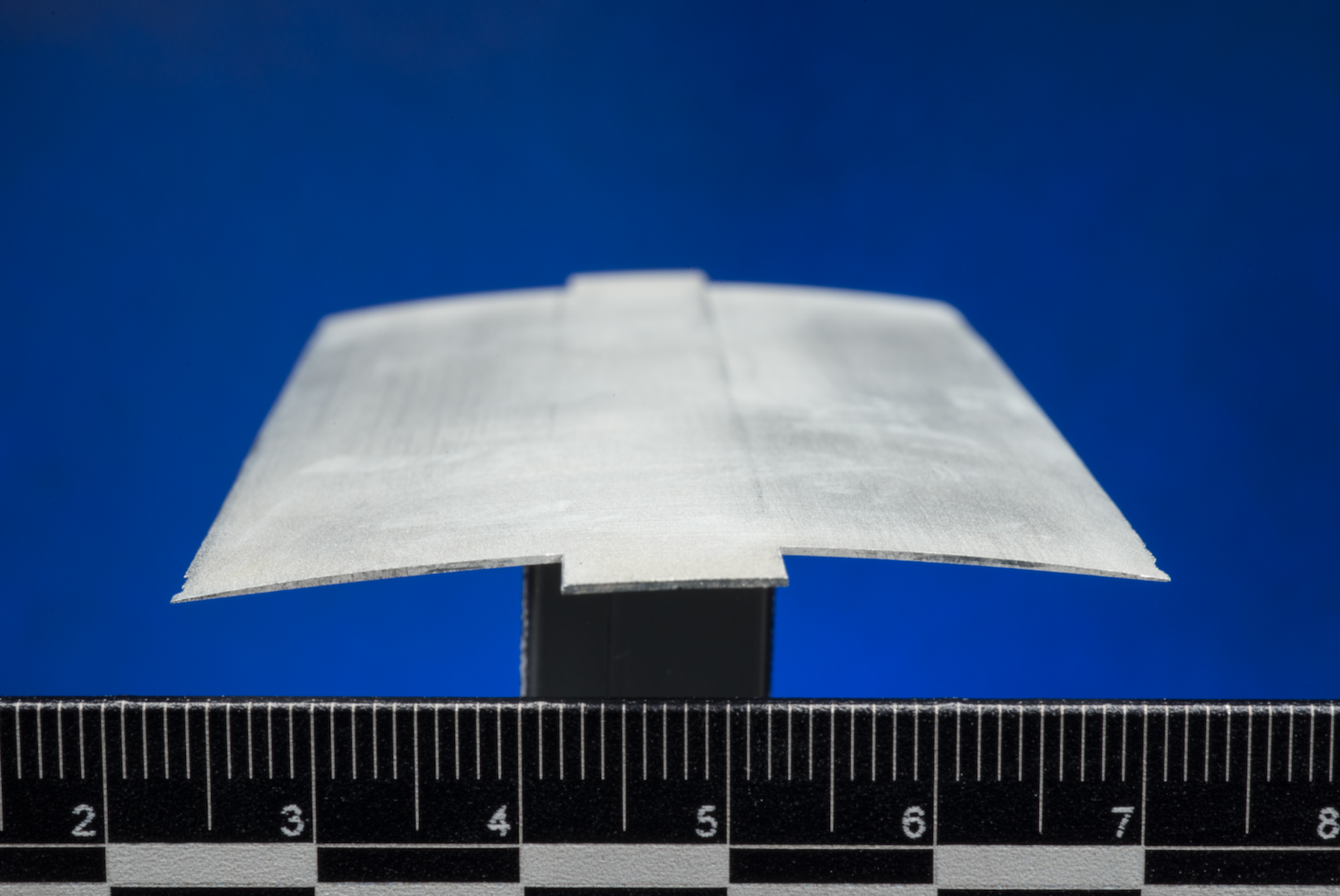
NASA Designs New Helicopter Blades for Longer, Safer Flights on Mars
NASA researchers are developing the future of flight on Mars by designing helicopter blades that could help next-generation rotorcraft fly higher, travel farther, carry scientific instruments, and conduct more ambitious research. Engineers are combining high-fidelity computer simulations with wind tunnel testing to develop improved rotor blades for Mars missions.
Building on Ingenuity’s Historic Mars Flights
NASA’s Ingenuity helicopter made history as the first powered aircraft to fly on another planet. The Skyfall mission, scheduled to launch in 2028, builds on that achievement with three helicopters designed to explore Mars.
Both missions use rotor blades designed to operate in Mars’ thin atmosphere. These blades feature curved edges that are similar to, but different from, those used on helicopters flying on Earth.
A New Airfoil for Mars Helicopters
Researchers are investigating thinner, sharper, and unconventional blade designs to help future Mars missions extend their flight range. A team at NASA’s Ames Research Center in California’s Silicon Valley, working with Imperial College London in the United Kingdom and Nagoya University in Japan, is testing a new blade cross-section known as an airfoil.
The team developed an airfoil called ROAMX-0201 using advanced simulations and algorithms tailored to Martian flight conditions. The design has a thinner, asymmetrical shape intended to improve aerodynamic performance in Mars’ atmosphere.
Wind tunnel tests showed that the optimized ROAMX-0201 design delivered improved performance and better recovery in hazardous flight conditions. Researchers also used high-fidelity simulation tools to compare the airfoil’s performance with Ingenuity’s capabilities.
Flights of Up to 18.7 Kilometers
According to the researchers’ analysis, redesigned blades could allow future Mars helicopters to carry scientific instruments while increasing the distance covered during a single uninterrupted flight. The projected range could reach up to 18.7 kilometers, compared with Ingenuity’s 0.7-kilometer flight distance.
The research was published in the Journal of the American Institute of Aeronautics and Astronautics on September 22.
Reducing Drag Divergence in the Martian Atmosphere
The ROAMX-0201 blade performed better in part because it could operate at higher speeds for longer before reaching a phenomenon known as drag divergence. This aerodynamic effect causes a sudden loss of performance as a rotor approaches the speed of sound, with the behavior differing in Mars’ thin atmosphere compared with Earth’s atmosphere.
Using Turbulence to Generate Lift
The new blades also differ from previous designs in how they use turbulence to create lift. As air flows over a rotor blade, a thin region called the boundary layer forms along its surface.
The ROAMX-0201 airfoil disrupts the boundary-layer flow at the front of the blade, directly at the leading edge. This disturbance can counterintuitively pull the blade upward, helping the rotorcraft generate lift more efficiently than previous designs.
Improving Mars Helicopter Stall Performance
Stalling is another challenge for rotorcraft. It occurs when aerodynamic performance decreases rapidly as the angle of airflow changes, potentially making flight unstable.
Ingenuity’s blades showed a sharp decline in performance during stall conditions. By comparison, the ROAMX-0201 design significantly improved stall behavior under the conditions studied. This could help future Mars helicopters remain stable across a wider range of flight angles.
Preparing the Next Generation of Mars Aircraft
Although the technology is not yet ready for use on Mars, continued testing will help engineers understand and resolve differences between computational predictions and real-world performance.
NASA’s ongoing research into advanced Mars helicopter blades could lead to more efficient rotorcraft capable of flying farther, carrying larger payloads, and supporting new science and discovery missions across the Red Planet.
Source: www.nasa.gov